Batam investment is increasingly seen as a natural extension of Singapore’s economic footprint. Its proximity, lower operating costs, and improving industrial infrastructure make it an attractive location for Singapore-based businesses expanding production or logistics capacity in Southeast Asia.
For many firms, Batam supports regional scaling while Singapore remains the commercial and headquarters base.
This guide explains why businesses expand from Singapore into Batam, where investment opportunities are concentrated, and what to consider when planning and operating Batam activities.
Key drivers of Batam investment for Singapore companies
Businesses typically turn to Batam when production growth can no longer be accommodated within Singapore’s industrial space and cost structure. Expanding locally becomes constrained, yet relocating headquarters or commercial functions is not viable. Batam, therefore, provides nearby operating capacity while preserving Singapore-based control.
This trend is reflected in Batam investment data. In the first half of 2025:
- Singapore companies invested IDR 7.9 trillion (S$632 million) in Batam
- This represented about 69% of the region’s total FDI
The scale of capital concentration shows Batam’s role as a long-term complementary hub rather than a temporary cost alternative. Many firms now formalise a twin-location structure:
- Singapore retains its headquarters, finance, and R&D
- Batam hosts manufacturing, logistics, or operations
This model improves cost efficiency and scalability while maintaining management proximity.
Singapore investment footprint in Batam
Singapore investors remain the largest foreign presence in Batam, reflecting sustained use of the island as an operating base alongside Singapore rather than a standalone market. Lower operating costs and improving technical talent continue to support this cross-border structure.
Most operations follow a Singapore-anchored model in which production or digital functions are located in Batam.
Manufacturing concentration in Batamindo
Batamindo Industrial Park remains the core of Singapore-linked manufacturing. Many firms operate under a twinning structure:
- Manufacturing in Batam
- R&D, management, or headquarters in Singapore
Its Free Trade Zone (FTZ) location and proximity to sector-specific zones support the production of electronics, precision engineering, and logistics.
Digital operations cluster in Nongsa
Batam investment also extends into digital and technology activities at Nongsa Digital Park, which hosts offshore development, data infrastructure, and creative studios. Key indicators include:
- Expansion of Singapore’s Infinite Studios workforce in Batam
- Presence of global firms such as Apple and Infineon
- Multiple active data centres in the park
Integrated Singapore–Batam operating footprint
Across sectors, Batam entities typically operate as subsidiaries of Singapore-based parent companies. Production or delivery occurs in Batam, while contracts and regional control remain in Singapore.
High-potential industries for Singapore investors in Batam
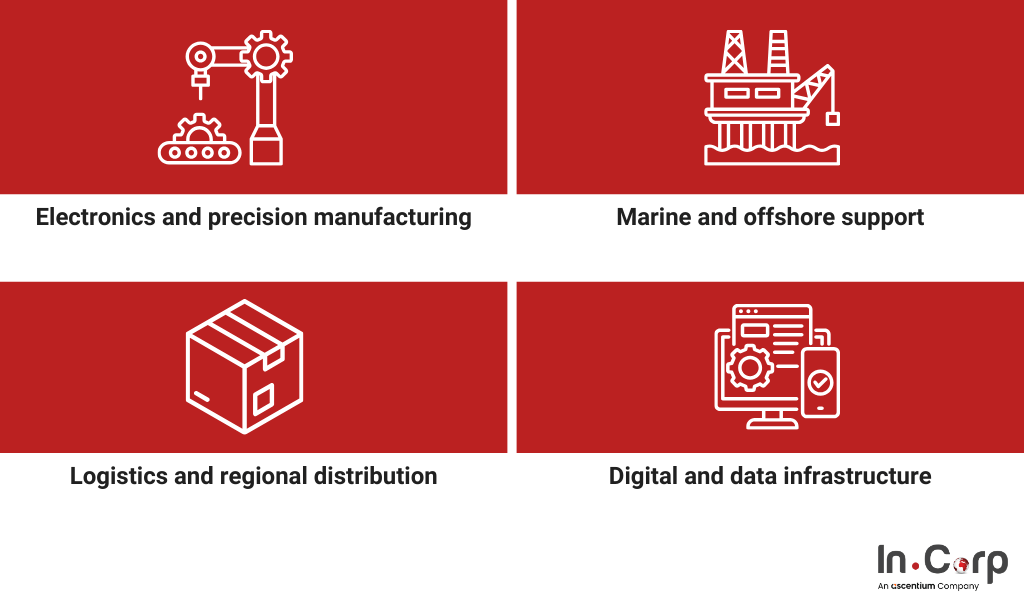
Batam investment is concentrated in industries where additional production space and lower operating costs directly support Singapore-based operations. Physical activities are placed in Batam while commercial control remains in Singapore.
Electronics and precision manufacturing
The most established sector is focused on export-oriented production.
- Electronics assembly and testing
- Precision components and tooling
- Industrial engineering parts
Marine and offshore support
Batam supports Singapore’s maritime and offshore ecosystem.
- Shipbuilding and repair
- Offshore fabrication
- Marine equipment servicing
Logistics and regional distribution
Free Trade Zone status enables storage and re-export functions for Singapore trade flows.
- Regional warehousing
- Spare-parts distribution
- Cross-border fulfilment
Digital and data infrastructure
Technology operations are also expanding in Batam, particularly near Nongsa.
- Software and digital production
- Media and animation studios
- Data centre operations
Across these industries, Batam primarily expands operational capacity rather than providing access to Indonesia’s domestic market.
Regulatory structure for Singapore-owned Batam companies
Batam operations fall within Indonesia’s national investment framework and comply with Free Trade Zone administration. Licensing follows national rules, while operations are supervised locally.
Corporate establishment under Indonesia investment rules
Singapore investors typically establish a foreign-owned company (PT PMA). Key elements include:
- PT PMA incorporation
- OSS business licensing
- KBLI activity classification
Free Trade Zone administration in Batam
As a Free Trade Zone, Batam applies additional operational and customs controls. Core aspects are:
- Registration with the Batam FTZ authority
- Control of imported materials
- Reporting of domestic vs export flows
Multi-agency coordination
Companies interact with both national and Batam institutions. Main interfaces such as:
- OSS licensing system
- BP Batam
- Customs / FTZ supervision
Batam entities, therefore, remain Indonesian companies even when operating as Singapore subsidiaries.
Operating challenges for Singapore businesses in Batam
Batam operations provide cost advantages, but companies must still meet Indonesia’s licensing, labour, tax, and reporting obligations. Complexity typically arises from maintaining local compliance while management remains Singapore-based.
Licensing and regulatory compliance
Batam entities must maintain Indonesian business licenses and align their activities with those licenses, even when operating mainly for export or Singapore-linked supply chains. Key areas:
- OSS licence validity and updates
- Activity scope (KBLI) alignment
- Operational permit maintenance
Labor and employment administration
Employment in Batam follows Indonesian labour rules, requiring local documentation and reporting separate from Singapore HR systems. Obligations include:
- Local employment contracts and policies
- Workforce reporting and administration
- Statutory benefits and compliance
Tax and Free Trade Zone compliance
Despite operating in FTZ facilities, Batam companies remain Indonesian taxpayers and must meet their national tax obligations. Core aspects:
- Corporate tax registration and filing
- VAT / FTZ transaction treatment
- Transfer pricing for Singapore transactions
Annual corporate reporting
Singapore-owned Batam entities must maintain Indonesian corporate filings and annual operational reports.
Ongoing requirements:
- Annual financial statements
- Investment activity reporting
- Licence and company data updates
These requirements are routine for Indonesian companies but require structured coordination when Batam operates as a Singapore subsidiary.
Guide to Doing Business in Batam
Support your Singapore–Batam expansion with InCorp
Singapore companies continue to use Batam as a practical base for expanding production and logistics capacity near their headquarters. However, Batam entities still operate under Indonesia’s licensing, labour, tax, and reporting framework, requiring ongoing local compliance alongside Singapore-based management.
InCorp Indonesia (an Ascentium Company) supports Singapore businesses in establishing and operating Batam entities, including:
- PT PMA setup and OSS licensing
- Licence scope and KBLI alignment
- Labor and statutory administration
- Indonesian tax and FTZ compliance
- Transfer pricing with Singapore
- Annual corporate and investment reporting
With structured local compliance support, Batam operations can scale predictably within a Singapore-anchored business structure.
Get in touch with us.
What you'll get
A prompt response to your inquiry
Knowledge for doing business from local experts
Ongoing support for your business
Disclaimer
The information is provided by PT. Cekindo Business International (“InCorp Indonesia/ we”) for general purpose only and we make no representations or warranties of any kind.
We do not act as an authorized government or non-government provider for official documents and services, which is issued by the Government of the Republic of Indonesia or its appointed officials. We do not promote any official government document or services of the Government of the Republic of Indonesia, including but not limited to, business identifiers, health and welfare assistance programs and benefits, unclaimed tax rebate, electronic travel visa and authorization, passports in this website.

Verified by
Ales Cina
Consulting Manager at InCorp Indonesia
Aleš manages solution delivery at InCorp Indonesia, optimizing incorporation processes and client relationships. His experience in internal auditing, retail, and sales offers valuable global insights. Aleš, with a degree in Economics and Finance from the Czech Republic, helps clients navigate cross-border business challenges, focusing on cultural and legal insights.