A business license in Indonesia depends on a company’s activities and regulatory risk level under the Online Single Submission (OSS) system. While all companies obtain a Business Identification Number (NIB), some can operate immediately, while others must secure additional certificates or sector approvals before starting commercial activities.
This article explains how the framework of business license in Indonesia works, including the main license types, when each is required, and the steps businesses follow to obtain the appropriate license for their operations.
How business licensing works in Indonesia
A business license in Indonesia is an approval issued through the OSS system that allows a company to carry out specific activities at a defined regulatory risk level. The license is linked to the approved activity rather than to the company entity itself.
Since licensing follows the declared business activity, operational readiness doesn’t always align with incorporation status. A company may already have an NIB but still be unable to begin certain services, production, or commercial transactions until the required license for that activity has been issued or verified.
In practice, one company can hold multiple business licenses in Indonesia for different activities, each with its own approval scope.
Types of business licenses in Indonesia
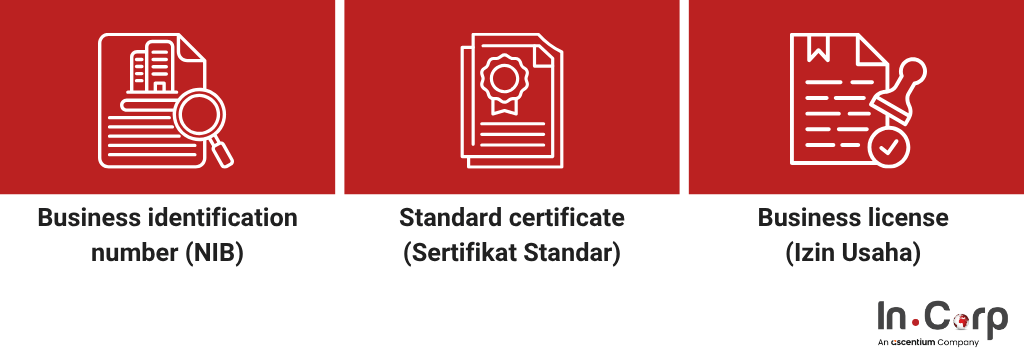
Business license in Indonesia is issued through the OSS system in three forms, each corresponding to a regulatory risk level. These license types determine when a company is legally allowed to operate its declared activities.
Business identification number (NIB)
NIB is the basic OSS registration issued to all companies. It records the approved KBLI activities and serves as the operational license for low-risk activities, allowing a company to begin operations after issuance.
Standard certificate (Sertifikat Standar)
A Standard Certificate (Sertifikat Standar) applies to medium-risk KBLI activities. It confirms that operational standards have been fulfilled in OSS, either through self-declaration or authority verification. The activity can operate only after the required certificate status is completed.
Business license (Izin Usaha)
A Business License (Izin Usaha) applies to high-risk KBLI activities. It is issued after technical approval by the relevant authority through OSS, and operations can begin only once the license has been granted.
Risk-based licensing categories in Indonesia
Indonesia assigns each business activity a regulatory risk level under Government Regulation No. 28 of 2025 on risk-based business licensing. This risk level determines which business license is required and when a company can begin operating.
| Risk Level | OSS License Output | When Operations Can Begin |
| Low | Business Identification Number (NIB) | After NIB issuance |
| Medium–Low | NIB + Standard Certificate (self-declared) | After the NIB issuance and declaration |
| Medium–High | NIB + Standard Certificate (verified) | After verification |
| High | NIB + Business License (Izin Usaha) | After license approval |
This framework explains why companies in similar sectors can have different licensing timelines. The determining factor is the specific activity and its assigned risk level.
Sectoral and operational business licenses
Some business activities require additional approvals from sector regulators before operations can begin. These sectoral licenses confirm that the business meets technical or operational standards specific to the activity and apply alongside the main business license in Indonesia.
Industrial business license (IUI)
Manufacturing activities may require an Industrial Business License (IUI). This approval confirms that production facilities and processes meet industrial and safety standards.
Construction business certification (SBU)
Construction service providers must obtain Construction Business Certification (SBU). It verifies a company’s qualifications and classification for construction work.
Restaurant license
Restaurant operations require tourism-sector operational approval confirming compliance with hygiene, facility, and service standards.
Hotel license
Hotel and accommodation services require tourism licensing to verify facility standards and operational readiness for lodging activities.
Transportation license
Transportation services require approval from the transport authority, depending on the mode and type of service provided.
BPOM distribution permit
Businesses that distribute food, cosmetics, or pharmaceuticals require authorization from the National Agency of Drug and Food Control (BPOM) before marketing their products.
Financial services approval
Financial service activities require licensing from the Financial Services Authority (OJK) to operate regulated financial products or services.
Requirements to obtain a business license in Indonesia
Obtaining a business license in Indonesia requires both corporate information and activity-related documents. Requirements depend on the business scope and whether the activity is regulated. Common requirements include:
- Company establishment and legal entity documents (PT or PT PMA)
- Declared business activities
- Business location
- Capital information (for PT PMA)
- Technical or operational documents
- Environmental or sector approvals for regulated activities
Aligning the declared business scope with supporting documents helps avoid revisions or licensing delays.
How to obtain a business license in Indonesia
Business licensing in Indonesia is completed through the OSS system. The process moves from company registration to activity approval and any required sector clearances before operations can begin. General steps include:
- Establish the company and legal entity status
- Register the business and obtain a Business Identification Number (NIB)
- Declare business activities and operational details
- Complete any required certificates or approvals
- Obtain sectoral licenses where applicable
Lower-risk activities can complete licensing shortly after registration, while regulated activities require additional verification before operations can begin.
Common mistakes in Indonesia business licensing
Licensing delays often result from misalignment between declared activities, approvals, and actual operations. Common issues include:
- Incorrect business activity selection that doesn’t match actual operations
- Assuming company registration or basic licensing allows immediate operations
- Starting commercial activities before required approvals are completed
- Missing sector-specific permits for regulated industries
- Inconsistency between licensing data, corporate documents, and operations
Guide to Doing Business in Jakarta
Get the right business in Indonesia with InCorp
Business licensing in Indonesia depends on the activity scope and regulatory risk. Some businesses can operate after registration, while others require additional approvals before starting.
Companies can complete licensing independently, but regulated or multi-approval activities benefit from structured guidance to ensure approvals are obtained correctly.
InCorp Indonesia (an Ascentium Company) supports business licensing through:
- Business activity and licensing assessment
- Company establishment (PT and PT PMA)
- NIB, standard certificate, and business license processing
- Sectoral licensing coordination
- Regulatory compliance review
Fill out the form below to begin your operations in Indonesia with the right licensing in place.
Get in touch with us.
What you'll get
A prompt response to your inquiry
Knowledge for doing business from local experts
Ongoing support for your business
Disclaimer
The information is provided by PT. Cekindo Business International (“InCorp Indonesia/ we”) for general purpose only and we make no representations or warranties of any kind.
We do not act as an authorized government or non-government provider for official documents and services, which is issued by the Government of the Republic of Indonesia or its appointed officials. We do not promote any official government document or services of the Government of the Republic of Indonesia, including but not limited to, business identifiers, health and welfare assistance programs and benefits, unclaimed tax rebate, electronic travel visa and authorization, passports in this website.

Verified by
Ales Cina
Consulting Manager at InCorp Indonesia
Aleš manages solution delivery at InCorp Indonesia, optimizing incorporation processes and client relationships. His experience in internal auditing, retail, and sales offers valuable global insights. Aleš, with a degree in Economics and Finance from the Czech Republic, helps clients navigate cross-border business challenges, focusing on cultural and legal insights.