For companies planning to operate in Indonesia, securing land is often one of the first operational decisions. Businesses may need land for factories, warehouses, logistics facilities, commercial buildings, or hospitality projects. However, buying land in Indonesia for business use is not always the only option.
Depending on the scale of the investment, regulatory requirements, and operational flexibility, companies typically choose between acquiring land rights, leasing land, or operating within a designated industrial area.
Understanding these options helps businesses structure their operations more efficiently and avoid regulatory complications.
Buying land in Indonesia through a company
For long-term business operations, companies often choose to buy land in Indonesia through a locally established entity, usually a PT PMA (a foreign investment company).
The land is typically held under Right to Build (Hak Guna Bangunan – HGB), which allows the company to construct and operate buildings on the land for business purposes.
This option is commonly used for:
- Manufacturing plants
- Hotels and resorts
- Commercial buildings
- Office facilities
Holding land rights under HGB provides greater control over development and operations. However, companies must ensure that the zoning designation supports the intended business activity before proceeding with the acquisition.
Leasing land for business operations
Instead of buying land in Indonesia, some businesses choose to lease land through contractual arrangements. Land leases are commonly structured as Leasehold Rights (Hak Sewa) or private lease agreements with landowners. This option is often used by companies that:
- Require operational flexibility
- Plan shorter-term projects
- Want to reduce upfront capital investment
Leasing is common for logistics facilities, warehouses, and distribution centers. While it allows faster operational setup, the business does not hold land rights and may have limited control over long-term land use.
Operating within industrial or commercial estates
Another common option for businesses is operating within industrial estates or commercial developments. These areas are specifically designed for business activities and usually provide:
- Industrial zoning approval
- Infrastructure such as roads and utilities
- Environmental compliance systems
Companies typically obtain land rights or lease arrangements directly from the estate developer.
For many businesses, operating within industrial estates simplifies the setup process because zoning and infrastructure requirements are already addressed.
Can foreign investors buy land in Indonesia?
Foreign individuals cannot directly own land under Freehold Title (Hak Milik). Under Indonesia’s Basic Agrarian Law (Law No. 5 of 1960), Hak Milik is reserved exclusively for Indonesian citizens. Foreign investors usually access land for business activities through a PT PMA, which may hold certain land rights under Indonesia’s land regulations.
Under Government Regulation No. 18 of 2021, companies may obtain land rights such as:
- Right to Build (Hak Guna Bangunan – HGB) for commercial or industrial development
- Right to Cultivate (Hak Guna Usaha – HGU) for agricultural or plantation activities
Through these rights, companies can legally build and operate facilities for business activities.
Zoning considerations when buying land in Indonesia
Even when land rights are available, zoning regulations determine whether the land can support a particular business activity. Land designated for residential use, for example, may not be approved for industrial operations or commercial development. Businesses should therefore verify:
Spatial plan classification
- Industrial, commercial, residential, or agricultural designation
- Must align with the intended land use or activity
- Determines whether business licensing can be obtained
Location conformity
- Land must conform to the regional spatial plan (RTRW/RDTR)
- Confirmed through location or spatial information check
- Required before development or licensing
Land use conversion
- Needed when the current zoning differs from the planned use
- Common for agricultural to industrial or commercial change
- Subject to regional approval and process
Area restrictions
- Environmental, coastal, forestry, or protected zones
- May limit or prohibit certain land use
- Affects development feasibility
Confirming zoning compatibility early helps prevent land acquisition that cannot support operational licensing.
Due diligence before buying land in Indonesia
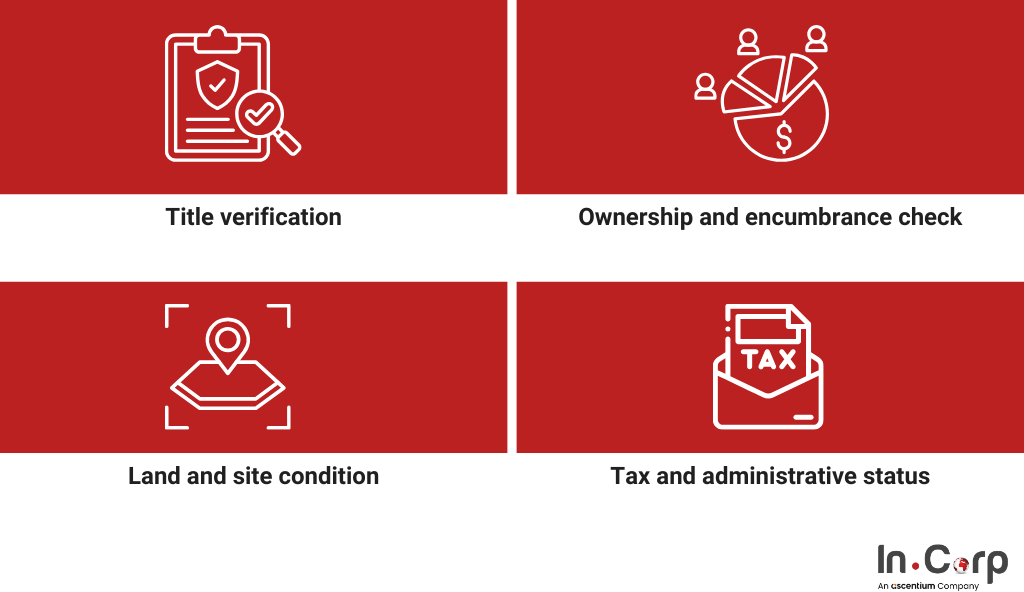
Before buying land in Indonesia for business purposes, companies usually conduct legal and administrative checks to confirm that the land can be transferred and used as intended. These checks typically include:
Title verification
- Certificate authenticity at the land office (BPN)
- Title type and registered holder
- Match between the certificate and the seller
Ownership and encumbrance check
- Transfer history and prior transactions
- Mortgage, dispute, or legal claim status
- Court or administrative restrictions
Land and site condition
- Boundary and area consistency
- Physical occupation or third-party use
- Access road and infrastructure availability
Tax and administrative status
- Land tax (PBB) payment status
- Land registration data consistency
- Required documents for transfer
Proper due diligence reduces the risk of acquiring disputed, restricted, or unusable land.
Taxes and costs when buying land in Indonesia
Buying land in Indonesia involves transfer taxes and transaction costs that must be settled before title registration. These apply to both buyer and seller.
Buyer tax (BPHTB)
- Tax on the acquisition of land and property rights.
- Generally, 5% of taxable acquisition value (NPOP − NPOPTKP)
- NPOPTKP threshold set by each region
- Paid before deed registration
Seller tax (PPh)
- Final income tax on transfer of land rights
- Generally, 2.5% of gross transaction value
- Paid before deed signing (AJB)
Notary and PPAT fees
- Deed preparation and transfer handling
- Usually based on transaction value or agreement
- Includes administrative and documentation costs
Land office (BPN) fees
- Registration and certificate update
- Official non-tax state revenue (PNBP) tariffs
- Paid during the title transfer process
Supporting transaction costs
- Due diligence or land check
- Measurement or survey, if required
- Document legalization or certification
These taxes and costs must be settled before the land title can be transferred and registered.
Common challenges when buying land in Indonesia for business
Companies entering Indonesia sometimes encounter difficulties when land title, zoning designation, and ownership structure are not aligned. Common challenges include:
Title and legal status risks
- Unclear ownership records
- Duplicate land certificates
- Unresolved legal claims
Zoning limitations
- Land designated for a different purpose
- Restrictions on industrial or commercial activities
Ownership and structuring
- Incorrect entity structure
- Land rights that do not support foreign investment
Identifying these issues early can help businesses avoid delays in licensing and development.
Guide to Doing Business in Jakarta
Prepare your business operations in Indonesia with InCorp
Buying or leasing land for business in Indonesia usually requires the right corporate structure and regulatory compliance from the outset. In many cases, companies must establish a local entity before they can secure land rights, obtain operational licenses, or begin development.
InCorp Indonesia (an Ascentium Company) supports investors entering the Indonesian market through:
- PT PMA incorporation and investment structuring
- Business licensing and regulatory compliance
- Business compliance, such as payroll, accounting, and tax compliance
With the proper corporate setup and ongoing compliance support, businesses can establish and operate their activities in Indonesia with greater regulatory clarity.
Get in touch with us.
What you'll get
A prompt response to your inquiry
Knowledge for doing business from local experts
Ongoing support for your business
Disclaimer
The information is provided by PT. Cekindo Business International (“InCorp Indonesia/ we”) for general purpose only and we make no representations or warranties of any kind.
We do not act as an authorized government or non-government provider for official documents and services, which is issued by the Government of the Republic of Indonesia or its appointed officials. We do not promote any official government document or services of the Government of the Republic of Indonesia, including but not limited to, business identifiers, health and welfare assistance programs and benefits, unclaimed tax rebate, electronic travel visa and authorization, passports in this website.

Verified by
Ales Cina
Consulting Manager at InCorp Indonesia
Aleš manages solution delivery at InCorp Indonesia, optimizing incorporation processes and client relationships. His experience in internal auditing, retail, and sales offers valuable global insights. Aleš, with a degree in Economics and Finance from the Czech Republic, helps clients navigate cross-border business challenges, focusing on cultural and legal insights.