Company establishment in Indonesia begins with selecting the appropriate business structure. This decision shapes ownership options, licensing scope, and the business’s operating model. Most investors already understand market entry requirements. The difficulty usually appears at the structural level. Indonesia offers several entity forms with varying liability exposure, capital requirements, and permitted activities.
A mismatch between structure and operations often leads to licensing limits or later restructuring. Aligning the legal form with the intended business model helps ensure a smoother company establishment in Indonesia. Selecting the structure early supports licensing alignment and a more stable establishment in Indonesia.
Main business structures available in Indonesia
Indonesia offers several business structures that differ in ownership eligibility, liability separation, and operational scope. Not all forms support the same commercial activities, and some are limited to specific investor profiles.
For company establishment in Indonesia, the main structures fall into three broad groups:
- Foreign-investment structures used by overseas investors
- Domestic entities for locally owned businesses
- Non-commercial or specialised forms
Foreign investors usually operate through a PT PMA or begin with a representative office. Domestic founders commonly establish a PT, a CV, or an individual enterprise, depending on scale and liability preferences.
Foreign investment structures in Indonesia
Foreign investors cannot use all Indonesian entity forms. Under Law No. 25 of 2007 on Investment and Indonesia’s Company Law, the establishment of a company in Indonesia for overseas ownership is primarily limited to a PT PMA or a representative office, depending on whether commercial activity is planned.
PT PMA (Foreign-owned company)
A PT PMA is the standard structure for establishing a foreign company in Indonesia when the business plans to generate revenue and operate directly in Indonesia. It is a separate legal entity distinct from its shareholders, offering limited liability protection.
Foreign ownership may be partial or full, depending on the business sector. Some activities allow 100 percent foreign ownership, while others require Indonesian participation.
Typical PT PMA features include:
- Minimum investment above IDR 10 billion per activity
- Minimum paid-up capital of IDR 2.5 billion
- At least two shareholders
- Director and commissioner roles
- Indonesian business address
A PT PMA can secure full business licensing under Indonesia’s risk-based system, enabling long-term foreign operations in the country.
Representative office
A foreign company uses a representative office to establish a presence in Indonesia when it needs a presence without direct commercial operations. It functions as a liaison for the parent company and remains non-revenue-generating in Indonesia.
Permitted activities are limited to coordination and market support. Commercial transactions, contracts, and revenue stay with the foreign parent outside Indonesia.
Unlike a PT PMA, a representative office has no minimum capital requirement. It is commonly chosen for early market entry before full company establishment in Indonesia.
Indonesia recognizes several representative office types:
- KPPA for general liaison and supervision functions
- BUJKA for foreign construction services in cooperation with local firms
- KP3A for marketing and product development support
- Sector-specific representative office for regulated industries such as electronic trading or electricity services
Each type follows the same non-commercial principle but aligns with the parent company’s sector and intended activities.
Local business structures in Indonesia
Domestic investors can choose from several entity forms depending on ownership preference, liability separation, and business scale. These structures are commonly used for company establishment in Indonesia by locally owned businesses and MSMEs.
PT (Local limited liability company)
A PT is the most common structure used by domestic investors for company establishment in Indonesia. It is a separate legal entity with share-based ownership and limited liability for shareholders.
Ownership of a local PT is restricted to Indonesian individuals or Indonesian legal entities. Businesses expecting future foreign investment are usually advised to establish a PT PMA from the start to avoid restructuring later. Typical PT requirements include:
- Minimum two shareholders
- Director and commissioner roles
- Indonesian business address
- Ministry approval of articles of association
A PT is generally chosen for established local operations that require contracts, licensing, and scalable ownership.
PT Perorangan (Single shareholder company)
A PT Perorangan is a simplified limited liability company designed for micro- and small businesses owned by a single Indonesian citizen. It allows a company to be established in Indonesia without multiple shareholders while retaining a separate legal personality.
This structure has no statutory minimum capital requirement. The founder determines the capital level, making it accessible for small-scale formalisation.
Key characteristics include:
- Single Indonesian citizen shareholder
- Limited liability protection
- Simplified establishment process
- Intended for micro and small enterprises
A PT Perorangan is typically used by individual founders transitioning from an informal activity to a formal business structure in Indonesia.
CV and Firma (Partnership structures)
CV and Firma are partnership forms used by domestic founders who operate together without forming a limited liability company. These structures are still common in small and medium businesses in Indonesia. A CV determines the roles of active partners, who run the business, from those of passive partners, who provide capital. Active partners bear full liability for obligations.
A Firma is a general partnership in which all partners manage the business and share unlimited liability. It typically relies on close cooperation and trust.
Both structures have no minimum capital requirement but expose partners to personal liability. They are chosen when simple establishment is preferred over liability protection.
Usaha Dagang (Individual enterprise)
Usaha Dagang is the simplest form of business used by individual Indonesian founders. It does not create a distinct legal entity, so the owner and the business are legally the same. This structure has no minimum capital requirements and involves minimal formalities for establishment. However, the owner is personally liable for all business obligations.
Usaha Dagang is typically used for small trading or service activities where simplicity is prioritized over liability separation.
How to choose the right structure for company establishment in Indonesia
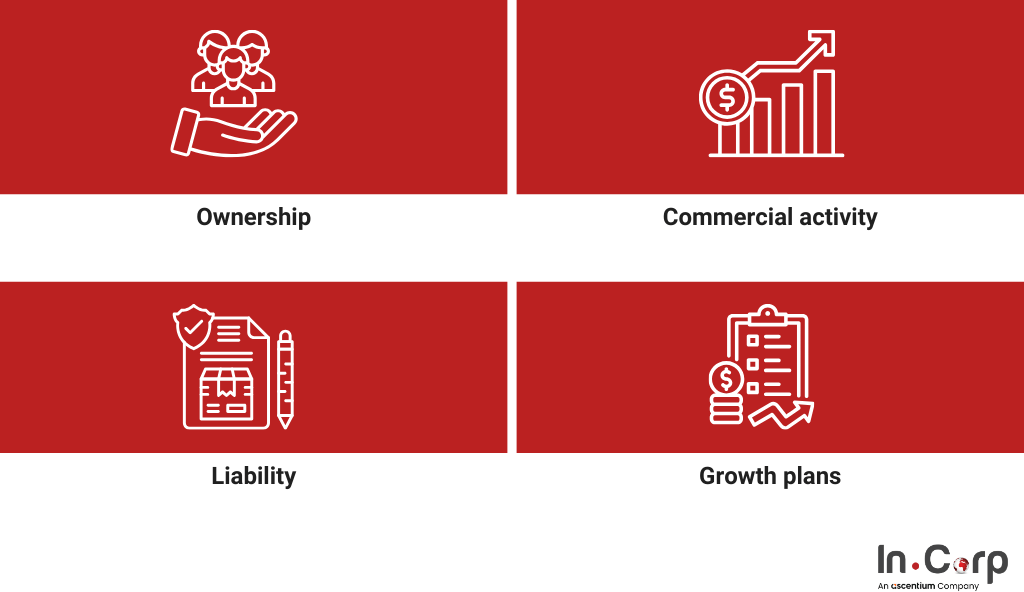
Selecting the appropriate structure is the core step in establishing a company in Indonesia. The choice affects ownership eligibility, commercial activity, liability, and future expansion.
- Ownership: Foreign investors require a PT PMA, while domestic founders may use PT, CV, or an individual enterprise.
- Commercial activity: Revenue-generating businesses need a PT PMA or PT, while representative offices remain non-commercial.
- Liability: PT and PT PMA provide limited liability, whereas CV, Firma, and Usaha Dagang expose owners to personal liability.
- Growth plans: Share-based structures make investment and expansion easier.
In practice, foreign investors choose to operate through PT PMA in Indonesia. Local founders usually select PT for scalable businesses and simpler forms for small activities.
Guide to Doing Business in Jakarta
Start your company establishment in Indonesia with InCorp
Establishing the right structure in Indonesia involves ownership rules, alignment of licensing, and regulatory compliance. InCorp (an Ascentium Company) supports company establishment in Indonesia through:
- PT PMA and incorporation
- Representative office setup
- OSS licensing and NIB registration
- Post-establishment compliance support
Fill out the form below to make the company establishment journey in Indonesia smoother.
Get in touch with us.
What you'll get
A prompt response to your inquiry
Knowledge for doing business from local experts
Ongoing support for your business
Disclaimer
The information is provided by PT. Cekindo Business International (“InCorp Indonesia/ we”) for general purpose only and we make no representations or warranties of any kind.
We do not act as an authorized government or non-government provider for official documents and services, which is issued by the Government of the Republic of Indonesia or its appointed officials. We do not promote any official government document or services of the Government of the Republic of Indonesia, including but not limited to, business identifiers, health and welfare assistance programs and benefits, unclaimed tax rebate, electronic travel visa and authorization, passports in this website.

Verified by
Ales Cina
Consulting Manager at InCorp Indonesia
Aleš manages solution delivery at InCorp Indonesia, optimizing incorporation processes and client relationships. His experience in internal auditing, retail, and sales offers valuable global insights. Aleš, with a degree in Economics and Finance from the Czech Republic, helps clients navigate cross-border business challenges, focusing on cultural and legal insights.