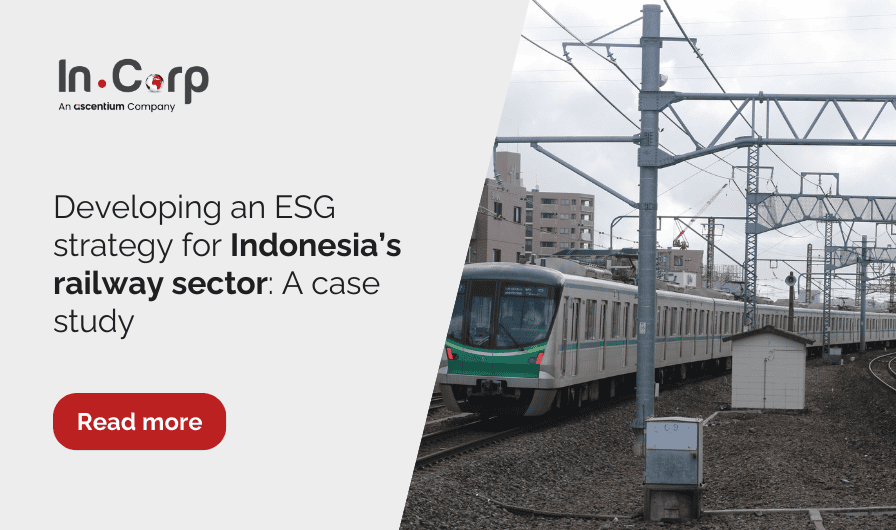
Indonesia’s railway sector is vital to national infrastructure, serving millions and driving economic growth. Railway operators face rising expectations to operate responsibly and sustainably. Stakeholders now demand better environmental protection, social practices, and governance. As a result, a clear ESG strategy is crucial for long-term resilience and public trust.
A leading railway and infrastructure company in Indonesia partnered with InCorp to assess its readiness for implementing environmental, social, and governance (ESG) practices. Although it met key regulatory requirements, its sustainability efforts lacked a cohesive strategy.
The collaboration aimed to develop a practical ESG strategy with a clear roadmap, defined initiatives, and measurable key performance indicators (KPIs), enhancing stakeholder confidence and supporting long-term sustainability.
Why a structured ESG strategy was needed
Before the engagement, the company had already complied with key environmental, safety, and governance regulations. However, these efforts were carried out separately and were not yet connected under a single ESG strategy.
Key challenges identified during the initial assessment included:
- No unified ESG strategy beyond regulatory compliance
- Limited alignment with global railway ESG benchmarks
- Growing pressure from regulators, investors, and the public
The company recognized that ESG needed to shift from a compliance-driven to a more strategic approach. A structured ESG strategy was necessary to set priorities, guide decision-making, and support sustainable growth within Indonesia’s railway sector.
Our approach to ESG strategy development
To address the identified gaps, InCorp Indonesia (an Ascentium Company) provided end-to-end ESG advisory support focused on practicality and implementation. The objective was to develop a strategy that could realistically be applied within the operational and regulatory context of Indonesia’s railway sector.
The engagement covered the following key areas:
- ESG gap analysis to assess current practices
- Materiality assessment to identify priority ESG issues
- ESG strategy development aligned with business objectives
- ESG roadmap planning for 2025–2027
The company’s existing policies and operations were benchmarked against local regulations and global railway ESG standards. Based on this assessment, a clear ESG governance structure was defined, including the establishment of a Sustainability Committee and internal ESG roles to support coordination and accountability across departments.
This structured approach resulted in the identification of 23 ESG initiatives across the environmental, social, and governance pillars. Each initiative was designed to be measurable and aligned with the United Nations Sustainable Development Goals, ensuring consistency with international sustainability expectations while remaining relevant to local operations.
Putting the ESG strategy into action
After the ESG strategy was finalized, the focus moved to execution. The goal was to turn commitments into actions that could be implemented without disrupting daily railway operations.
The ESG strategy was rolled out through a structured set of initiatives:
- 23 initiatives across Environmental, Social, and Governance pillars
- Clear ownership assigned to each initiative
- Measurable ESG KPIs defined to track progress and performance
- Governance embedded into existing operational and decision-making structures
To support consistent execution, the company adopted a three-year ESG roadmap (2025–2027). This roadmap was broken down into phased milestones, allowing the organization to prioritize initiatives, manage internal change, and demonstrate progress to regulators, investors, and other stakeholders.
Measurable outcomes and business impact
The ESG advisory engagement delivered clear and practical results that strengthened the company’s sustainability readiness and long-term positioning.
Key outcomes from the ESG strategy implementation included:
- A three-year ESG roadmap (2025–2027) with defined milestones
- Clear ESG KPIs to track progress across environmental, social, and governance areas
- Improved readiness for green bonds and sustainability-linked financing
- Stronger engagement with regulators, investors, and other stakeholders
By adopting a structured ESG strategy, the company moved beyond compliance toward a more proactive sustainability approach. This helped improve transparency, support long-term planning, and prepare the organization for future regulatory and investor expectations.
How ESG strategy supports sustainable railway operations
For companies operating in public infrastructure, ESG is no longer optional. In Indonesia, the railway sector is closely linked to public safety, environmental impact, and social responsibility. This makes a clear ESG strategy essential for long-term credibility and trust.
A well-defined ESG strategy helps railway companies:
- Build trust with regulators, investors, passengers, and the public
- Reduce environmental, operational, and reputational risks
- Improve access to sustainability-linked financing
- Align business operations with national sustainability goals
As regulations and stakeholder expectations continue to evolve, companies with a structured ESG strategy are better prepared to adapt, remain compliant, and stay competitive in the long run.
Guide to Doing Business in Jakarta

Conclusion
A structured ESG strategy allows railway companies to move beyond compliance and take a more proactive approach to sustainability. By aligning ESG priorities with operations, governance, and long-term planning, organizations can strengthen accountability, improve transparency, and create lasting value.
Are you ready to strengthen your ESG framework? Partner with InCorp Indonesia (an Ascentium Company) to develop an ESG strategy that is practical, measurable, and aligned with global best practices. Together, we can help your organization build a credible ESG strategy that supports long-term sustainability and stakeholder confidence.
Frequently Asked Questions
Why do railway companies in Indonesia need an ESG strategy?
To meet rising expectations on environmental, social, and governance performance and build long-term trust with regulators and stakeholders.
What ESG challenge did the railway company face?
It met regulations but lacked a unified ESG strategy and alignment with global sustainability standards.
What did the ESG advisory project deliver?
A three-year ESG roadmap, 23 initiatives, clear KPIs, and a defined governance structure.
How does an ESG strategy benefit railway operators?
It improves sustainability performance, stakeholder confidence, and readiness for green financing.
Is ESG compliance enough for infrastructure companies?
No. Companies now need a structured ESG strategy that goes beyond compliance toward proactive sustainability.
Get in touch with us.
What you'll get
A prompt response to your inquiry
Knowledge for doing business from local experts
Ongoing support for your business
Disclaimer
The information is provided by PT. Cekindo Business International (“InCorp Indonesia/ we”) for general purpose only and we make no representations or warranties of any kind.
We do not act as an authorized government or non-government provider for official documents and services, which is issued by the Government of the Republic of Indonesia or its appointed officials. We do not promote any official government document or services of the Government of the Republic of Indonesia, including but not limited to, business identifiers, health and welfare assistance programs and benefits, unclaimed tax rebate, electronic travel visa and authorization, passports in this website.