
Many business leaders explore how to start a business in Indonesia as they evaluate opportunities in one of Southeast Asia’s most dynamic markets.
Indonesia’s consumer base, regulatory modernization, and investment-friendly policies continue to attract both regional and global companies, offering promising opportunities for growth and success.
While the system is structured, navigating the requirements can feel unfamiliar without a clear overview of the process. Understanding the key elements helps create a more predictable pathway to entering the Indonesian market.
Understanding Indonesia’s business environment
Indonesia’s regulatory landscape continues to evolve as the government strengthens transparency and improves market accessibility. Two frameworks shape most discussions around company registration in Indonesia:
- The Positive Investment List (Presidential Regulation No. 10/2021) clarifies foreign ownership limits and open sectors.
- The risk-based licensing system (Government Regulation No. 28/2025) organizes permits on the OSS-RBA portal by business activity and risk level.
These regulations provide investors with clearer expectations and streamline the early stages of business setup.
Choosing the correct business entity in Indonesia
Selecting the proper structure is an essential early step in how to start a business in Indonesia. Each option provides a different level of ownership, operational capacity, and compliance expectation.
- PT (Local Company): Fully owned by Indonesian nationals.
- PT PMA (Foreign-Owned Company): The most common structure for foreign investors, allowing majority or full ownership in eligible sectors.
- Representative Office (KPPA / KP3A): Suitable for non-commercial activities such as research, liaison, and promotional work.
- CV (Limited Partnership): A domestic option used mainly for smaller, locally driven operations.
- Sole Proprietorship: Reserved for Indonesian citizens and limited in scalability.
Understanding these distinctions helps ensure the chosen structure aligns with your long-term objectives on how to start a business in Indonesia.
Legal requirements for entering the Indonesian market
A few core elements shape the regulatory framework for on how to start a business in Indonesia with a PT PMA structure or any other entity. These are:
Investment expectations
PT PMA companies must present a minimum planned investment of IDR 10 billion per business classification. The minimum paid-up capital at incorporation is IDR 2.5 billion, reflecting the operational scale expected of foreign-owned entities.
Sector eligibility and licensing structure
The Positive Investment List determines whether your activities allow full foreign ownership or require specific conditions. Under OSS-RBA, lower-risk businesses may require only basic registration, while higher-risk sectors may require additional operational permits.
These requirements guide the company formation process and define the approvals required as operations expand.
How to start a business in Indonesia: Key steps
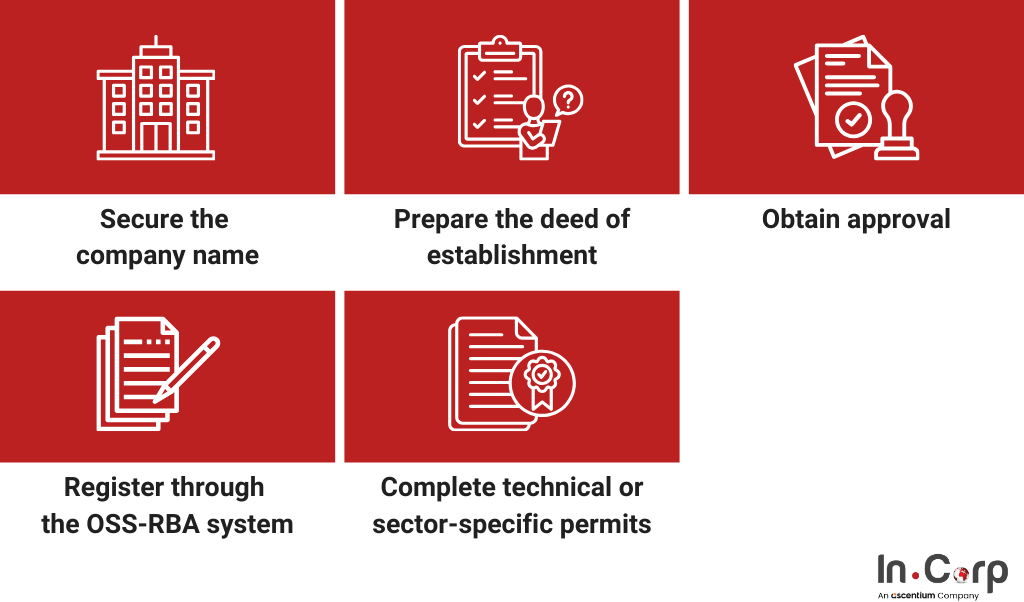
The steps for company registration in Indonesia follow a general sequence, though specific requirements can vary:
Secure the company name
- A proposed name must meet the criteria set by the Ministry of Law and Human Rights.
- Availability checks and naming conventions differ depending on the intended structure.
Prepare the deed of establishment
- A notary drafts the deed based on your company’s purpose, activities, and ownership.
- The specific wording and documentation often require adjustments depending on the KBLI codes you plan to use.
Obtain approval from the Ministry of Law and Human Rights
- Approval confirms the company’s legal standing.
- Requirements can differ based on shareholder profiles and sector classification.
Register through the OSS-RBA system
- The Business Identification Number (NIB) is issued through the risk-based licensing platform.
- Different activities generate different licensing pathways, and additional documents may be required.
Complete technical or sector-specific permits
- Regulated industries typically involve follow-up approvals after the NIB is issued.
- Each ministry or regional authority applies its own criteria, depending on the nature of the business.
These steps provide a clear overview, helping you feel confident that your documentation and sequencing will be manageable given your chosen structure and activities.
Tax registration and compliance obligations in Indonesia
Tax obligations are part of operating any company in Indonesia. Several key requirements apply to newly registered businesses:
Registration requirements (NPWP & PKP)
- NPWP is mandatory for all PT and PT PMA entities.
- PKP (Taxable Entrepreneur) status applies when annual turnover exceeds IDR 4.8 billion, activating VAT obligations.
Monthly tax obligations
- VAT (PPN) is charged at 12% and reported monthly.
- Withholding taxes (PPh 21/23/26/4(2)) apply to salaries, services, and certain payments, with payment and reporting deadlines in the following month.
Annual tax obligations
- Corporate Income Tax (CIT) returns are generally due by the end of the fourth month after the fiscal year ends.
- Individual Income Tax returns are due by March 31st.
Record-keeping expectations
Companies are required to maintain financial records in Bahasa Indonesia and in Rupiah, unless they have obtained a permit to use an alternative language or currency. This standard supports consistency during audits and reviews.
These requirements underpin tax compliance, though specifics often vary by sector and operational structure.
Opening a corporate bank account in Indonesia
A corporate bank account is essential for operating in Indonesia and is an important step once the company’s legal documents are in place. The banks typically request:
- Company establishment documents, including the deed and approval from the Ministry of Law and Human Rights
- Identification for shareholders and directors
- Tax registration details
- Information about intended business activities
Requirements may differ across institutions, especially for PT PMA companies, so selecting a bank that aligns with your operational needs can make onboarding smoother.
Labor regulations in Indonesia
Indonesia’s employment framework is structured to protect workers while providing clear expectations for employers, which is helpful for anyone exploring how to start a business in Indonesia with long-term operations in mind.
When hiring begins, employers must comply with labor standards relating to:
- Contract types and conditions
- Regional minimum wage requirements
- BPJS employment and health insurance registration
- Additional steps for hiring expatriates, including work authorization and stay permits
These rules help maintain consistency and protect both employers and workers in the Indonesian market.
Guide to Doing Business in Jakarta
Simplify your entry into Indonesia with InCorp
Entering Indonesia is far easier with a partner who understands the regulatory landscape and the expectations behind each step. InCorp Indonesia (an Ascentium Company) provides end-to-end support for companies seeking confident, compliant market entry.
- Business setup: Guidance on selecting and forming the correct entity
- BPO services: Corporate secretarial and compliance support
Complete the form below to streamline setup and ongoing operations in the Indonesian market.
Get in touch with us.
What you'll get
A prompt response to your inquiry
Knowledge for doing business from local experts
Ongoing support for your business
Disclaimer
The information is provided by PT. Cekindo Business International (“InCorp Indonesia/ we”) for general purpose only and we make no representations or warranties of any kind.
We do not act as an authorized government or non-government provider for official documents and services, which is issued by the Government of the Republic of Indonesia or its appointed officials. We do not promote any official government document or services of the Government of the Republic of Indonesia, including but not limited to, business identifiers, health and welfare assistance programs and benefits, unclaimed tax rebate, electronic travel visa and authorization, passports in this website.

Verified by
Ales Cina
Consulting Manager at InCorp Indonesia
Aleš manages solution delivery at InCorp Indonesia, optimizing incorporation processes and client relationships. His experience in internal auditing, retail, and sales offers valuable global insights. Aleš, with a degree in Economics and Finance from the Czech Republic, helps clients navigate cross-border business challenges, focusing on cultural and legal insights.