The Indonesia economic outlook reflects a period of transition rather than a push for rapid expansion. Global conditions remain challenging, shaped by geopolitical tensions, shifting supply chains, and tighter financial markets. These dynamics continue to influence domestic performance and highlight long-standing structural gaps that Indonesia must manage carefully.
As the country moves into 2026, the focus shifts toward policy consistency, investment quality, and the readiness of key sectors to adapt within an evolving regulatory landscape.
Growth projections for Indonesia economic outlook 2026
Indonesia’s performance in 2025 provides the baseline for understanding the year ahead. Growth remained moderate but steady, driven by domestic consumption, industrial recovery, and ongoing investment activity.
Growth and output
- FY 2025 GDP growth: 4.95%, setting a stable base for the year ahead
- FY 2026 GDP expectation: 4.9%–5.0%
- Q2 2025 GDP expansion: 5.12% (y.o.y.), slightly above earlier projections
Sector performance
- Manufacturing growth: 5.68% (y.o.y.), rising from 4.55% in Q1, the strongest improvement since 2011 outside the pandemic years
- Household consumption: 4.97% (y.o.y.), supported by seasonal spending and representing 52.9% of total GDP
Investment, trade, and price stability
- Investment realization (Q3 2025): IDR 491.4 trillion, growing 13.9% (y.o.y.), with domestic investors contributing the most significant share
- Trade surplus (July–August 2025): USD 9.67 billion, nearly 195% higher (y.o.y.)
- Inflation (Sept 2025): 2.65% (y.o.y.), comfortably within Bank Indonesia’s target range
These indicators point to a steady foundation, though sustaining progress will depend on investment quality, inflation management, and resilience to external pressures shaping the broader Indonesia economic outlook for 2026.
Key economic drivers shaping Indonesia in 2026
With this baseline in place, Indonesia’s economic direction for 2026 will be shaped by several structural drivers. These forces indicate where resilience is building and where vulnerabilities may continue.
Domestic demand
Household spending continues to anchor growth, supported by consistent consumption patterns. It represents more than half of GDP and remained stable through 2025. While domestic demand is not accelerating sharply, it provides a reliable base for 2026.
Manufacturing recovery
Manufacturing expanded through 2025, helping lift the broader economy. Reports from the Coordinating Ministry for Economic Affairs highlight continued expansion in industrial activity and improved output. This momentum is expected to carry into 2026, though progress will depend on logistics improvements and deeper supply chain integration.
Investment quality
While investment increased in 2025 mainly from domestic capital, the slowdown in FDI underscores the need for high-quality investments and clear regulations to ensure sustainable growth in 2026.
Trade remains resilient
Indonesia’s trade surplus strengthened due to robust commodity exports. Maintaining this performance in 2026 will require careful management amid fluctuating global prices and softening demand in key markets.
Policy and monetary stability
Bank Indonesia kept inflation within target and maintained a stable policy stance to support the rupiah. Consistent communication and cautious adjustments will be essential for preserving macroeconomic stability in 2026.
Opportunities in various sectors for 2026
Several sectors are positioned to gain momentum as Indonesia balances consumption-driven growth with industrial development. These areas reflect ongoing policy priorities and shifting investment patterns.
Industrial downstreaming
- Expansion in mineral and metal processing
- Growth in industrial materials and chemical production
EV and battery supply chain
- Rising investment in battery materials and components
- Development of EV manufacturing facilities
Renewable energy expansion
- Gradual progress in solar and hydropower projects
- Strengthening energy infrastructure for industrial zones
Logistics and transport networks
- Better connectivity through upgraded transport corridors
- Growth of ports, warehousing, and distribution hubs
Tourism and MICE development
- Recovery supported by business travel and events
- Increased demand for hotels, convention venues, and MICE services
Financial and business services
- Steady need for banking and financing solutions
- Continued demand for advisory and compliance support
Risks and challenges to Indonesia economic outlook in 2026
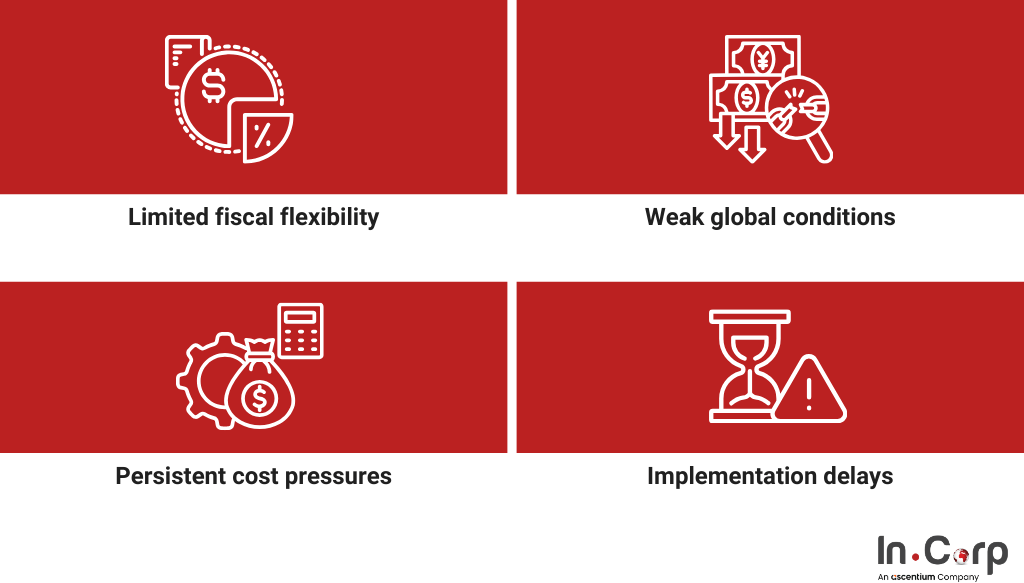
Despite these opportunities, several risks could influence how effectively Indonesia maintains growth momentum. Key risks to monitor:
- Limited fiscal flexibility: The no-new-taxes stance supports certainty but restricts fiscal space and increases reliance on compliance measures.
- Weak global conditions: Slower external demand and volatile capital flows may weigh on exports and investment activity.
- Persistent cost pressures: Food, energy, and logistics prices remain vulnerable to supply disruptions.
- Implementation delays: Regulatory and administrative bottlenecks may slow investment progress and business planning.
Investment climate and business confidence for 2026
The investment landscape remains constructive, supported by domestic capital and targeted incentives. While foreign investors are more selective, strategic sectors continue to attract interest.
- Domestic investors continue to drive capital formation.
- Foreign investment remains selective but strong in downstream, EV, and energy projects.
- Industrial zones and logistics corridors improve competitiveness.
- Incentives help mitigate external uncertainty.
Fiscal incentives
- Tax holidays: 10–20 years, depending on sector and investment size
- Tax allowances:
- 30% reduction of taxable income
- Loss carry-forward up to 10 years
- Accelerated depreciation and amortization
- Dividend tax: 10% or lower (treaty-based)
- VAT & customs facilities:
- VAT/luxury tax exemption on eligible goods
- Duty and import tax exemptions for approved capital goods and materials
Non-fiscal incentives
- Simplified licensing through SEZ administrators
- Positive Investment List defining sector openness
- Selected SNI exemptions
- Developer-assisted environmental and building permits
- No export obligation for applicable sectors
- Land use rights up to 80 years
- Immigration facilities for investors and executives
These incentives strengthen business confidence and support the broader Indonesia economic outlook for 2026.
Guide to Doing Business in Jakarta

Unlock Indonesia’s growth potential with InCorp
The Indonesia economic outlook shows steady fundamentals and sector-led momentum, even amid global uncertainty. To capture these opportunities, businesses need clear guidance and reliable operational support.
InCorp Indonesia (an Ascentium Company) streamlines market entry and operational setup, providing the support needed to navigate regulations and capitalize on Indonesia’s growth opportunities in 2026.
- Business setup: Efficient company registration, licensing, and compliance support from day one.
- Continuous corporate and advisory support: Outsourcing for HR, payroll, accounting, and admin tasks so you can focus on core priorities.
Position your business for long-term success with a partner that understands the market by filling out the form below.
Frequently Asked Questions
What are the best sectors to invest in Indonesia?
Top sectors include mining & processing, renewable energy, digital economy, manufacturing, infrastructure, and tourism & F&B.
What makes Indonesia attractive for foreign investors?
Indonesia has one of Southeast Asia’s fastest-growing economies, untapped markets, a large labor force, and strong government support for investment.
What are the main challenges of investing in Indonesia?
Key challenges include complex regulations, cultural differences, evolving tax rules, infrastructure gaps, and limited skilled talent.
How can investors reduce risks when entering Indonesia?
Work with local experts for licensing, compliance, tax, HR, and cultural guidance to avoid delays and costly mistakes.
Can InCorp Indonesia help with foreign investment?
Yes. InCorp provides end-to-end support in licensing, tax, HR, compliance, and local business advisory to make investing easier and safer.
Get in touch with us.
What you'll get
A prompt response to your inquiry
Knowledge for doing business from local experts
Ongoing support for your business
Disclaimer
The information is provided by PT. Cekindo Business International (“InCorp Indonesia/ we”) for general purpose only and we make no representations or warranties of any kind.
We do not act as an authorized government or non-government provider for official documents and services, which is issued by the Government of the Republic of Indonesia or its appointed officials. We do not promote any official government document or services of the Government of the Republic of Indonesia, including but not limited to, business identifiers, health and welfare assistance programs and benefits, unclaimed tax rebate, electronic travel visa and authorization, passports in this website.

Verified by
Ales Cina
Consulting Manager at InCorp Indonesia
Aleš manages solution delivery at InCorp Indonesia, optimizing incorporation processes and client relationships. His experience in internal auditing, retail, and sales offers valuable global insights. Aleš, with a degree in Economics and Finance from the Czech Republic, helps clients navigate cross-border business challenges, focusing on cultural and legal insights.