Indonesia payroll calculation can appear straightforward, yet many employers still encounter complications when regulations shift or contribution rates change without much notice.
Even when the basics are familiar, staying aligned with updated labor requirements, tax rules, and social security obligations often demands more attention than expected.
Understanding how each component fits together offers a way out of this complexity.
How the Indonesia payroll calculation system works
Payroll in Indonesia feels routine until regulatory updates change the details of benefits, mandatory contributions, or tax reporting. Understanding the structure behind the Indonesia payroll calculation process allows businesses to identify gaps early and maintain smoother, more predictable payroll cycles.
Employee’s fundamental rights and minimum entitlements
Every payroll calculation begins with statutory employee protection. When wage standards or working-hour requirements are assumed rather than confirmed, errors start to appear.
- Minimum wage (UMP/UMK): Updated annually by province or city.
- Standard working hours: 40 hours per week unless an alternative schedule is legally allowed.
- Salary payment: Must follow an agreed pay cycle and be issued in Indonesian Rupiah.
These rights set the baseline for every payroll calculation.
Mandatory benefits and allowances
Benefits and allowances are included in gross earnings. Misclassifying or excluding them leads to incorrect BPJS and tax calculations. Common components include:
- Fixed allowances such as meals and transport.
- THR (Religious Holiday Allowance) is paid annually.
Correct classification ensures accurate calculations of taxable income and contributions.
Social security contributions (BPJS Ketenagakerjaan)
BPJS Ketenagakerjaan protects employees through several programs. Each program has a defined rate and payer, making it an essential part of the Indonesia payroll calculation.
- Work accident protection: It ranges from 0.24% to 1.74% of monthly wages and is paid by the employer. The rate depends on the industry’s risk level.
- Death benefits (JKM): Set at 0.30% and are paid by the employer.
- Old-age savings (JHT): Consists of a 3.70% contribution from the employer and a 2.00% contribution from the employee.
- Pension program (JP): 2.00% contribution from the employer and 1.00% from the employee, subject to a monthly wage cap that adjusts periodically.
These elements form a large portion of statutory employer obligations.
Health insurance (BPJS Kesehatan)
BPJS Kesehatan contributions are also mandatory and are directly deducted from payroll calculations.
- 4% employer-paid
- 1% employee-paid
Both are calculated up to a regulated maximum wage. Using outdated caps is one of the most common payroll errors.
Tax reporting
Income tax withholding for employees (PPh 21) requires careful treatment because minor miscalculations affect both take-home pay and year-end reporting. Payroll practice typically follows:
- The Effective Tax Rate (ETR) method for monthly withholding
- Precise categorization of taxable vs. non-taxable income
- Timely reporting to avoid administrative penalties
Accurate taxation is one of the most critical parts of the Indonesia payroll calculation system.
Leave regulation and statutory leave rights
Certain types of leave must be fully paid, which directly affects monthly salary calculations.
- Annual leave: 12 days per year after completing 12 months of service.
- Maternity leave: Employees are entitled to fully paid leave for the legally mandated three-month period around childbirth.
- Sick leave: Paid leave, with a doctor’s note typically required for extended absences.
- Personal leaves: Certain family or personal matters qualify for paid leave under statutory guidelines.
Clear leave rules ensure predictable, fair adjustments throughout the payroll cycle.
Overtime rules and calculation methods in Indonesia
Indonesia has strict overtime limits and multipliers that must be followed to ensure payroll compliance and fairness.
Maximum acceptable overtime hours
Indonesia allows overtime as long as it follows clear limits. Exceeding these limits not only affects employee well-being but also exposes companies to compliance issues. Key rules include:
- Maximum 4 hours of overtime per day
- Maximum 18 hours per week
These limits apply unless a specific exception is approved under special regulations.
Calculation of overtime rate
Overtime payment is based on a defined formula that uses:
Hourly wage = Monthly salary ÷ 173
This standard is applied consistently across different types of workdays, which helps create transparency in the payroll process. To keep Indonesia payroll calculations accurate, companies must use the correct overtime multiplier based on the day and situation.
Overtime work on regular weekdays
When employees work beyond their regular schedule on a standard weekday, the following multipliers apply:
- First hour: 1.5 × hourly wage
- Each additional hour: 2 × hourly wage
This ensures the overtime rate increases in proportion to the extra effort required.
Overtime on weekly rest days and public holidays
Overtime on rest days or public holidays follows a different structure because the days themselves carry higher compensation standards.
Common multipliers include:
- First 8 hours: 2 × hourly wage
- Hour 9: 3 × hourly wage
- Hour 10 and beyond: 4 × hourly wage
These rates help maintain fairness for work performed on days meant for rest or national observance.
How to calculate a monthly salary in Indonesia
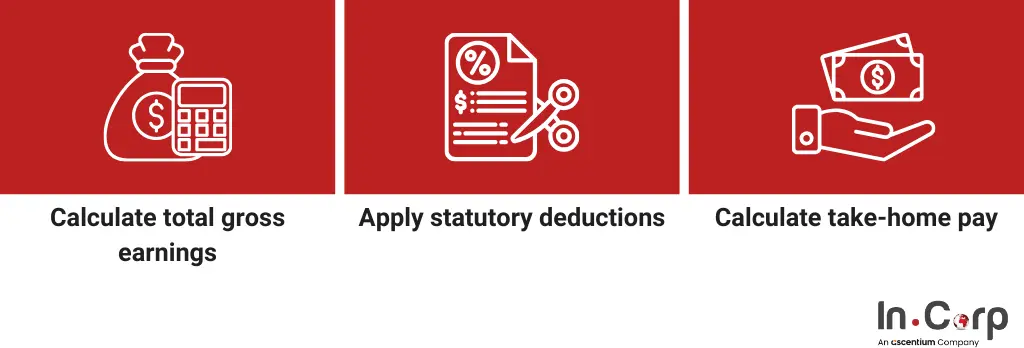
Calculating monthly salaries in Indonesia is simpler when the components are organized sequentially. This method helps minimize errors and ensures consistent payroll each month.
Calculate total gross earnings
Gross earnings include all income before deductions. These items commonly form the basis:
- Basic salary
- Fixed allowances (meal, transport, etc.)
- Bonuses or variable allowances
- Overtime pay
- THR if applicable
Correctly identifying these components ensures that later deductions are calculated on the proper amount.
Apply statutory deductions
After establishing gross earnings, the next step is to deduct mandatory contributions and taxes. Employee deductions typically include:
- BPJS Ketenagakerjaan
- BPJS Kesehatan
- Income tax (PPh 21)
These deductions must follow current rules to keep the Indonesia payroll calculation compliant.
Calculate take-home pay
Take-home pay is the amount the employee receives after statutory deductions are subtracted from gross earnings. A simple formula is:
Take-home pay = Gross earnings – (Employee BPJS + PPh 21)
This final figure reflects both regulatory requirements and the employee’s actual monthly income.
Streamline your payroll process with InCorp
Managing the Indonesia payroll calculation process becomes much easier when each component is handled consistently and in line with updated regulations. InCorp Indonesia (an Ascentium Company) provides businesses with accurate, compliant, and fully managed payroll solutions, enabling internal teams to focus on operations.
- End-to-end payroll processing with accurate monthly salary calculations
- PPh 21 tax calculation and reporting, including ETR compliance
- Customized payroll reports for management and auditing
Streamline payroll management and support long-term operations by filling out the form below.
Get in touch with us.
What you'll get
A prompt response to your inquiry
Knowledge for doing business from local experts
Ongoing support for your business
Disclaimer
The information is provided by PT. Cekindo Business International (“InCorp Indonesia/ we”) for general purpose only and we make no representations or warranties of any kind.
We do not act as an authorized government or non-government provider for official documents and services, which is issued by the Government of the Republic of Indonesia or its appointed officials. We do not promote any official government document or services of the Government of the Republic of Indonesia, including but not limited to, business identifiers, health and welfare assistance programs and benefits, unclaimed tax rebate, electronic travel visa and authorization, passports in this website.