
A joint venture in Indonesia is usually considered when setting up a fully owned company is not the most effective option. This may be due to foreign ownership limits, sector regulations, or practical challenges in operating independently in the local market.
Partnering with another party can help address these constraints. Emphasizing shared control and long-term obligations fosters trust, but unclear roles or exit paths can create problems later, even when the partnership starts on good terms.
This article explains how joint ventures in Indonesia are commonly structured, how foreign ownership rules affect them, and what should be addressed to manage risk and maintain operational clarity.
What a joint venture means in Indonesia
In Indonesia, a joint venture (JV) is not a separate legal form. It refers to a business arrangement where two or more parties cooperate by sharing ownership, control, and risk.
Indonesian law does not recognize a “joint venture company” as a specific entity type. In practice, the term describes how a business is structured, rather than what it is called.
This structure is generally used when:
- Foreign ownership is restricted or capped
- A local party controls key assets, licenses, or access
- Operational or commercial risk needs to be shared
Whether a joint venture works depends less on its label and more on how ownership, control, and responsibilities are clearly defined from the outset, which helps build confidence in managing risks.
Read more: How a company registration consultant can save up time and money
Joint venture vs. PT PMA
A joint venture and a PT PMA are often confused, but they serve different purposes.
A joint venture describes the relationship between shareholders. It explains how parties share ownership, control, and risk.
A PT PMA is the legal company form required for foreign ownership in Indonesia, whether the company is wholly or jointly owned.
In practice:
- A joint venture can exist within a PT PMA
- A PT PMA does not automatically mean a joint venture
- A wholly owned PT PMA has one shareholder group, while a joint venture PT PMA has multiple parties with shared interests
The key decision is not whether to form a PT PMA, but whether to share ownership and control with another party.
Common joint venture structures used in Indonesia
Joint ventures in Indonesia are typically set up through a company or through a contract, depending on the purpose and duration of the cooperation.
Joint venture through a PMA company
This is the most common structure for foreign investors. Under this model, the parties establish (or use) a PT PMA with shared shareholding. The company operates as a standalone business entity.
This structure is usually chosen when the venture needs to:
- Hold business licenses
- Employ staff
- Enter into contracts
- Own assets in Indonesia
This structure is usually chosen when the venture needs to hold business licenses, employ staff, enter into contracts, or own assets in Indonesia. Clear governance rules are essential to prevent delays or deadlocks, reassuring readers about operational certainty.
Contractual joint venture without a new entity
In this model, the parties cooperate through an agreement without forming a separate company. This approach is commonly used for:
- Project-based activities
- Construction or infrastructure work
- Limited-scope cooperation
Each party remains legally independent. While this offers flexibility and faster setup, legal, tax, and liability risks must be managed carefully, as obligations do not sit within a separate entity.
Consortium and other project cooperation
A consortium is a form of project cooperation, often used for tenders. The parties remain separate companies, and the arrangement ends upon completion of the project.
Because there is no shared ownership or ongoing governance, a consortium is generally not suitable for long-term operations or investment.
Foreign ownership rules and joint ventures in Indonesia
Foreign ownership rules are a key factor in joint venture planning. If a foreign investor holds any share (even 1%), the company must be classified as a PT PMA (a foreign investment company). This applies regardless of whether the structure is a joint venture or another form of foreign ownership.
Once classified as a PT PMA, several requirements apply:
- A minimum investment plan of more than IDR 10 billion per business activity, excluding land and buildings
- Paid-up capital of at least IDR 2.5 billion
- Business registration and licensing through OSS RBA
- Ongoing reporting on investment realization and operations
Foreign ownership rules are a key factor in joint venture planning. Sector-specific restrictions under Indonesia’s Positive Investment List can limit ownership percentages, influencing whether a this structure is necessary to comply with regulations. When sectors are fully open, forming a joint venture becomes a strategic choice rather than a regulatory requirement.
Importantly, ownership percentage does not automatically determine control. Governance arrangements often matter more than shareholding ratios in practice.
Joint venture agreement in Indonesia: What must be covered
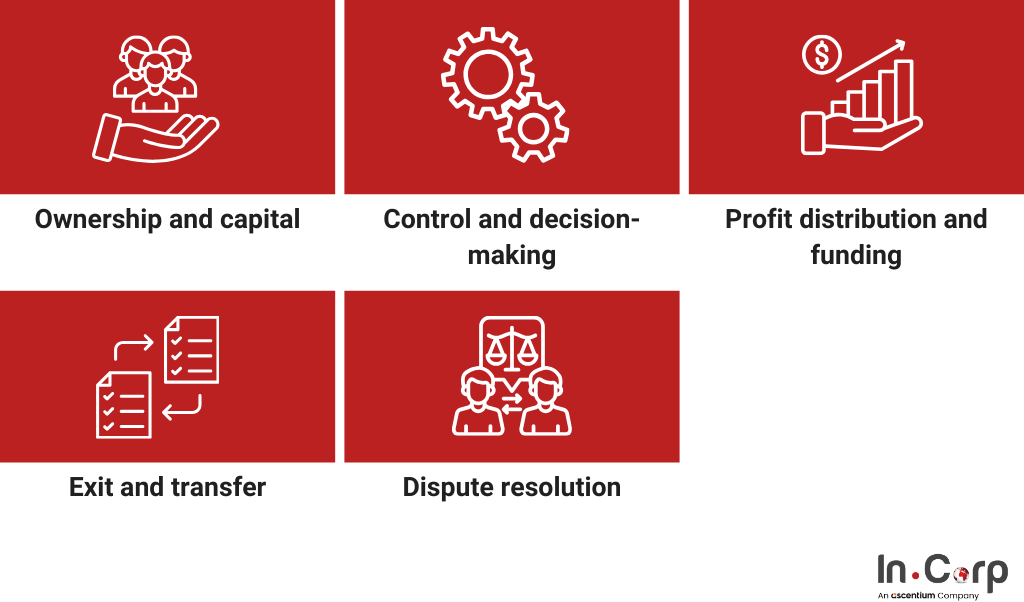
Many joint venture issues arise not from regulation, but from agreements that leave key points unclear. A joint venture agreement defines how the relationship operates and how changes are handled. At a minimum, it should address the following areas.
Ownership and capital
The agreement should clearly state:
- Shareholding percentages
- Form of capital contribution
- Timing of capital injection
This is especially important where contributions are made in assets or services rather than cash.
Control and decision-making
The agreement should define:
- Management and board structure
- Voting rights and thresholds
- Decisions requiring joint approval
Clear control rules reduce the risk of operational delays and deadlock.
Profit distribution and funding
The agreement should explain:
- Dividend policy
- Treatment of retained earnings
- Approach to additional funding
This keeps financial expectations aligned over time.
Exit and transfer
The agreement should set rules for:
- Share transfers
- Exit options
- Termination scenarios
Exit terms matter even when the partnership is stable.
Dispute resolution
The agreement should specify:
- How disputes are resolved
- Which law governs the agreement
Explicit dispute provisions help manage risk before issues escalate.
Tax and compliance considerations for joint ventures
A joint venture in Indonesia is subject to standard Indonesian tax rules, including:
- Corporate income tax at 22%
- Dividend withholding tax of 10% to 20%, depending on the Applicable tax treaty
- VAT at 11 % for most goods and services
- Transfer pricing rules for related-party transactions
In specific sectors, this structure may qualify for incentives such as tax holidays, tax allowances, or import duty exemptions.
Tax exposure is shaped less by the joint venture structure and more by how transactions are managed in practice.
How to set up a joint venture in Indonesia
Setting up a joint venture in Indonesia is primarily about sequencing and alignment. The process typically involves:
- Confirming sector and ownership rules under the Positive Investment List
- Aligning on structure and roles, including ownership and control
- Finalizing the agreement before incorporation
- Establishing the PT PMA and completing OSS RBA registration
- Putting post-establishment compliance in place, including tax and reporting
Joint ventures that are carefully structured from the start are easier to operate and unwind if priorities change.
Guide to Doing Business in Jakarta
Set up a company in Indonesia with InCorp
A joint venture in Indonesia is a structural decision, not a quick fix. Its success depends less on the partnership itself and more on how ownership, control, and compliance are set from the beginning.
For companies that need support at different stages, InCorp Indonesia (an Ascentium Company) can assist across the lifecycle:
- Company registration: Establishing PT PMA entities and OSS RBA licensing
- Business process outsourcing: Aligning tax and ongoing compliance requirements
Fill out the form below to explore your company structure. Early alignment often prevents friction as the business evolves.
Frequently Asked Questions
What is a joint venture in Indonesia?
A joint venture in Indonesia is a business arrangement where two or more parties share ownership, control, and risk—it is not a separate legal entity type.
Is a joint venture the same as a PT PMA?
No. A PT PMA is the legal company form for foreign investment, while a joint venture describes the relationship between shareholders. A joint venture can operate through a PT PMA.
When do businesses usually choose a joint venture in Indonesia?
Joint ventures are commonly used when foreign ownership is restricted, a local partner controls key licenses or assets, or when risks and responsibilities need to be shared.
What are common joint venture structures in Indonesia?
Joint ventures are typically set up either through a PT PMA with shared ownership or through contractual cooperation for specific projects without forming a new company.
What should a joint venture agreement clearly cover?
It should define ownership and capital contributions, control and decision-making, profit sharing, exit options, and dispute resolution to avoid future conflicts.
Get in touch with us.
What you'll get
A prompt response to your inquiry
Knowledge for doing business from local experts
Ongoing support for your business
Disclaimer
The information is provided by PT. Cekindo Business International (“InCorp Indonesia/ we”) for general purpose only and we make no representations or warranties of any kind.
We do not act as an authorized government or non-government provider for official documents and services, which is issued by the Government of the Republic of Indonesia or its appointed officials. We do not promote any official government document or services of the Government of the Republic of Indonesia, including but not limited to, business identifiers, health and welfare assistance programs and benefits, unclaimed tax rebate, electronic travel visa and authorization, passports in this website.

Verified by
Ales Cina
Consulting Manager at InCorp Indonesia
Aleš manages solution delivery at InCorp Indonesia, optimizing incorporation processes and client relationships. His experience in internal auditing, retail, and sales offers valuable global insights. Aleš, with a degree in Economics and Finance from the Czech Republic, helps clients navigate cross-border business challenges, focusing on cultural and legal insights.