
Recent changes to KBLI have brought renewed attention to how business activities are classified in Indonesia. While KBLI is often treated as a technical step near the end of the company registration process, its role is becoming increasingly relevant much earlier in the setup process.
These updates do not change how businesses operate day to day. However, understanding how it is used in practice helps companies approach market entry with greater clarity and fewer adjustments later, making them feel more confident and prepared.
Understanding KBLI 2025 and its role
KBLI does not follow a fixed annual update cycle. Revisions are introduced when economic activities develop, new sectors emerge, or alignment with international standards is required. Badan Pusat Statistik (BPS) issues these changes and then applies them across government systems, including licensing platforms.
The current framework, commonly referred to as KBLI 2025, refines how certain business activities are grouped and defined. Rather than introducing new obligations, it influences how activities are assessed during registration and licensing, as well as in the event of future changes to a company’s operations.
For investors and businesses, this system should be viewed as an evolving reference and not a one-time administrative step.
What KBLI represents in business registration
KBLI (Klasifikasi Baku Lapangan Usaha Indonesia) is Indonesia’s official system for classifying business activities. It is used during company setup to define the scope of activities recorded for registration and licensing purposes.
In practice, Klasifikasi Baku Lapangan Usaha Indonesia is used by regulators to determine:
- Which activities are formally recognized
- What types of licenses and approvals may be issued
- How regulatory requirements apply to a business
Badan Pusat Statistik centrally maintains this system, and the same classification is applied consistently across institutions.
As a result, this system reflects how authorities interpret a business. When recorded activities differ from actual operations, the gap often becomes visible during licensing, expansion, or compliance reviews.
Why KBLI 2025 matters during business setup
KBLI plays a central role in how the government recognizes a business. Beyond classifying activities, it serves as a reference when authorities issue core registrations and activity-based approvals.
In practice, Klasifikasi Baku Lapangan Usaha Indonesia is part of the process for issuing:
- The Business Identification Number (NIB)
- Activity-specific business licenses and approvals
- Supporting registrations linked to declared business activities
When business operations do not align with the selected KBLI, approvals may be delayed or restricted. Ensuring correct classification helps businesses feel more secure and confident in a smooth licensing process, especially for regulated activities such as import and export.
Reviewing early, especially under the current framework, helps businesses feel empowered and reassured that licensing requirements will be more precise and less problematic later on.
Read more: Indonesia business registry explained: Essential guide for foreign investors
How business activities are structured under KBLI 2025
Under KBLI 2025, business activities are grouped into sections identified by letters (A–U), with each specific activity assigned a five-digit numeric code.
Each level narrows the scope:
- Section: Identified by a letter, this represents the primary economic sector, such as agriculture, manufacturing, or trade.
- Main category: The first two digits of the code describe the general business group within that sector.
- Category: The third digit further specifies the type of economic activity.
- Sub-category: The fourth digit provides a more detailed breakdown of related activities.
- Group: The fifth digit defines the most specific business activity, including niche or specialized operations.
Example of Klasifikasi Baku Lapangan Usaha Indonesia
A business engaged in wholesale trading of fruits uses KBLI 46312, which breaks down as:
- Section G: Wholesale and retail trade
- Main category 46: Wholesale trade
- Category 463: Wholesale of food, beverages, and tobacco
- Sub-category 4631: Wholesale of agricultural food and beverage products
- Group 46312: Wholesale trade of fruits
This layered structure explains why KBLI selection requires care. Common pitfalls include choosing a code based solely on wording or assuming similar activities fall under the same classification. A proper understanding of activity definitions helps prevent licensing delays and regulatory complications.
How to select the right KBLI for your business activities
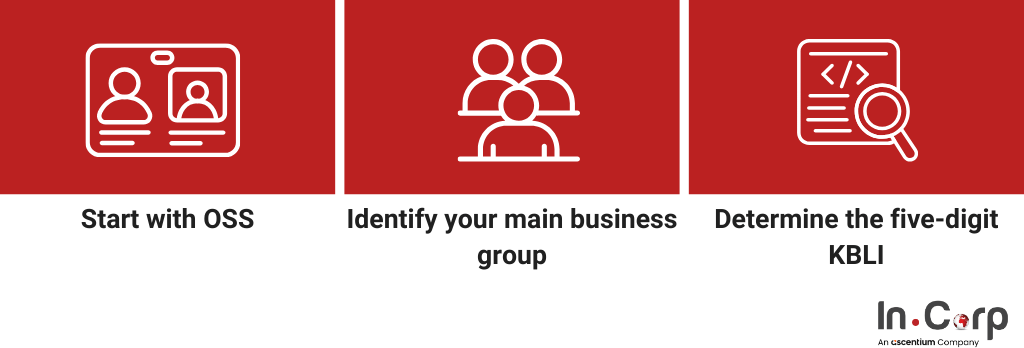
Choosing the right KBLI starts with understanding how activities are organized, rather than selecting a code based solely on wording, such as:
Start with OSS
The Online Single Submission (OSS) system groups business activities into broad sections labeled A through U, each representing a significant sector of the economy.
For example, Section C covers manufacturing and includes activities such as food, beverages, textiles, footwear, and other industrial products.
Identify your leading business group
Within each section, activities are divided into main groups that reflect the core nature of the business.
A footwear manufacturing company, for instance, falls under Section C and is grouped under code 152, which represents footwear manufacturing.
Determine the five-digit KBLI
The final step is selecting the five-digit KBLI that best reflects the company’s specific activity. Each additional digit narrows the classification.
Using the footwear example:
- 15201: Footwear for daily use
- 15202: Footwear for sports activities
- 15203: Footwear for field or industrial use
- 15204: Footwear for other purposes
A company manufacturing running shoes would therefore use KBLI 15202.
A company may register more than one KBLI if its activities are diverse but related. Carefully selecting all relevant KBLIs that support the core operations ensures smooth licensing, reduces delays, and maintains compliance with Indonesian regulations, especially for businesses with multiple activity streams.
Guide to Doing Business in Jakarta
Obtain your KBLI with InCorp
Getting right from the outset helps businesses avoid revisions as operations expand or licensing requirements change.
InCorp Indonesia (an Ascentium Company) supports businesses by aligning KBLI selection with regulatory requirements and long-term operating plans, including:
- Assessment and alignment: Mapping business activities to the appropriate classifications.
- Business setup and registration support: Aligning classification, company structure, and licensing from incorporation.
- OSS and licensing coordination: Supporting registrations and activity-based approvals linked to KBLI.
Fill out the form below to enter the Indonesian market with greater confidence and fewer adjustments later on.
Frequently Asked Questions
What is KBLI and why is it important for businesses in Indonesia?
KBLI is Indonesia’s official system for classifying business activities, and it determines how a company is registered, licensed, and recognized by regulators.
What is KBLI 2025?
KBLI 2025 refers to the current classification framework that refines how business activities are grouped, helping authorities assess licensing and registrations more accurately.
Does KBLI affect daily business operations?
No. KBLI does not change how a business operates day to day, but it affects licensing, approvals, and future changes to business activities.
Why should KBLI be reviewed early during business setup?
Choosing the right KBLI early helps avoid licensing delays, restricted approvals, and revisions later when the business expands or changes activities.
Can a company register more than one KBLI?
Yes. A company may register multiple KBLIs if it conducts several related business activities, as long as each activity is accurately classified.
Get in touch with us.
What you'll get
A prompt response to your inquiry
Knowledge for doing business from local experts
Ongoing support for your business
Disclaimer
The information is provided by PT. Cekindo Business International (“InCorp Indonesia/ we”) for general purpose only and we make no representations or warranties of any kind.
We do not act as an authorized government or non-government provider for official documents and services, which is issued by the Government of the Republic of Indonesia or its appointed officials. We do not promote any official government document or services of the Government of the Republic of Indonesia, including but not limited to, business identifiers, health and welfare assistance programs and benefits, unclaimed tax rebate, electronic travel visa and authorization, passports in this website.

Verified by
Ales Cina
Consulting Manager at InCorp Indonesia
Aleš manages solution delivery at InCorp Indonesia, optimizing incorporation processes and client relationships. His experience in internal auditing, retail, and sales offers valuable global insights. Aleš, with a degree in Economics and Finance from the Czech Republic, helps clients navigate cross-border business challenges, focusing on cultural and legal insights.