The Online Single Submission (OSS) Indonesia system is the government’s centralized digital platform for business licensing. While many businesses know OSS as the tool for obtaining a Business Identification Number (NIB), fewer clearly understand what OSS approvals mean or how they affect daily operations and legal compliance.
This guide explains OSS requirements, how the risk‑based approach works, what obligations apply after approval, and how to use OSS Indonesia correctly to reduce compliance risks.
What is OSS Indonesia?
OSS (Online Single Submission) Indonesia is the central government platform that brings together business licensing applications from different ministries and agencies. Its primary purpose is to:
- Issue Business Identification Numbers (NIB)
- Facilitate access to business permits and technical licenses
- Provide a single digital point for compliance tracking
However, OSS does not replace regulatory oversight. Although submissions are centralized, actual licensing decisions and compliance enforcement remain with respective ministries and local authorities.
Read more: Indonesia business registry explained: Essential guide for foreign investors
How the OSS RBA (risk‑based approach) works
Under Government Regulation No. 28 of 2025, OSS implements a Risk‑Based Approach (RBA) to determine licensing requirements based on activity risk.
Key components of OSS RBA
- KBLI classification: Each business activity is classified under the Indonesian Standard Industrial Classification (KBLI)
- Risk levels: Activities are assigned a risk level (low, medium, high)
- License requirements: Risk level dictates whether:
- Only an NIB is needed
- Commitments or conditions are required
- Technical approvals must be obtained first
Why KBLI selection matters
- Each activity is evaluated independently
- One business may have different licensing statuses
- Adding or changing activities can change risk levels and permit requirements
Selecting the correct KBLI codes is essential to building confidence in your licensing process; they directly determine obligations and compliance expectations.
What OSS approvals really mean for business operations
An OSS approval doesn’t always mean your business is fully cleared to operate. Even if your status shows “approved,” you may still need to meet other requirements, depending on your business type and risk level:
- Some business activities require post‑registration fulfillment before operations
- Licenses may be conditional
- Technical ministries may still conduct verifications or site inspections
Standard post‑licensing requirements include:
- Obtaining sectoral technical permits
- Zoning or location compliance
- Environmental or safety standards
- Periodic reporting
A valid OSS license may still have obligations that must be completed later.
How to use OSS Indonesia effectively
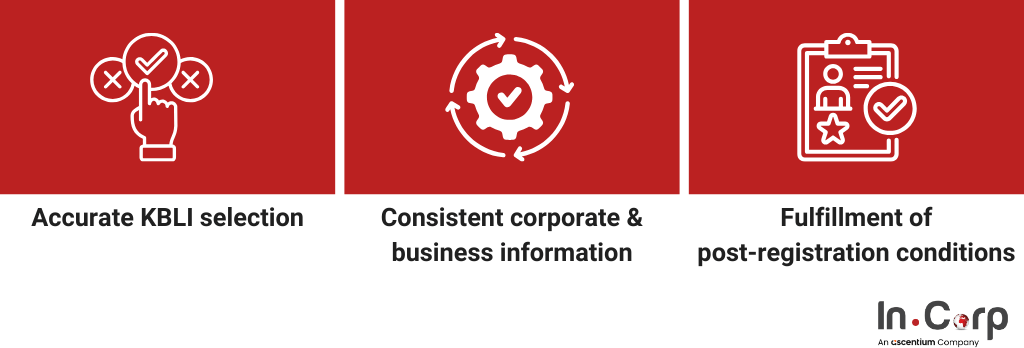
Many OSS problems come not from the system itself, but from how businesses set up and manage their licensing information.
Accurate KBLI selection
Selecting the correct KBLI codes ensures:
- Right risk level
- Correct type of license
- Accurate post‑licensing obligations
Mistakes or overly broad classifications often lead to unexpected regulatory hurdles.
Consistent corporate & business information
Make sure OSS data matches your corporate documents:
- Deed of Establishment
- Shareholder and capital details
- Registered business address
Even minor discrepancies can delay approvals or trigger additional requirements.
Fulfillment of post‑registration conditions
Many OSS approvals are based on self-declared commitments, such as:
- Sectoral permits
- Environmental checks
- Safety compliance
- Zoning or location confirmation
Completing these steps on time helps your business operate smoothly and stay compliant with the law.
Why OSS licensing can still be unclear
From a government point of view, OSS Indonesia works as planned by making submissions and tracking easier. However, from a business point of view, confusion often happens because:
- Approvals may be conditional
- Compliance may continue after approval
- Multiple authorities may still be involved beyond OSS
For foreign-owned companies (PMA), OSS licensing is linked to investment compliance. Therefore, any changes in capital realization, business activities, or shareholding structure require updates to your OSS registration to maintain compliance and avoid licensing issues.
Common OSS licensing mistakes you must avoid
Many issues in the OSS Indonesia system are not caused by the platform itself, but by how businesses prepare and manage their submissions. Below are the most common mistakes and their consequences:
Incorrect KBLI selection
This often results in the wrong risk level being assigned and in the incorrect license being applied for. It can also trigger additional checks by authorities and slow down the approval process.
Inconsistent business data
Discrepancies between OSS data and official company documents, such as the deed of establishment, shareholding structure, or registered address, can delay approvals or result in rejections during verification.
Ignoring post-licensing tasks
Many OSS licenses include conditions that must be met after approval. Failure to meet these obligations can result in non-compliance, enforcement actions, or license revocation.
Treating OSS approval as final
An approval shown in the OSS dashboard does not automatically grant operational clearance. Additional permits, technical approvals, or inspections may still be required depending on the business activity.
Guide to Doing Business in Jakarta
Navigate OSS Indonesia licensing and regulatory compliance with InCorp
OSS Indonesia is a powerful tool that simplifies the business licensing process, but it is not a substitute for regulatory compliance. Getting licensed is just the first step; understanding how those approvals affect your business operations is where it really matters.
InCorp (an Ascentium Company) provides full-service solutions across every stage of the process. Our services include:
- Company registration for both local and foreign-owned (PMA) entities, aligned with the latest regulations
- Business licensing through the OSS system, including strategic KBLI selection, NIB registration, and sectoral approvals
- Compliance outsourcing (BPO) to manage ongoing obligations such as reporting, technical verifications, and regulatory submissions
Fill out the form below to turn OSS approvals into absolute operational clarity.
Frequently Asked Questions
What is OSS Indonesia used for?
OSS Indonesia is the government’s central online system for business licensing, used to obtain a Business Identification Number (NIB) and manage permits and compliance tracking.
Does an OSS approval mean my business can operate immediately?
Not always. Some OSS approvals are conditional and require additional permits, technical approvals, or post-registration obligations before operations can begin.
How does the OSS risk-based approach (RBA) work?
OSS assigns licensing requirements based on business risk levels determined by KBLI classification, which decides whether only an NIB, commitments, or technical licenses are required.
Why is KBLI selection important in OSS licensing?
KBLI codes determine your risk level, license type, and post-licensing obligations. Incorrect selection can lead to delays or unexpected compliance issues.
What are common mistakes businesses make when using OSS?
Common errors include choosing the wrong KBLI, inconsistent company data, ignoring post-licensing requirements, and assuming OSS approval is the final clearance.
Get in touch with us.
What you'll get
A prompt response to your inquiry
Knowledge for doing business from local experts
Ongoing support for your business
Disclaimer
The information is provided by PT. Cekindo Business International (“InCorp Indonesia/ we”) for general purpose only and we make no representations or warranties of any kind.
We do not act as an authorized government or non-government provider for official documents and services, which is issued by the Government of the Republic of Indonesia or its appointed officials. We do not promote any official government document or services of the Government of the Republic of Indonesia, including but not limited to, business identifiers, health and welfare assistance programs and benefits, unclaimed tax rebate, electronic travel visa and authorization, passports in this website.

Verified by
Ales Cina
Consulting Manager at InCorp Indonesia
Aleš manages solution delivery at InCorp Indonesia, optimizing incorporation processes and client relationships. His experience in internal auditing, retail, and sales offers valuable global insights. Aleš, with a degree in Economics and Finance from the Czech Republic, helps clients navigate cross-border business challenges, focusing on cultural and legal insights.