
Pension contributions in Indonesia are becoming a key focus for employers, especially with updates to the contribution cap, emphasizing the importance of staying compliant and confident in your payroll management.
What may seem like a technical adjustment can affect payroll structure, employment cost, and workforce planning. Without proper alignment, small gaps in contribution calculations and policy setup can lead to compliance and cost inefficiencies.
Pension contribution updates in 2026
Recent updates to pension contributions in Indonesia focus on adjusting the maximum capped wage ceiling under the BPJS Ketenagakerjaan (Jaminan Pensiun / JP) program.
As of March 2026, the maximum capped wage ceiling has increased to IDR 11,086,300 per month, up from the previous threshold. Contributions remain structured as:
- 2% paid by the employer
- 1% paid by the employee
However, both are calculated only up to the capped limit.
For example:
An employee earning IDR 15 million per month will still have pension contributions calculated based on IDR 11.08 million, not the full salary.
This adjustment may seem incremental, but it has practical implications:
- Higher contribution base for mid-to-high income employees
- Increased employer cost over time
- Need to update payroll calculations and systems
The wage ceiling determines how much is contributed during their working years.
Is the pension cap advantageous for companies?
The capped structure is a valuable tool for controlling expenses, particularly for roles in the mid-to-high-income range.
- Cost predictability: Even as salaries increase, employer contributions remain capped, helping companies maintain predictable payroll costs.
- Controlled exposure for higher salaries: For senior or specialized roles, the cap prevents pension contributions from scaling in line with full compensation.
- Gradual adjustment: Although the ceiling increases periodically, the change is incremental. This allows companies to adjust budgets over time rather than absorb sudden increases.
In this context, the capped system has some advantages, even with upward adjustment.
What is the current retirement age in Indonesia?
The official retirement age in Indonesia remains 59. This applies to employees enrolled in the BPJS Ketenagakerjaan (BPJamsostek) pension program (Jaminan Pensiun / JP).
This age has been in effect since January 2025. It will remain in place until the next scheduled adjustment, encouraging HR professionals to proactively align policies and ensure clarity regarding retirement and employment termination.
It is important to note that this refers to pension eligibility, not mandatory retirement. In practice:
- Employees become eligible to receive pension benefits at 59
- Companies may still define their own retirement age internally
- Employment does not automatically end at this age
The increase follows a structured timeline, with the retirement age expected to reach 65 years by 2043.
Why is the retirement age increasing?
The increase in the retirement age follows a structured framework under Government Regulation (PP) No. 45/2015, which gradually raises it over time.
The structured increase in the retirement age reflects broader goals, such as longer life expectancy and the need to sustain the pension system, thereby influencing workforce participation and benefit funding strategies.
While this change mainly affects when employees access benefits, it sits alongside pension contribution rules that shape how those benefits are funded.
Why does retirement age not automatically end employment?
One of the most common gaps in applying the retirement age in Indonesia is the assumption that it automatically determines when employment must end. In practice, this is not always the case.
There is a clear distinction between regulatory benchmarks and internal company policy:
| Aspect | Explanation |
| Retirement Age | Refers to pension eligibility under BPJS |
| Company Retirement Policy | Internal rule set by the employer |
| End of Employment | Depends on contract and company policy |
This means an employee reaching 59 does not automatically result in termination. Companies may:
- Set a different retirement age in employment agreements
- Extend employment based on business needs
- Align retirement with internal workforce strategy
However, this flexibility comes with responsibility. Policies that are not clearly defined or aligned with current regulations can create confusion, especially when handling termination or benefit entitlement.
For employers, defining a clear retirement age and ensuring it aligns with contracts and policies is crucial for maintaining control and avoiding confusion in workforce management.
How pension contributions affect employers and employees
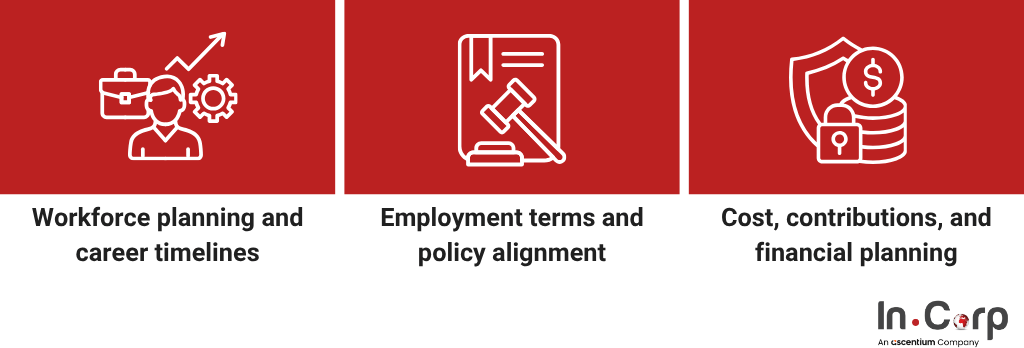
Changes to pension contributions in Indonesia, along with the broader retirement framework, affect both employers and employees in distinct yet interconnected ways.
Workforce planning and career timelines
Employees remain in their roles for longer, which affects how companies plan hiring and succession. At the same time, employees may need to adjust their career expectations as retirement is pushed further into the future.
Employment terms and policy alignment
For employers, retirement clauses in employment agreements need to reflect current regulations and internal policy. For employees, this determines how and when retirement transitions are handled in practice.
Cost, contributions, and financial planning
Employers face increased long-term contribution obligations, especially with the higher pension cap. On the other hand, employees contribute over a longer period, which may improve pension accumulation but also requires more structured financial planning.
Risks of not adjusting to pension contribution changes
When updates to pension contributions in Indonesia and the retirement age are not reflected internally, the impact usually manifests as small inconsistencies that accumulate over time.
- Policy and contract misalignment: Differences between written agreements and actual practice can lead to disputes.
- Inconsistent application: Uneven implementation across employees may create internal issues.
- Payroll inaccuracies: Outdated systems may lead to incorrect pension contribution calculations.
- Unclear communication: Employees may not fully understand retirement eligibility or benefit timing.
Payroll Outsourcing in Indonesia: Building Continuity Through Compliance
Manage workforce changes with InCorp
Updates to pension contributions in Indonesia, particularly the capped wage ceiling, directly affect payroll and employment costs.
While the retirement age in Indonesia continues to increase, its role in contribution calculations is more contextual than immediate. Understanding both elements allows companies to manage cost, maintain compliance, and plan workforce changes more effectively.
InCorp Indonesia (an Ascentium Company) can support companies in adapting to these changes through:
- Employer of Record (EOR) for compliant workforce management
- Payroll services aligned with BPJS Indonesia updates
- Recruitment support for workforce planning
Fill out the form below to explore the right approach for your workforce planning and compliance needs.
Frequently Asked Questions
What changed in Indonesia’s new pension contributions?
The BPJS pension (JP) wage ceiling increased to IDR 11,086,300 per month, affecting how contributions are calculated.
How are pension contributions calculated in Indonesia?
Contributions are 2% from the employer and 1% from the employee, calculated only up to the capped wage limit.
Does a higher salary increase pension contributions?
Not always. Contributions are capped, so salaries above the threshold are still calculated based on the maximum limit.
What is the retirement age for pension benefits in Indonesia?
The current retirement age is 59, which determines pension eligibility, not automatic employment termination.
What happens if companies don’t update their payroll systems?
They may face payroll inaccuracies, compliance issues, and misalignment with current pension regulations.
Get in touch with us.
What you'll get
A prompt response to your inquiry
Knowledge for doing business from local experts
Ongoing support for your business
Disclaimer
The information is provided by PT. Cekindo Business International (“InCorp Indonesia/ we”) for general purpose only and we make no representations or warranties of any kind.
We do not act as an authorized government or non-government provider for official documents and services, which is issued by the Government of the Republic of Indonesia or its appointed officials. We do not promote any official government document or services of the Government of the Republic of Indonesia, including but not limited to, business identifiers, health and welfare assistance programs and benefits, unclaimed tax rebate, electronic travel visa and authorization, passports in this website.