
If you understand how PMA vs PMDN impacts ownership, capital, and sector access, you’ll feel more confident in making the right choice for your business goals.
This guide provides a practical comparison to help you choose the structure that best suits your operational plans.
Quick comparison: PMA vs PMDN at a glance
This clear comparison of PMA vs PMDN across key factors aims to make your decision process easier and less overwhelming.
| Factor | PMA | PMDN |
| Ownership | Foreign shareholders allowed | 100% Indonesian-owned only |
| Minimum Investment | IDR 10 billion total; IDR 2.5 billion paid-up | No fixed national minimum |
| Sector Access | Subject to the Positive Investment List | Generally broader access |
| Foreign Shareholders | Yes — up to 100% in open sectors | Not permitted |
| LKPM Reporting | Required (quarterly/annual) | Not required |
| Best For | Foreign investors, overseas companies | Indonesian-owned local businesses |
What is a PMA company in Indonesia?
A PMA (Penanaman Modal Asing) is a foreign-invested company established under Indonesian law. Unlike a representative office, a PMA is a fully operational legal entity; it can issue invoices, hire employees, sign contracts, and generate local revenue.
PMA companies are regulated under Indonesia’s Investment Law and registered through the OSS (Online Single Submission) system. Every PMA is classified under a specific KBLI (business classification code), which determines ownership limits, licensing requirements, and eligible activities.
Can a foreigner own 100% of a PMA?
Yes, in many sectors, full foreign ownership is permitted. However, this depends on Indonesia’s Positive Investment List, which classifies each business activity as fully open, partially restricted (requiring a local partner), or closed to foreign investment.
Understanding these classifications and how they apply to your chosen KBLI code is essential for assessing sector feasibility and planning your investment strategy.
What is a PMDN company in Indonesia?
A PMDN (Penanaman Modal Dalam Negeri) is a domestic investment company that must be 100% owned by Indonesian individuals or entities. It is the standard structure for locally-owned businesses operating in Indonesia.
Compared to a PMA, a PMDN has fewer regulatory restrictions and no fixed minimum capital requirement. However, it cannot accommodate any foreign shareholding, making it unsuitable for international investors.
Can a PMDN have a foreign shareholder?
No. The moment a foreign party holds shares, the entity must be structured as a PMA. Some businesses explore informal arrangements to circumvent this, but such structures carry significant legal risk and are not recognized under Indonesian law.
Which sectors can a PMA operate in?
The most important difference between PMA vs PMDN is not just the structure itself; it’s what sectors and activities each allows you to operate in, especially considering the Positive Investment List and sector restrictions that may impact your business plans.
For PMA companies, foreign ownership limits are set on a sector-by-sector basis under the Positive Investment List. Sectors fully open to 100% foreign ownership include consulting and professional services, most IT and digital businesses, and certain trading activities.
Restricted sectors, such as media, certain agricultural activities, and some retail formats, require partial local ownership.
If your target sector is restricted, you can either include a local Indonesian shareholder at the required percentage or review whether an adjacent KBLI classification allows full foreign ownership.
How many capital requirements do you need for PMA?
Knowing the capital requirements for PMA helps you plan effectively, giving you a sense of control over your investment process.
A PMDN has no fixed national minimum. The nature and scale of the business determine the capital required.
The PMA threshold is not negotiable during the licensing process. Structuring below IDR 10 billion typically leads to complications or rejection during OSS registration. Planning this requirement from the start is far more efficient than attempting to minimize it.
Not sure how to structure your capital for a PMA? Our consultants can walk you through your options in a free 30-minute session. Talk to us →
What are the ongoing compliance requirements for PMA?
From a tax perspective, both PMA vs PMDN follow the same general framework in Indonesia. This includes:
- Corporate Income Tax at 22%
- Value Added Tax (VAT), where applicable
- Withholding tax obligations depend on transactions
However, there are additional considerations for PMA companies.
Because they involve foreign ownership, PMA entities may be subject to:
- Transfer pricing rules for related-party transactions
- LKPM reporting (investment activity reporting)
- More structured compliance monitoring
PMDN companies are generally not exposed to either requirement unless they form part of a larger corporate group.
This doesn’t make a PMA more complex to run day-to-day, but it does mean that compliance requirements-such as LKPM reporting, transfer pricing, and structured monitoring-must be integrated into your operational planning from the start, which could impact ongoing costs and resource allocation.
Which option should you choose: PMA or PMDN?
The choice between PMA vs PMDN becomes clearer when aligned with your business situation. You may consider a PMA if:
- You are a foreign national or an overseas company entering Indonesia
- Your business requires foreign ownership or control
- You plan to scale regionally or bring in international investment
A PMDN may be more suitable if:
- Indonesian parties will fully own and operate the business
- No foreign investment is involved at any stage
- You prefer a simpler structure without LKPM reporting obligations
In some cases, businesses explore hybrid approaches or phased entry strategies. This depends on sector rules, funding plans, and long-term direction.
Rather than focusing only on setup, it helps to consider where the business is expected to be in the next few years.
How to set up a PMA in Indonesia
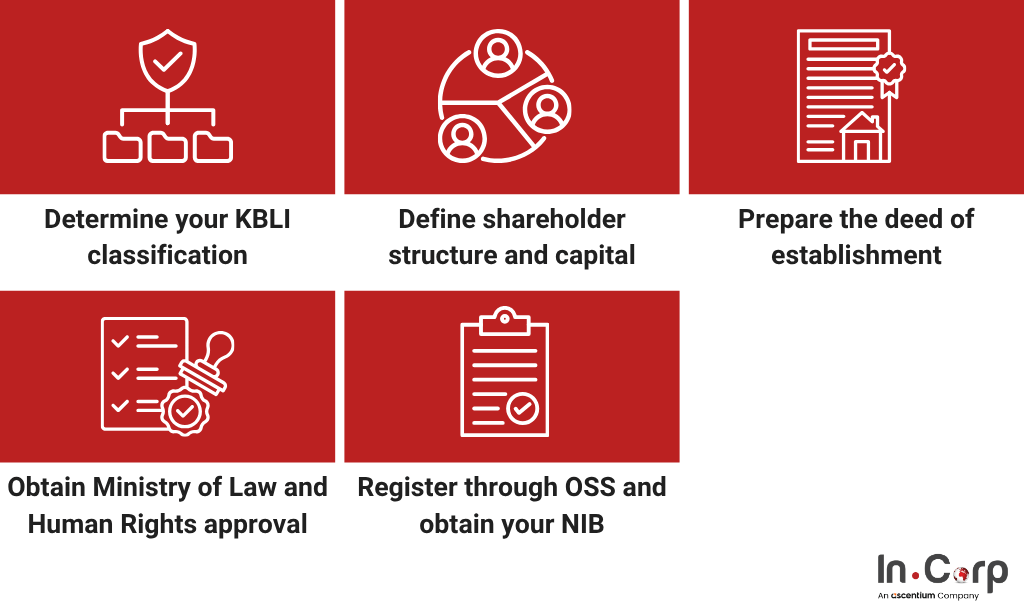
Setting up a PMA in Indonesia follows a structured process. With proper preparation, the timeline is typically 3–6 weeks.
- Determine your KBLI classification: This defines your business activity and directly determines your eligibility for foreign ownership. Misclassification is the most common cause of delays.
- Define shareholder structure and capital: Confirm ownership percentages, total investment value (must exceed IDR 10 billion), and paid-up capital (minimum IDR 2.5 billion).
- Prepare the deed of establishment: A notary drafts and executes the articles of association.
- Obtain Ministry of Law and Human Rights approval: This legalizes the entity under Indonesian law.
- Register through OSS and obtain your NIB: Apply for your Business Identification Number and any sector-specific licenses based on your risk classification.
Guide to Doing Business in Jakarta

Ready to set up your PMA in Indonesia?
Choosing between PMA vs PMDN is just the first step. Getting the KBLI classification, capital structure, and licensing right from the start is what prevents costly delays later.
InCorp Indonesia (an Ascentium Company) is a trusted business incorporation consultant helping foreign investors set up and operate in Indonesia with confidence. Our services include:
- PMA incorporation: End-to-end setup from deed of establishment to NIB issuance
- KBLI consultation: Identifying the right business classification to maximize your ownership options
- OSS registration: Handling the full licensing process through Indonesia’s Online Single Submission system
- LKPM compliance: Ongoing quarterly and annual investment activity reporting
Fill out the form below to get started, and our team will be in touch within one business day.
Frequently Asked Questions
What is the main difference between PMA and PMDN?
A PMA allows foreign ownership, while a PMDN must be 100% owned by Indonesian individuals or entities.
Can a foreigner own a company in Indonesia?
Yes, through a PMA structure. In many sectors, foreign investors can own up to 100%, depending on the Positive Investment List.
What are the capital requirements for a PMA?
A PMA requires a minimum total investment of IDR 10 billion and at least IDR 2.5 billion paid-up capital.
Do PMA and PMDN have different compliance requirements?
Yes. PMA companies must submit LKPM reports and may face transfer pricing rules, while PMDN companies generally have fewer reporting obligations.
Which structure should I choose: PMA or PMDN?
Choose PMA if you involve foreign ownership or investment. Choose PMDN if the business is fully owned and operated by Indonesian parties.
Get in touch with us.
What you'll get
A prompt response to your inquiry
Knowledge for doing business from local experts
Ongoing support for your business
Disclaimer
The information is provided by PT. Cekindo Business International (“InCorp Indonesia/ we”) for general purpose only and we make no representations or warranties of any kind.
We do not act as an authorized government or non-government provider for official documents and services, which is issued by the Government of the Republic of Indonesia or its appointed officials. We do not promote any official government document or services of the Government of the Republic of Indonesia, including but not limited to, business identifiers, health and welfare assistance programs and benefits, unclaimed tax rebate, electronic travel visa and authorization, passports in this website.

Verified by
Ales Cina
Consulting Manager at InCorp Indonesia
Aleš manages solution delivery at InCorp Indonesia, optimizing incorporation processes and client relationships. His experience in internal auditing, retail, and sales offers valuable global insights. Aleš, with a degree in Economics and Finance from the Czech Republic, helps clients navigate cross-border business challenges, focusing on cultural and legal insights.