Businesses in Indonesia may occasionally receive a clarification letter from the Directorate General of Taxes (DGT). One of the most common is SP2DK Indonesia, or Surat Permintaan Penjelasan atas Data dan/atau Keterangan, which asks taxpayers to explain certain data identified in the tax authority’s system.
Since the letter comes from the tax office, many taxpayers immediately associate it with a tax audit or a Tax Assessment Letter (Surat Ketetapan Pajak / SKP). However, these processes serve different purposes. Understanding how SP2DK Indonesia differs from tax audits and tax assessments helps businesses respond appropriately and avoid unnecessary concern.
Why does the Indonesian tax authority issue an SP2DK?
In Indonesia’s tax monitoring system, SP2DK is issued when the tax authority identifies data that requires clarification. The letter, issued by the Head of the Tax Office (KPP), requests an explanation regarding certain tax information recorded in the DGT system.
This process is guided by DGT Circular SE-05/PJ/2022, which outlines how tax officers monitor taxpayer compliance through data verification. Instead of immediately starting an audit, the tax office may first ask the taxpayer to review the data and provide clarification.
An SP2DK Indonesia may be issued when the tax authority identifies:
- Incomplete tax reporting
- Differences between tax filings and third-party data
- Transactions that do not align with the taxpayer’s profile
- Indicators suggesting tax obligations may not be fully met
In practice, SP2DK functions as an early verification step. It allows taxpayers to explain or correct discrepancies before the matter progresses into a formal tax examination.
How SP2DK differs from tax audits and SKP in Indonesia
Although they are part of the same tax administration system, SP2DK, tax audits, and Tax Assessment Letter (SKP) serve different roles in the compliance process. The main difference lies in the stage of review and the level of authority exercised by the tax office.
| Aspect | SP2DK | Tax Audit | Tax Assessment Letter (SKP) |
| Main Objective | Request clarification on the tax data identified by the tax office | Conduct a detailed compliance review | Determine the final tax position |
| What Usually Triggers It | Data mismatch or incomplete reporting | Issues not resolved during clarification or higher-risk indicators | Result of findings from an audit |
| Process Type | Initial verification stage | Formal examination by the tax authority | Official determination issued by the tax office |
| What the Taxpayer Typically Does | Explain and provide supporting documents | Submit accounting records and other relevant evidence | Review the assessment or consider filing an objection |
| Possible Result | Clarification accepted or case escalated | Tax adjustments may be identified | SKPKB, SKPLB, or SKPN may be issued |
| Practical Impact | Usually none if the clarification is accepted | May lead to the issuance of an SKP | May result in additional tax payable or a refund |
SP2DK Indonesia appears earlier in the process and allows taxpayers to clarify or correct their reporting before the matter progresses to a tax audit or the issuance of an SKP.
Who can receive an SP2DK in Indonesia?
Both businesses and individuals can receive SP2DK Indonesia. The letter is issued to taxpayers when the tax office needs clarification on specific data recorded in its system.
In practice, SP2DK may be sent to:
- Corporate taxpayers, including local companies and foreign-owned entities (PT PMA)
- Individual taxpayers, particularly those with business or professional income
- Taxpayers with transactions reported by third parties, such as banks, vendors, or customs records
SP2DK Indonesia is based on data verification, and the request can arise from various reporting sources. This means the letter is not limited to a specific type of taxpayer, but rather depends on the data available to the tax authority.
When can SP2DK Indonesia escalate further?
SP2DK is a clarification stage, but if issues remain unresolved, the tax office may conduct further reviews if the explanation does not sufficiently address the discrepancy.
Escalation may occur when:
- The taxpayer does not respond within the requested timeframe
- The clarification or documents provided are incomplete
- The explanation does not align with the data available to the tax authority
- The review indicates possible underreporting of tax obligations
When this happens, the tax authority may conduct a tax audit to examine the taxpayer’s records in greater detail. If the audit later identifies unpaid taxes, the process can ultimately result in the issuance of a Tax Assessment Letter (SKP).
For this reason, responding carefully to SP2DK can help resolve the matter earlier in the review process.
Common misunderstandings about SP2DK Indonesia
Since the letter comes from the tax office, SP2DK is often misunderstood by taxpayers. In many cases, the concern comes from assuming the letter already indicates a tax violation or a formal examination.
Some common misunderstandings include:
- SP2DK is the same as a tax audit: The letter is only a request to explain certain data. A tax audit is a separate and more formal examination.
- Receiving SP2DK means a violation has been identified: The request usually arises from data that does not fully match the tax authority’s records, not from confirmed non-compliance.
- Penalties automatically apply once SP2DK is issued: When the clarification resolves the discrepancy, the matter may end without further consequences.
- It is better to delay the response: Waiting too long can complicate the review. Providing clarification within the requested timeframe helps keep the process straightforward.
- The response always requires extensive documentation: In many cases, the tax office only asks for specific documents or a brief explanation related to the transaction under review.
Understanding the role of SP2DK helps taxpayers approach the request more calmly and prepare the necessary explanation before the matter progresses further.
What taxpayers should do after receiving an SP2DK Indonesia?
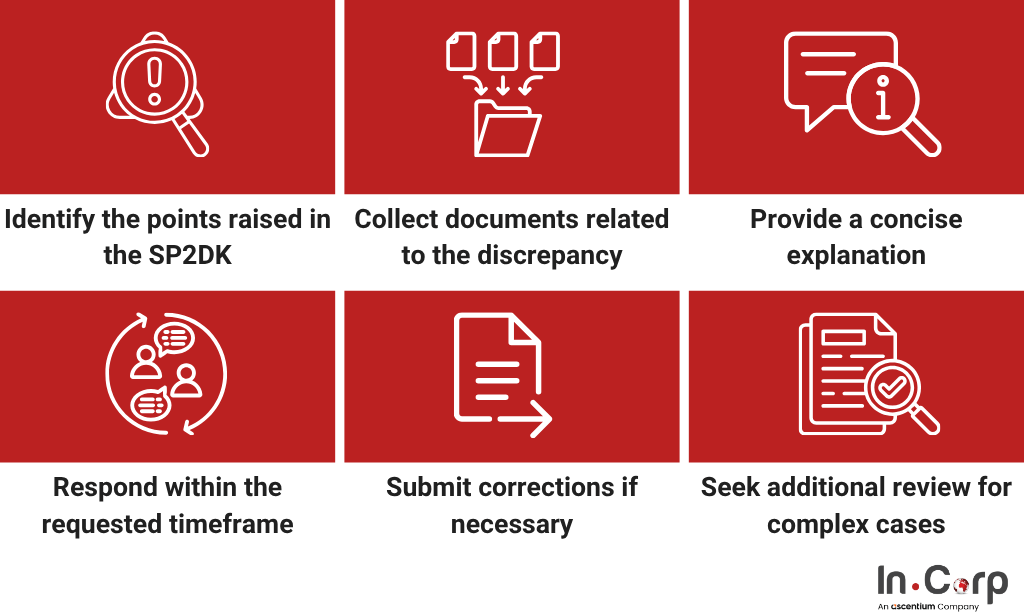
When receiving SP2DK, the focus should be on understanding the issue raised by the tax office and responding with the appropriate clarification. Since the request usually relates to specific data, the response process can remain straightforward when handled carefully. Practical steps may include:
- Identify the points raised in the SP2DK: Review the items mentioned in the letter and compare them with your internal records.
- Collect documents related to the discrepancy: In many cases, only documents connected to the specific transaction or reporting period are needed.
- Provide a concise explanation: Address each point clearly so the tax office can understand the context of the data.
- Respond within the requested timeframe: Submitting the clarification on time helps keep the matter within the verification stage.
- Submit corrections if necessary: If a reporting error is identified, the taxpayer may include the correction along with the explanation.
- Seek additional review for complex cases: Businesses with layered transactions may benefit from internal or professional review.
By responding carefully, taxpayers can often resolve SP2DK during the clarification stage before the review progresses into a tax audit or the issuance of a Tax Assessment Letter (SKP).
Mastering Corporate Taxation in Indonesia

Manage SP2DK Indonesia with InCorp
Handling SP2DK in Indonesia often requires careful reconciliation between tax filings and financial records. With the right review process, businesses can address clarification requests more efficiently.
InCorp Indonesia (an Ascentium Company) can assist with:
- Reviewing tax data and reconciliation related to SP2DK inquiries
- Preparing clarification responses to the tax office
- Corporate tax compliance and reporting support
- Advisory on Indonesian tax procedures and documentation
With practical guidance, companies can address tax clarification requests while maintaining smooth day-to-day operations.
Get in touch with us.
What you'll get
A prompt response to your inquiry
Knowledge for doing business from local experts
Ongoing support for your business
Disclaimer
The information is provided by PT. Cekindo Business International (“InCorp Indonesia/ we”) for general purpose only and we make no representations or warranties of any kind.
We do not act as an authorized government or non-government provider for official documents and services, which is issued by the Government of the Republic of Indonesia or its appointed officials. We do not promote any official government document or services of the Government of the Republic of Indonesia, including but not limited to, business identifiers, health and welfare assistance programs and benefits, unclaimed tax rebate, electronic travel visa and authorization, passports in this website.

Verified by
Heldy Narua
Senior External Finance Manager at InCorp Indonesia
Heldy, with seven years of experience, leads InCorp Indonesia’s External Finance team, specializing in reliable Payroll Outsourcing and Finance Management solutions. She has an Accounting and Business Administration degree from Sampoerna University and Oregon State University. She is certified with Brevet AB, highlighting her technical expertise and commitment to client success.