
Many tax disputes in Indonesia begin earlier than companies expect, often when differences identified by the tax authority are not fully clarified during SP2DK.
Although SP2DK is not an audit or enforcement action, it signals that certain reported data or transactions require explanation, which often determines whether a tax dispute will develop.
For this reason, SP2DK functions as an early resolution checkpoint within Indonesia’s tax dispute landscape.
Why SP2DK matters in tax disputes prevention
SP2DK is issued when the tax authority identifies a discrepancy in a company’s reported data that requires clarification. It does not create a tax assessment or enforcement finding. Its purpose is to determine whether differences can be explained before the case progresses further.
At this point, the authority has not taken a formal position, and companies still have room to explain transactions, align documents, or correct reporting. Many issues can be resolved here before they develop into audit findings or tax disputes.
At the SP2DK stage:
- No audit has started
- No tax assessment exists
- No formal tax dispute has begun
- Clarification is still possible
After SP2DK, the process typically shifts to audit, where the focus moves from explanation to verification. That transition makes disputes more likely.
How SP2DK can resolve tax disputes before an audit
SP2DK allows companies to explain differences before they become audit issues. Since the tax authority is still seeking clarification rather than making corrections, clear responses can often settle the matter early and prevent it from developing into tax disputes.
Resolution usually occurs when the company directly explains the difference and supports it with documents. This may include clarifying transaction details, timing, or classification of differences, or correcting filings before the audit begins.
How SP2DK responses help prevent tax disputes
If these points are addressed at SP2DK, the issue often closes. If not, it may proceed to audit, where dispute risk becomes higher.
- Explaining why data differs from tax authority records
- Showing documents that support the reported position
- Clarifying timing or classification differences
- Making voluntary corrections if needed
Common triggers that lead to SP2DK and tax disputes
Certain differences repeatedly trigger SP2DK, especially where reporting depends on timing, classification, or transaction structure. Typical SP2DK triggers include:
- Income reported by third parties differs from tax returns
- VAT reporting does not match counterparty data
- Withholding tax credits cannot be verified
- Related-party transactions lack a clear explanation
- Customs and tax data show inconsistent values
These differences usually begin with clarification requests. When companies cannot reconcile them during SP2DK, the same issues may progress into audit adjustments and formal tax disputes.
Practical steps to resolve SP2DK issues early
Handling SP2DK effectively means focusing on the specific difference identified and explaining it with supporting evidence. The goal is not to argue about a legal position, but to reconcile data and show how reported figures reflect actual transactions.
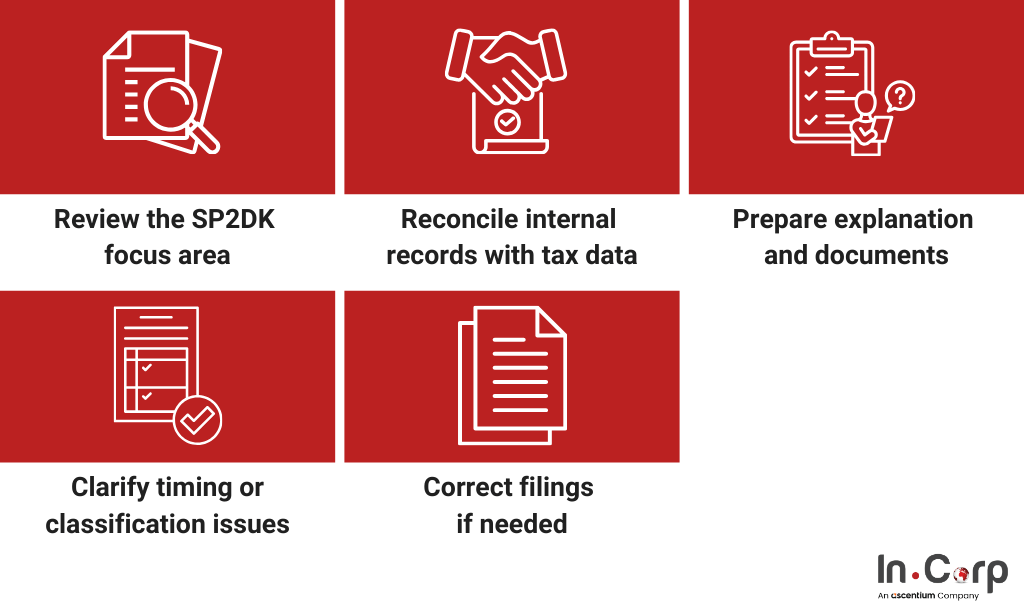
Practical response steps include:
- Review the SP2DK focus area: Identify the questioned data or transaction
- Reconcile internal records with tax data: Compare returns, accounting, and third-party information
- Prepare explanation and documents: Link differences to invoices, contracts, or schedules
- Clarify timing or classification issues: Show reporting or treatment differences
- Correct filings if needed: Make voluntary adjustments to close gaps
When responses follow this structure, many SP2DK cases close without escalation. If reconciliation remains incomplete, the issue may proceed to audit and later form the basis of a tax dispute.
Possible outcomes of SP2DK in tax dispute cases
After reviewing a company’s response, the tax authority decides whether the difference has been explained or still requires verification.
- Issue considered explained: The authority accepts the clarification, and no further action is taken.
- Voluntary correction made: The company adjusts reporting or settles a shortfall, closing the matter early.
- Further monitoring: The issue is noted but not escalated, usually pending future review.
- Escalation to tax audit: The authority proceeds with verification, increasing tax-dispute risk.
The first two outcomes resolve the issue at SP2DK. Escalation moves the case into audit, where positions become formalized, and disputes are more likely.
Risks of ignoring SP2DK
When SP2DK is not addressed properly, the clarification opportunity narrows. The tax authority may assume the difference cannot be explained and proceed directly to audit. At that stage, the issue is examined through verification rather than explanation, increasing the likelihood of tax disputes. If SP2DK is unmanaged, outcomes often include:
- Escalation into a tax audit
- Issuance of tax assessment
- Reduced ability to clarify facts
- Higher likelihood of a formal tax dispute
Once a case reaches audit or assessment, resolution depends more on defending positions than explaining them. This is why unmanaged SP2DK often allows manageable issues to develop into disputes.
How structured SP2DK support reduces tax dispute risk
SP2DK responses often require both technical reconciliation and a clear explanation of transactions. Professional handling focuses on aligning facts, documents, and reporting positions so the tax authority can understand the difference without escalation.
- Reviewing the issue against tax and accounting data
- Reconciling differences across documents and returns
- Preparing clear explanations linked to evidence
- Identifying corrections that close gaps early
- Managing clarification with the tax office
Reduce tax dispute risk early with InCorp
Early alignment at the SP2DK stage often resolves issues before the audit begins. Once a case moves into assessment or formal dispute channels, resolution becomes more lengthy and procedural.
Treating SP2DK as a resolution stage rather than just a notice helps companies manage tax differences before they escalate into disputes.
InCorp Indonesia (an Ascentium company) supports companies in managing SP2DK and related tax dispute risks through:
- SP2DK response preparation and clarification support
- Reconciliation of tax authority and company data
- Documentation alignment and explanation structuring
- Voluntary correction assessment and guidance
- Tax audit and dispute assistance if escalation occurs
Fill out the form below to resolve issues at the clarification stage and reduce the likelihood of formal tax disputes.
Get in touch with us.
What you'll get
A prompt response to your inquiry
Knowledge for doing business from local experts
Ongoing support for your business
Disclaimer
The information is provided by PT. Cekindo Business International (“InCorp Indonesia/ we”) for general purpose only and we make no representations or warranties of any kind.
We do not act as an authorized government or non-government provider for official documents and services, which is issued by the Government of the Republic of Indonesia or its appointed officials. We do not promote any official government document or services of the Government of the Republic of Indonesia, including but not limited to, business identifiers, health and welfare assistance programs and benefits, unclaimed tax rebate, electronic travel visa and authorization, passports in this website.

Verified by
Heldy Narua
Senior External Finance Manager at InCorp Indonesia
Heldy, with seven years of experience, leads InCorp Indonesia’s External Finance team, specializing in reliable Payroll Outsourcing and Finance Management solutions. She has an Accounting and Business Administration degree from Sampoerna University and Oregon State University. She is certified with Brevet AB, highlighting her technical expertise and commitment to client success.