For companies importing goods into Indonesia, the customs declaration Indonesia is where classification, licensing, and valuation come together. Many shipment delays start here, not because the products are prohibited, but because the declared HS code, value, or supporting documentation don’t fully meet regulatory requirements.
In Indonesia, the import declaration is less a formality and more a compliance statement. Customs uses it to determine duties, confirm import eligibility, and check whether documentation is consistent. When classification, permits, and shipment data are aligned before arrival, clearance tends to be smoother and more predictable.
What is a customs declaration Indonesia for imported goods?
A customs declaration for imported goods is the formal submission that reports shipment details to customs before products can enter the domestic market. In the import context, this declaration is known as the PIB (Pemberitahuan Impor Barang). It records how goods are classified and valued, and serves as the basis for duty and tax assessment.
Unlike passenger declarations, which relate to personal belongings, the PIB reflects regulatory accountability for commercial imports. Customs relies on the declared HS code to determine duty rates and regulatory controls, applies valuation rules to calculate charges, and verifies whether any required permits match the product category.
Who must submit a customs declaration Indonesia?
A customs declaration for Indonesia must be submitted by the party legally recognized as the importer of record. In Indonesia, this typically refers to a company holding a valid NIB and import status. The submission itself is transmitted through a licensed customs broker, Pengusaha Pengurusan Jasa Kepabeanan (PPJK).
Depending on how the import is structured, the importer of record may be:
- Indonesian importing companies: Importing under their own NIB
- Local distributors or partners: Acting on behalf of foreign suppliers
- Group entities: Centralized importing within a corporate group
Although PPJK prepares and submits the PIB, legal responsibility remains with the importer. This means classification accuracy, licensing validity, and declared value ultimately sit with the importing entity.
Key information required in a customs declaration for Indonesia
Customs relies on the PIB to confirm the product’s identity, classification, and eligibility for entry into Indonesia. The declaration needs to align technical details, commercial data, and regulatory status. When these elements do not match, shipments often move into inspection or correction.
A PIB typically includes:
- HS code: Determines the duty rate and regulatory status
- Product description: Consistent with HS classification
- Quantity and unit: Aligned with the packing list
- Customs value (CIF): Basis for duties and taxes
- Country of origin: Affects tariff treatment
- Importer data: NIB and import status
- Regulatory references (if applicable): Lartas permits or approvals
- Shipment references: Bill of Lading (BL) or Airway Bill (AWB), and manifest data
Only goods classified as Lartas-controlled require permit references. Non-restricted products proceed solely based on classification and valuation.
Customs declaration process for imports in Indonesia
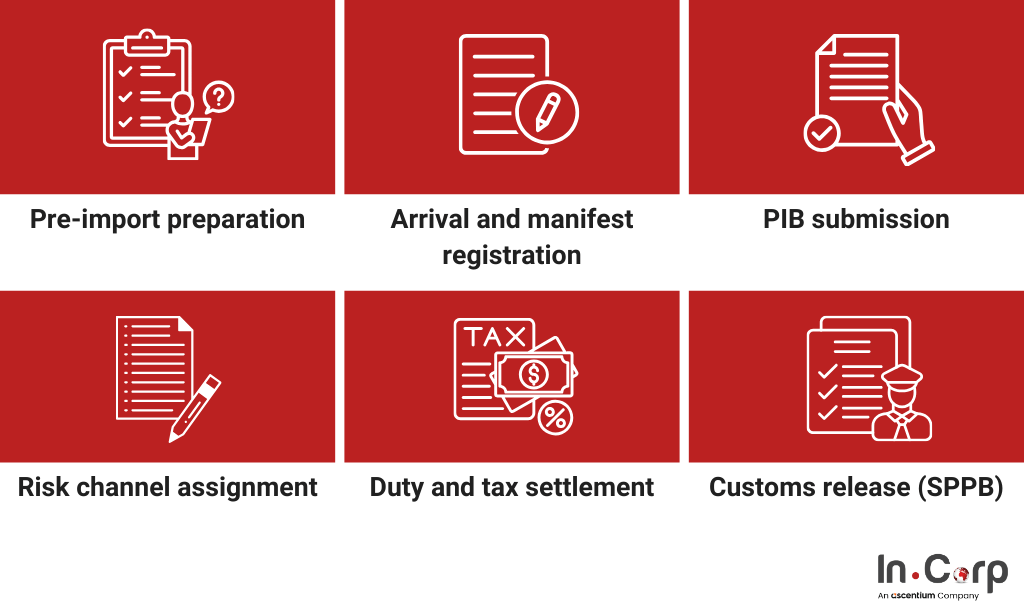
The customs declaration process in Indonesia follows a defined sequence in which classification, shipment data, and regulatory status are checked before goods can be released. Although the PIB is the central declaration, clearance outcomes are largely shaped by preparation completed before shipment.
Pre-import preparation
Importers confirm HS classification and determine whether the product falls under Lartas controls. If permits are required, they need to be secured and aligned with the intended HS code before shipment.
Arrival and manifest registration
Upon arrival, the carrier registers shipment details in the customs manifest. This creates the official arrival record referenced by the PIB.
PIB submission
The importer, through a licensed PPJK, submits the PIB electronically with classification, value, shipment references, and any applicable permits. Customs systems then cross-check this data against manifest and licensing records.
Risk channel assignment
Customs assigns the shipment to a clearance channel based on risk profiling. This determines whether the release is automated, document-checked, or inspected.
Duty and tax settlement
Import duties and taxes are calculated based on the HS code and declared value and must be paid before release. If valuation or classification appears inconsistent, customs may reassess before payment is finalized.
Customs release (SPPB)
Once requirements are satisfied, customs issues the Surat Persetujuan Pengeluaran Barang (SPPB), allowing the goods to exit the port or airport and enter the Indonesian market.
When classification, permits, and declaration data are aligned from the start, clearance is usually straightforward. Misalignment often leads to inspection or correction.
Duties and taxes in customs declaration Indonesia
Import duties and taxes in Indonesia are determined based on the information declared in the PIB, particularly the HS code and customs value. These elements set the tariff rate and tax exposure, ultimately determining the landed cost of goods. Classification and valuation decisions, therefore, have an immediate financial impact at the time of clearance.
For most commercial imports, the main charges include:
- Import duty (Bea masuk): Based on the HS code tariff rate
- Import VAT (PPN): Applied to the import value after duty
- Income tax on import (PPh 22): Advance corporate tax collected at import
All charges are calculated from the CIF value declared in the PIB. Import VAT and PPh 22 are assessed on the import value, which includes the customs value plus import duty. If customs determines that the HS code or declared value does not reflect the actual goods or transaction, duties and taxes may be reassessed before release.
Since tariff rates and tax exposure vary by classification, accurate HS determination and valuation alignment are essential to predictable import cost and clearance.
Clear Paths to Product Registration in Indonesia
Navigate import compliance for Indonesia market entry
For companies importing into Indonesia, alignment across classification, licensing, and declaration data supports smooth market entry. Customs declaration Indonesia requirements sit within a broader compliance framework that InCorp Indonesia (an Ascentium Company) assists companies through:
- HS classification and tariff assessment support
- Lartas and import licensing advisory
- Guidance on the importer of record and structuring
- Coordination of customs declarations with PPJK
- Import compliance review and risk assessment
Ensure import requirements are aligned before shipment by completing the form below.
Get in touch with us.
What you'll get
A prompt response to your inquiry
Knowledge for doing business from local experts
Ongoing support for your business
Disclaimer
The information is provided by PT. Cekindo Business International (“InCorp Indonesia/ we”) for general purpose only and we make no representations or warranties of any kind.
We do not act as an authorized government or non-government provider for official documents and services, which is issued by the Government of the Republic of Indonesia or its appointed officials. We do not promote any official government document or services of the Government of the Republic of Indonesia, including but not limited to, business identifiers, health and welfare assistance programs and benefits, unclaimed tax rebate, electronic travel visa and authorization, passports in this website.

Verified by
Hotdo Nauli
Senior Legal & Delivery Manager at InCorp Indonesia
Hotdo heads the Legal and Delivery team at InCorp Indonesia, managing Product Registration, Legal Advisory, and Business Licensing. With over 8 years of experience, she focuses on compliance and integrity, ensuring all client operations align with Indonesian laws and regulatory standards, including contract reviews and sector-specific licenses. She is also a licensed advocate and a member of the Indonesian Advocates Association (PERADI).