Indonesia leads the global nickel industry, holding the most significant reserves and dominating production. With rising demand for electric vehicles (EVs), the country is shifting from exporting raw ore to building a complete battery supply chain.
How can you explore the nation’s thriving nickel landscape? This article will explore how Indonesia is transforming into an EV hub, key opportunities, and challenges to navigate.
Indonesia’s nickel industry overview
Indonesia holds the world’s largest nickel reserves, positioning it as a source of national pride and a reliable partner for global investors. In 2024, it produced over 2.2 million metric tons, nearly half of the worldwide output, reinforcing its leadership in the industry.
To boost this economic value, the government banned the export of raw nickel ore in 2020, prompting industries to process the material domestically. This policy shift has triggered significant investments in smelters and downstream facilities.
Key Infrastructure Developments
To support its vision of becoming a global nickel industry hub, Indonesia is rapidly building essential infrastructure, demonstrating a strong commitment to growth that can inspire investor confidence.
- Smelter Expansion: Dozens of nickel smelters have been built or are under construction.
- Industrial Parks: Dedicated zones in Sulawesi and North Maluku support large-scale nickel and battery industries.
- Logistics and Utilities: Ports, roads, and power plants are being upgraded to support heavy industrial activities.
This rapid infrastructure growth is laying the groundwork for Indonesia to lead in battery-grade nickel production and EV supply chains.
Read more: Exploring the opportunities from the largest nickel reserve in Indonesia
From ore exporter to global EV battery hub
Nickel is a core material in EV battery production, especially in high-performance lithium-ion batteries. As global EV demand accelerates, so does the need for battery-grade nickel.
To capitalize on this trend, Indonesia took a bold step by banning the export of raw nickel ore in 2020. This move forced companies to invest in domestic processing and value-added manufacturing. Since then, the country has attracted billions in investments for smelters and EV battery materials.
Government-Backed Incentives
Indonesia’s government supports this transformation through various initiatives:
- Tax holidays and import duty exemptions for strategic investments
- Simplified licensing for downstream projects
- Public-private partnerships in industrial zones
- Incentives for ESG-compliant operations
These policies have accelerated the shift from an ore exporter to a battery production hub, positioning Indonesia as a key supplier in the global EV ecosystem.
Read more: Tax holiday benefits: Who qualifies and how to apply
Future investment opportunities in the EV-nickel business
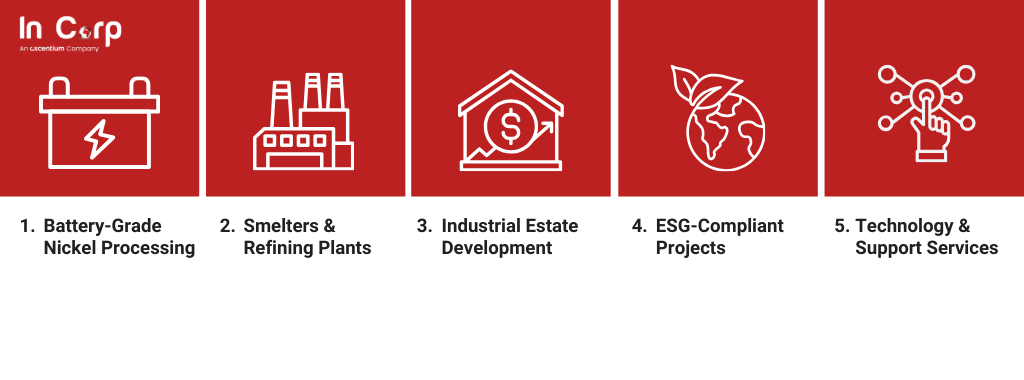
Indonesia’s transformation into a global nickel industry hub offers significant investment opportunities, especially in the rapidly expanding electric vehicle (EV) ecosystem.
Battery-Grade Nickel Processing
Demand for nickel sulfate is rising fast for EV batteries. Investors can tap into refining facilities that convert the material into battery-grade compounds. These plants are vital to meeting global EV manufacturing needs.
Smelters and Refining Plants
There is high demand for more nickel smelters and refining units, especially those producing ferronickel and nickel pig iron. These facilities are central to Indonesia’s downstream strategy, offering stable returns amid rising global consumption.
Industrial Estate Development
Areas like Morowali and Weda Bay are growing as key industrial parks tailored to the nickel and battery industries. Investing within these zones allows stakeholders to benefit from shared facilities and government support.
ESG-Compliant Projects
There’s growing interest in green nickel projects that meet global Environmental, Social, and Governance (ESG) standards, offering investors a chance to contribute to sustainable development and access premium markets.
Technology and Support Services
Beyond core mining, there’s strong demand for innovation in automation, waste management, digital monitoring, and supply chain optimization. These supports are essential for modern nickel operations and offer scalable investment options.
How can foreign investors invest?
Entering Indonesia’s nickel industry requires a clear understanding of the legal and administrative landscape. Here’s how foreign businesses can navigate the complex setup process:
1. Establish a Local Legal Entity
Foreign investors must register a company in Indonesia as a PT PMA (foreign-owned limited liability company). This is the legal foundation for conducting business in mining, processing, or industrial sectors.
2. Obtain Required Licenses and Permits
All nickel-related operations require these specific licenses:
- Mining Business License (IUP)
- Environmental permits
- Regional permits
- Construction and operation permit (only for processing facilities)
3. Apply for an Investor KITAS
To legally stay and work in Indonesia, foreign business owners and executives should apply for an Investor KITAS, a visa that also offers tax benefits and easier business management.
4. Partner with Local or Global Stakeholders
Collaborating with local businesses or global EV companies can help navigate regulatory hurdles, secure land, and build trust with local communities.
By following these steps, foreign investors can effectively tap into one of the world’s fastest-growing nickel markets.
Key challenges of investing in Indonesia’s nickel industry
While the opportunities are strong, investors should be aware of several key challenges:
- Changes in mining and export regulations can affect operations, making compliance essential.
- Environmental risks and the need for ESG compliance are widespread in Indonesia’s mining industry, making adherence to international standards essential for attracting global buyers and securing financing.
- Infrastructure limitations, such as a lack of stable power, water, and transport, can affect project efficiency and costs.
- Smelter and processing plants require significant upfront investment, often taking [X] years to develop, with returns influenced by global nickel prices and market demand.
- Nickel prices can fluctuate due to changes in global demand and evolving battery technology.
Being prepared for these risks helps investors make smarter, long-term decisions in Indonesia’s growing nickel industry.
Read more: Indonesia’s mining law reforms: Opportunities for businesses
Invest in Indonesia’s nickel reserves now
Indonesia’s nickel industry has significant potential, especially for investors in EV batteries and green energy. With the proper setup, it’s a great time to enter.
InCorp Indonesia (an Ascentium Company) provides end‑to‑end solutions to help you build and scale your EV‑related operations:
- Company Registration: Set up your business smoothly with expert guidance and full regulatory compliance.
- Investor KITAS: Let us manage the visa process while you focus on growing your venture.
- ESG Compliance: Strengthen sustainability performance with professional advisory tailored to global standards.
Partner with us and move forward with confidence as you invest in Indonesia’s growing nickel ecosystem.
Frequently Asked Questions
Why is Indonesia important in the global nickel industry?
Indonesia has the world’s largest nickel reserves and produces nearly half of global supply, making it a key player in EV batteries and stainless steel.
Why did Indonesia ban raw nickel ore exports?
The ban encourages domestic processing, helping Indonesia move from ore exports to higher-value nickel and battery production.
What investment opportunities exist in Indonesia’s nickel sector?
Opportunities include battery-grade nickel processing, smelters, industrial parks, ESG-focused projects, and mining support services.
How can foreign investors invest in Indonesia’s nickel industry?
Investors must set up a PT PMA, secure licenses, apply for an Investor KITAS, and often partner with local or global firms.
What are the main challenges for nickel investors in Indonesia?
Key challenges include regulatory changes, ESG compliance, infrastructure gaps, high capital costs, and price volatility.
Get in touch with us.
What you'll get
A prompt response to your inquiry
Knowledge for doing business from local experts
Ongoing support for your business
Disclaimer
The information is provided by PT. Cekindo Business International (“InCorp Indonesia/ we”) for general purpose only and we make no representations or warranties of any kind.
We do not act as an authorized government or non-government provider for official documents and services, which is issued by the Government of the Republic of Indonesia or its appointed officials. We do not promote any official government document or services of the Government of the Republic of Indonesia, including but not limited to, business identifiers, health and welfare assistance programs and benefits, unclaimed tax rebate, electronic travel visa and authorization, passports in this website.

Verified by
Ales Cina
Consulting Manager at InCorp Indonesia
Aleš manages solution delivery at InCorp Indonesia, optimizing incorporation processes and client relationships. His experience in internal auditing, retail, and sales offers valuable global insights. Aleš, with a degree in Economics and Finance from the Czech Republic, helps clients navigate cross-border business challenges, focusing on cultural and legal insights.