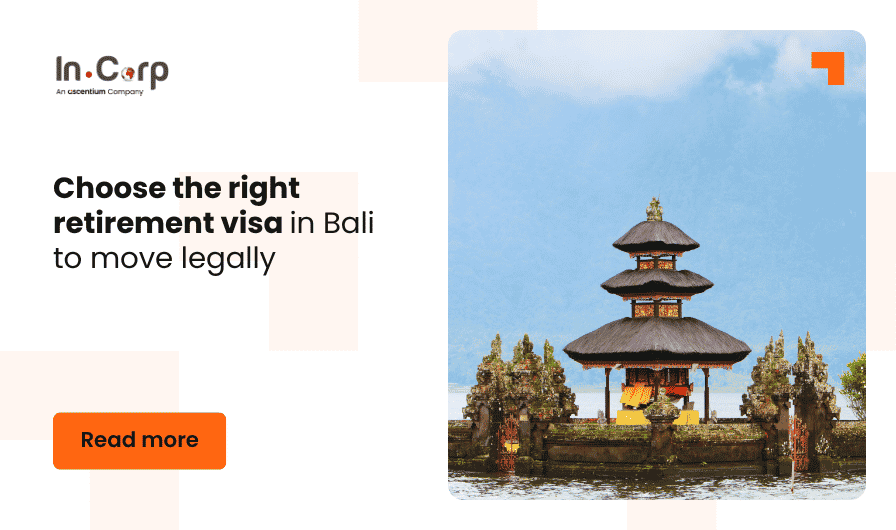
Retiring in Bali involves more than choosing where to live. Foreign retirees need to consider the right stay permit, financial requirements, permitted activities, and how their immigration status may affect longer-term plans, such as purchasing property. A retirement visa in Bali provides eligible foreigners with a legal basis for long-term residence as they plan their retirement on the island.
Understanding the available visa options and their requirements is the first step toward planning a secure and compliant retirement in Bali. Additionally, outline the application process, typical timelines, and submission locations to help readers prepare effectively.
Key Takeaways
- A retirement visa in Bali is generally available through the E33E or E33F visa route.
- E33E offers a five-year stay for eligible retirees, while E33F provides a one-year stay.
- Both visas require proof of sufficient income, while E33E also requires a USD 50,000 deposit commitment.
- Retirement visa holders cannot freely work, sell goods or services, or receive local employment income.
- Property plans, tax residency, and other long-term arrangements should be reviewed before choosing the visa.
E33E vs E33F retirement visa in Bali: Which is right for you?
The route depends on how long you intend to live in Bali and whether you can meet the financial and immigration requirements of each category.
| Requirement | E33E Visa | E33F Visa |
| Stay Period | 5 years | 1 year |
| Best For | Long-term retirement in Bali | Shorter-term retirement stay |
| Guarantor | Not required | Required |
| Minimum Income | USD 3,000/month | USD 3,000/month |
| Financial Requirement | USD 50,000 deposit commitment | No equivalent deposit requirement |
| Property Purchase | Eligible through Hak Pakai | Eligible through Hak Pakai |
| Renewal | Less frequent | Annual |
| Ideal If | You are ready for a longer-term commitment | You prefer greater flexibility |
| Path to KITAP | Yes | Yes |
Unsure whether E33E or E33F fits your situation?
InCorp Indonesia (An Ascentium Company) can assess your age, intended length of stay, income structure, sponsorship status, and planned activities before preparing an application. Talk to our team →
Can a retiree buy property with a retirement visa in Bali?
Yes. Foreign retirees with a retirement visa can purchase certain residential property in Bali through Right to Use (Hak Pakai) under PP 18/2021.
What Hak Pakai gives a retiree
- Registered title: Held under the retiree’s name.
- Long-term tenure: Up to 80 years through the initial term, extension, and renewal.
- Residential use: Available for eligible houses and apartment units.
- Transfer and inheritance: Can generally be transferred or inherited by another eligible holder.
Eligibility still depends on the property type, location, minimum purchase value, land title, and immigration status, underscoring the need for careful planning to ensure smooth property ownership.
What retirees should plan for
Hak Pakai is intended for residential use and doesn’t automatically allow commercial rental activity. Retirees planning to operate a villa for income may need a different structure, such as a PT PMA with HGB, together with the required business licenses.
Planning to retire and buy property in Bali? InCorp Indonesia (An Ascentium Company) can support both retirement visa processing in Bali and property due diligence. Talk to our team →
What documents are usually required to apply for the retirement visa in Bali?
The required documents depend on the visa category and applicant profile, but retirees should generally prepare the following:
- Identity documents: A valid passport, recent photograph, and personal information required for the application.
- Financial evidence: Bank statements and proof of qualifying income, pension, or other regular allowance.
- Accommodation details: Information showing the applicant’s intended residence in Indonesia, where required.
- Visa-specific documents: E33E applicants must meet the applicable financial commitment, while E33F applicants must fulfill the relevant guarantor requirements.
- Supporting declarations: Additional statements or evidence may be requested depending on the applicant’s circumstances.
Applicants should also time the application carefully. Indonesian limited-stay visas generally need to be used for entry within 90 days of issuance, so the filing date should align with the planned arrival in Bali.
What Bali retirement visa holders can and cannot do
E33E and E33F retirement visas allow foreigners to reside in Indonesia, including Bali, and engage in certain personal and limited business activities. However, work activities remain restricted under these visas.
What can retirement visa holders in Bali do?
- Reside in Indonesia during the approved stay period.
- Travel in and out of Indonesia while the applicable re-entry permission remains valid.
- Undertake tourism and personal activities.
- Attend certain business meetings.
- Purchase goods for personal use.
- Carry out permitted business-related activities within the scope of the visa.
What retirement visa in Bali holders cannot do
- Take regular employment in Indonesia.
- Receive wages or salary from an Indonesian company or individual.
- Sell goods or provide paid services in Indonesia.
- Actively operate an income-generating business beyond the visa conditions.
- Assume a retirement visa in Bali automatically covers regular remote work.
The visa should match what the foreigner will do. Retirees planning to work remotely, earn income, or actively conduct business should review whether another immigration category is more appropriate.
Retirement visa vs remote worker visa in Bali
A retirement visa may not be suitable if you plan to continue regular employment while living in Bali. Indonesia offers separate visa routes depending on whether you are retired, working remotely, or conducting business activities.
| Feature | E33E / E33F Retirement Visa | E33G Remote Worker Visa |
| Best For | Retirees living from pension, savings, or investment income | Foreigners working remotely for an overseas employer |
| Main Activity | Retirement and long-term residence | Remote employment while residing in Indonesia |
| Employment Status | Not intended for regular employment | Designed for ongoing overseas employment |
| Income Source | Pension, allowance, savings, or investment income | Salary from an overseas employer |
| Local Employment | Not permitted as regular employment | Doesn’t replace an Indonesian work-authorized visa |
| Ideal Choice If | You are no longer actively employed | You want to keep working remotely from Bali |
Foreigners planning to work or run a business in Indonesia may need a different visa route. Not sure which route fits your situation? Talk to our team to review your planned activities before applying.
Does living in Bali make a retiree an Indonesian tax resident?
Yes, it can. Foreign retirees who stay in Indonesia for more than 183 days within a 12-month period may become Indonesian tax residents under PMK 18/2021.
Once considered a tax resident, a retiree may need a Tax Identification Number (NPWP) and should review how Indonesia treats:
- Pension and retirement income
- Overseas investment income
- Indonesian-source income
- Tax reporting obligations
Indonesia also has Double Taxation Agreements with many countries to help prevent the same income from being taxed twice. However, the treatment of pensions and other foreign income depends on the applicable treaty and the retiree’s individual circumstances.
Visa approval doesn’t determine tax residency. InCorp Indonesia (an Ascentium Company) can review your tax position alongside your retirement visa in Bali and property plans. Talk to our team →
Guide to Doing Business in Bali & Lombok
Secure the right retirement visa in Bali with InCorp
Retiring to Bali requires the visa, financial evidence, and intended lifestyle to fit together. InCorp Indonesia (An Ascentium Company) supports foreign retirees with:
- Visa eligibility assessment: Review whether E33E, E33F, or another category fits the planned stay.
- Visa extensions and stay compliance: Help maintain the immigration status after arrival.
- Property and relocation support: Coordinate property due diligence and related regulatory considerations.
- Tax advisory: Review potential Indonesian tax-residence implications for long-term residents.
Planning to retire in Bali? Start with an eligibility assessment before committing to a visa, property, or long-term relocation arrangement. Fill out the form below.
Frequently Asked Questions
Is there a specific retirement visa for Bali?
No. Bali doesn't issue a separate retirement visa. E33E and E33F are Indonesian national immigration classifications. Eligible foreigners can use them to reside in Bali or elsewhere in Indonesia, subject to the conditions of their permits.
What is the E33E visa?
E33E is a five-year Indonesian senior residence visa. Current Immigration information states that it is intended for foreigners aged 55 or older who want to reside in Indonesia without requiring a guarantor.
How long is an E33F retirement visa valid?
The Directorate General of Immigration currently lists the E33F senior visa with a one-year stay period.
How much income is required for an Indonesian retirement visa?
Official Immigration information currently specifies evidence of income or allowance of at least USD 3,000 per month for the relevant senior visa classifications.
Does E33E visa require USD 50,000?
Yes. Current official eVisa information states that E33E applicants must commit to depositing at least USD 50,000 in a state-owned Indonesian bank, in addition to meeting the applicable income requirement.
Can I work in Bali with a retirement visa?
A retirement visa should not be treated as unrestricted work authorization. Immigration restricts the sale of goods or services and the receipt of prohibited wages or similar compensation. Applicants intending to work should have their activity reviewed against the appropriate visa classification.
Can I attend business meetings on E33E visa or E33F visa?
Official Immigration descriptions of senior visa activities include certain business-related activities and meetings. However, this is different from taking employment, receiving an Indonesian salary, or selling goods or services.
Can I work remotely from Bali after retiring?
Do not assume that a retirement visa covers continuing overseas employment. Indonesia has a separate E33G visa classification for remote workers, so the applicant's actual working arrangement should be reviewed before choosing the retirement route.
Can foreigners buy property after getting a retirement visa?
Foreigners may qualify for certain forms of residential property rights, including arrangements governed by PP 18/2021, but they cannot assume the same unrestricted freehold rights available to Indonesian citizens. The specific property and title should be legally reviewed before purchasing.
Should I choose E33E visa or E33F visa?
E33E generally makes more sense for an eligible retiree seeking a five-year residence arrangement and able to meet its financial commitment. E33F can be considered when a shorter retirement residence structure is more appropriate. Eligibility, finances, sponsorship, and intended activities should be assessed before making a decision.
Get in touch with us.
What you'll get
A prompt response to your inquiry
Knowledge for doing business from local experts
Ongoing support for your business
Disclaimer
The information is provided by PT. Cekindo Business International (“InCorp Indonesia/ we”) for general purpose only and we make no representations or warranties of any kind.
We do not act as an authorized government or non-government provider for official documents and services, which is issued by the Government of the Republic of Indonesia or its appointed officials. We do not promote any official government document or services of the Government of the Republic of Indonesia, including but not limited to, business identifiers, health and welfare assistance programs and benefits, unclaimed tax rebate, electronic travel visa and authorization, passports in this website.

Verified by
Hotdo Nauli
Senior Legal & Delivery Manager at InCorp Indonesia
Hotdo heads the Legal and Delivery team at InCorp Indonesia, managing Product Registration, Legal Advisory, and Business Licensing. With over 8 years of experience, she focuses on compliance and integrity, ensuring all client operations align with Indonesian laws and regulatory standards, including contract reviews and sector-specific licenses. She is also a licensed advocate and a member of the Indonesian Advocates Association (PERADI).