Indonesia’s energy landscape is significantly influenced by its oil and gas industry. As the sector undergoes a significant transformation, with resource depletion, evolving regulations, and global pressure to shift toward cleaner energy, the role of the gas company becomes even more crucial.
This includes ensuring supply stability, upgrading infrastructure, and committing to sustainable practices.
This article highlights ten successful gas companies in Indonesia that have shown remarkable resilience, consistent innovation, and outstanding performance, each playing a key role in shaping the country’s energy future.
The role of a gas company in Indonesia’s energy landscape
The gas company is central to the energy value chain in Indonesia, operating across three main segments:
- Upstream: Exploration and production of oil and natural gas
- Midstream: Transportation and storage of hydrocarbons via pipelines and terminals
- Downstream: Refining, processing, and distribution of fuels and related products
With rising domestic energy consumption and limited refining capacity, the gas company is making strategic investments in infrastructure upgrades, adopting digital technologies, and strengthening environmental standards. These initiatives are crucial in ensuring energy security and economic stability in the country.
Read more: The potential of the carbon capture and storage business in Indonesia
Indonesia’s oil and gas market size and share
According to Mordor Intelligence, Indonesia’s oil and gas market is projected to grow from USD 13.88 billion in 2025 to USD 18.09 billion by 2030, at a CAGR of 5.44%. Several key trends drive this growth:
- Shift from mature onshore fields to offshore development
- Increasing investment in carbon capture and storage (CCS)
- Expansion of digital tools for operational efficiency
- Return of international oil companies using advanced recovery techniques
- Broader LNG distribution reaching remote and underserved regions
Market segmentation highlights
To better understand where this growth is concentrated, here’s a breakdown of the market by sector, location, and service type:
| Category | Segment | Details |
| Sector | Upstream | 72.8% of market share in 2024 |
| Midstream | Expected to grow at 4.9% CAGR through 2030 | |
| Downstream | Projected to grow at a 4.4% CAGR | |
| Location | Offshore | Growing at a 6.1% CAGR; key areas include Natuna, Abadi Masela, and Mahakam |
| Onshore | Still dominant with 58.5% of the 2024 market | |
| Services | Construction | Holds 52.1% of the market |
| Maintenance & Turnaround | Growing at 6.3% CAGR |
Top 10 successful oil and gas companies in Indonesia
Indonesia’s energy landscape is shaped by a mix of state-owned enterprises, international operators, and private local firms. The following companies are recognized for their operational strength, offshore expansion, and sustainability initiatives:
PT Pertamina (Persero)
The national oil company, Pertamina, controls a majority share of Indonesia’s oil and gas output. It operates across upstream, midstream, and downstream sectors and is central to the country’s energy security and policy execution.
Chevron Corporation
Through its Indonesian subsidiary, Chevron has played a significant role in upstream operations, especially in Sumatra. Known for using advanced recovery technologies, it remains a key international operator in Indonesia.
BP Plc
BP’s Tangguh LNG project is one of the largest in Southeast Asia. The company is heavily invested in gas production and export, supporting Indonesia’s growing role as a regional LNG supplier.
Shell Plc
Shell is active in Indonesia’s upstream and LNG sectors. Its involvement in joint ventures and gas development projects aligns with the country’s long-term energy goals.
CNOOC (China National Offshore Oil Corporation)
CNOOC leads several deepwater exploration projects in Indonesia, bringing offshore technology and investment to support new production zones, such as the Natuna Sea.
ExxonMobil Indonesia
ExxonMobil operates key upstream assets and has participated in some of the country’s largest oil and gas fields. Its technical capacity and capital resources support long-life field development.
MedcoEnergi Internasional Tbk
As the largest private oil and gas company in Indonesia, MedcoEnergi operates both locally and regionally. It focuses on upstream oil and gas as well as power and energy infrastructure.
Petronas Carigali Indonesia
A subsidiary of Malaysia’s Petronas, this company contributes to upstream exploration and development. It plays a vital role in regional energy cooperation.
Eni Indonesia
Part of Italian-based Eni S.p.A., this company recently commenced new gas production and is a growing player in Indonesia’s LNG and gas export markets.
PGN (Perusahaan Gas Negara)
A subsidiary of Pertamina, PGN specializes in gas infrastructure, distribution, and downstream services. It supports domestic supply and is expanding gas access across Indonesia.
Investment opportunities in Indonesia’s gas sector
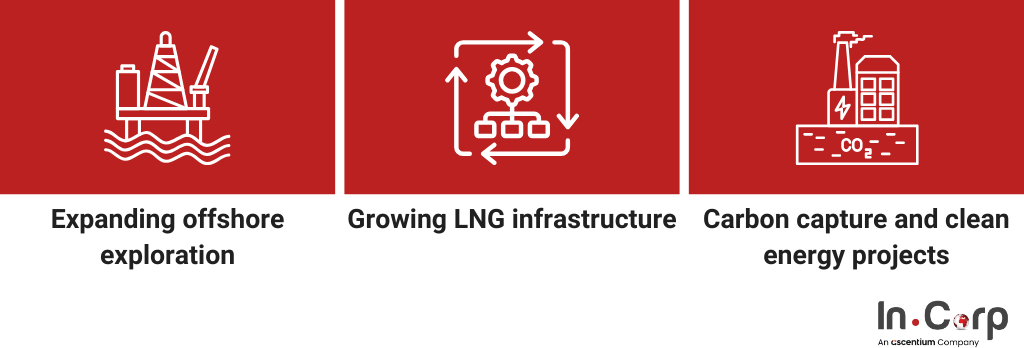
With steady growth, favorable government policies, and rising domestic demand, Indonesia’s gas sector is ripe for foreign and local investment. The shift toward LNG, offshore production, and carbon management creates diversified entry points.
Why Indonesia is attracting energy investors
- A strategic location near major Asian energy markets
- Revised regulations that promote offshore and marginal field development
- Steady energy demand from urbanization and industrial expansion
- A growing role for private and foreign players in key infrastructure projects
Recent investment highlights
- BP’s Tangguh LNG Train 3 project is expected to boost national gas exports significantly.
- Eni’s new gas production startup in East Kalimantan is demonstrating continued upstream interest.
- Petronas and MedcoEnergi joint ventures, showing regional collaboration in offshore development.
- Ongoing licensing rounds from SKK Migas for untapped offshore blocks and frontier basins.
Priority investment areas
- Offshore gas fields (Natuna Sea, Mahakam Delta, Abadi Masela)
- Small-scale LNG facilities for regional supply
- Carbon capture and storage infrastructure
- Gas pipeline expansions and distribution networks
Entry points for investors
Investors can explore opportunities by:
- Engage through the BKPM (Investment Coordinating Board)
- Register projects with SKK Migas (Upstream Oil and Gas Regulator)
- Form joint ventures with top-performing local and international operators
Guide to Doing Business in Jakarta

Launch your oil and gas company in Indonesia with InCorp
Investing in a regulated and dynamic sector like oil and gas requires the right local partner. InCorp Indonesia (an Ascentium Company) provides tailored support for international and regional investors to help you navigate market entry, compliance, and growth. Here’s how we can assist you:
- Company registration: Full support for setting up a foreign or local business entity
- Tax and regulatory compliance: Ongoing legal and financial guidance to meet Indonesian standards
- Workforce and immigration services: Talent recruitment, payroll, and visa processing for energy projects
- ESG strategy and reporting: Assistance in aligning with environmental, social, and governance standards required by regulators, investors, and global partners
Get expert help to build your presence in Indonesia’s gas industry. Fill out the form below to ensure a secure, compliant, and successful investment.
Frequently Asked Questions
Why are gas companies important to Indonesia’s energy sector?
Gas companies help secure energy supply by producing, transporting, and distributing natural gas, supporting both economic growth and energy stability.
What roles do gas companies play in Indonesia?
They operate across upstream (exploration and production), midstream (transport and storage), and downstream (processing and distribution) activities.
Is Indonesia’s oil and gas market still growing?
Yes. Indonesia’s oil and gas market is projected to grow steadily through 2030, driven by offshore development, LNG expansion, and infrastructure investment.
What makes Indonesia attractive for gas sector investment?
Strong domestic demand, revised regulations, offshore gas potential, and growing LNG and carbon management projects attract local and foreign investors.
How can investors enter Indonesia’s gas industry?
Investors can register through BKPM, work with SKK Migas for upstream projects, or form joint ventures with established local and international gas companies.
Get in touch with us.
What you'll get
A prompt response to your inquiry
Knowledge for doing business from local experts
Ongoing support for your business
Disclaimer
The information is provided by PT. Cekindo Business International (“InCorp Indonesia/ we”) for general purpose only and we make no representations or warranties of any kind.
We do not act as an authorized government or non-government provider for official documents and services, which is issued by the Government of the Republic of Indonesia or its appointed officials. We do not promote any official government document or services of the Government of the Republic of Indonesia, including but not limited to, business identifiers, health and welfare assistance programs and benefits, unclaimed tax rebate, electronic travel visa and authorization, passports in this website.

Verified by
Ales Cina
Consulting Manager at InCorp Indonesia
Aleš manages solution delivery at InCorp Indonesia, optimizing incorporation processes and client relationships. His experience in internal auditing, retail, and sales offers valuable global insights. Aleš, with a degree in Economics and Finance from the Czech Republic, helps clients navigate cross-border business challenges, focusing on cultural and legal insights.