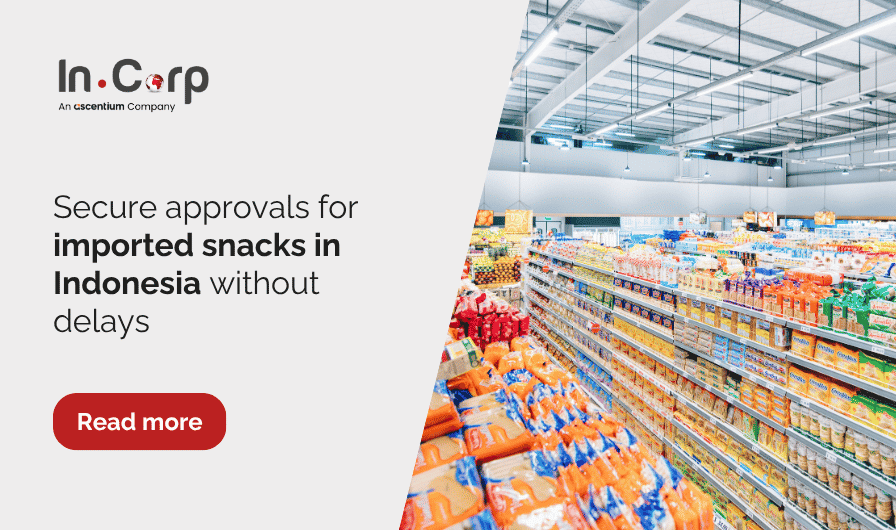
Imported snacks must meet several requirements before they can be legally sold in Indonesia. Each Stock Keeping Unit (SKU) needs a BPOM Foreign Food Registration Number (ML), a valid API-U or API-P import license, Indonesian language labeling, and mandatory Halal certification starting 17 October 2026.
Since each requirement is checked separately, missing one can delay customs clearance or cause the shipment to be held indefinitely.
Key Takeaways
- Every imported snack SKU requires a BPOM Foreign Food Registration Number (ML) to be legally imported into Indonesia.
- Permendag 23/2025 requires an Importer Identification Number (IT), Import Approval (PI), and Surveyor Report (LS) before goods reach Indonesian customs territory.
- Halal certification becomes mandatory for all packaged food and beverages from 17 October 2026.
- Import licensing requires either an API-U for trading or resale, or an API-P for production input.
- The API-U or API-P classification must be tied to a locally registered PT or PT PMA.
2026 compliance checklist for imported snacks in Indonesia
| Requirement | Regulator | What Changed in 2026 |
| BPOM ML Registration | BPOM | Still mandatory per SKU; risk-tiered by product category |
| Import License (API-U/API-P) | Ministry of Trade | Tightened under Permendag 23/2025 (in force since August 2025) |
| Import Approvals (IT/PI/LS) | Ministry of Trade | Required pre-entry for consumer goods under Permendag 23/2025 |
| Prohibited/Restricted Goods | Ministry of Trade | Expanded list under Permendag 47/2025, effective 1 January 2026 |
| Halal Certification | BPJPH | Becomes mandatory for all packaged food and beverages from 17 October 2026 |
| Labeling | BPOM | Indonesian language, allergens, nutrition facts, importer details |
BPOM requirements for imported snacks in Indonesia
Imported snack products must meet BPOM requirements before they can legally enter and be distributed in Indonesia. The two main BPOM requirements are:
- BPOM Foreign Food Registration Number (ML): Required for every imported snack SKU before the product can be sold in Indonesia.
- Entry Permit (Surat Keterangan Impor / SKI): Required for each shipment before the product can enter Indonesia.
BPOM risk classification
The BPOM registration track depends on the product’s risk classification:
- Low-risk products: Minimally processed snacks with standard additives
- Medium-risk products: Products processed through sterilization, pasteurization, irradiation, or similar methods
- High-risk products: Products marketed for infants, toddlers, pregnant women, or other sensitive consumer groups
Many packaged snack products may fall into the medium-risk category, depending on their ingredients, processing methods, and product claims.
Documents required for BPOM ML registration
Importers generally need to prepare the following documents for BPOM ML registration:
- Complete ingredient list
- Nutritional information
- Packaging or label samples
- Laboratory test results
- Product specification documents
- Manufacturer and importer details
A BPOM ML certificate is valid for five years. However, any new SKU, flavor variant, or formulation change may require a separate registration.
Labeling requirements for imported snacks
Imported snack labels must comply with BPOM labeling requirements before the products can be distributed in Indonesia. Labels generally need to include:
- Bahasa Indonesia product description
- Nutrition facts
- Allergen information
- Production and expiry dates
- Importer name and address
- Other mandatory product information required by BPOM
Snack brands should also monitor possible front-of-pack labeling updates, especially for high-sugar products. If new sugar or nutrition-grade labeling rules are introduced, affected brands may need to adjust their packaging before distribution.
Mandatory halal certification for imported snacks in Indonesia
From 17 October 2026, Halal certification becomes mandatory for all packaged food and beverages sold in Indonesia, under the Halal Product Assurance Law and BPJPH’s implementing regulations. For imported snacks, this means:
- Brands already Halal-certified abroad may register their existing certificate through BPJPH’s SIHALAL portal if their foreign certifier is recognized, avoiding a full local audit.
- Uncertified brands should start the BPJPH audit process immediately. Certification usually takes several months, and the demand for certifier slots is anticipated to rise sharply as the deadline approaches.
- Missing the 17 October 2026 deadline for Halal certification risks products being pulled from distribution, even if other import requirements are met.
Documents needed to import snacks into Indonesia
A company can only import snacks under its own name if it holds the correct import license. The two main API classifications are:
- Angka Pengenal Importir Umum (API-U): For companies importing goods for trading or resale.
- Angka Pengenal Importir Produsen (API-P): For companies importing goods as production inputs, not for direct resale.
Foreign companies cannot act as the Importer of Record directly in Indonesia. They must be handled through a locally registered PT or PT PMA with an NIB and the correct API classification.
Importers must also prepare the required shipment documents, which may include:
- Commercial invoice
- Packing list
- HS code classification
- Certificate of analysis, where applicable
- Import approval, producer importer approval, or surveyor report under Permendag 23/2025, where required
Common challenges for snack importers in Indonesia
Snack brands often face import delays because of small compliance gaps that are only discovered during registration or customs clearance. Common issues include:
- Incorrect HS code classification: Misclassified products may face higher import duties, additional permit requirements, or rejection during customs clearance.
- Non-compliant product labeling: Minor issues with label format, wording, logo placement, or mandatory information can lead to inspection issues or rejection.
- Incomplete BPOM documents: Missing ingredient details, lab test results, packaging samples, or product specifications can extend the BPOM review timeline.
- Restricted or prohibited ingredients: Some snack ingredients may fall under Indonesia’s list of restricted or prohibited goods, especially following regulatory updates.
- Late Halal certification preparation: Many brands underestimate how long Halal certification can take, especially as the 17 October 2026 deadline approaches.
Clear Paths to Product Registration in Indonesia
Get your snack products market-ready in Indonesia
InCorp Indonesia (an Ascentium Company) manages the full compliance process for packaged food and snack importers entering Indonesia. Our support includes:
- Product registration and entry permits: BPOM ML registration, SKI entry permits, and product risk classification review.
- Import licensing and customs readiness: NIB setup, API-U/API-P licensing, HS code review, and import approval coordination.
- Halal and labeling compliance: Halal certification pathway assessment, SIHALAL support for eligible foreign-certified brands, and Bahasa Indonesia label review.
Fill out the form below to map your BPOM, import licensing, and Halal certification timelines in a single consultation.
Frequently Asked Questions
Do all imported snacks need BPOM registration in Indonesia?
Yes. Every imported snack requires a BPOM Foreign Food Registration Number (ML) before it can be distributed.
Is Halal certification mandatory for imported snacks?
It becomes mandatory for all packaged food and beverages from 17 October 2026. Brands already certified abroad may be able to register through BPJPH's SIHALAL portal instead of a full local audit.
What import license do I need to bring snacks into Indonesia?
Most snack importers need an API-U license for trading/resale, or an API-P license if the goods are used as inputs for local production.
Can a foreign company import snacks directly into Indonesia?
No. Foreign companies cannot act as Importer of Record without a locally registered entity. InCorp Indonesia can also act as the product registration holder where applicable, depending on your market entry plan.
How long does BPOM registration take for a snack product?
Timelines vary by risk of tier and completeness of documentation; medium- and high-risk products take longer due to lab testing requirements.
What happens if my snack ingredients are on the restricted list?
Under Permendag 47/2025, certain ingredients or categories may be subject to prohibition or heightened scrutiny at entry. InCorp Indonesia screens your product against current restricted and prohibited lists before you commit to a shipment.
What labeling rules apply to imported snacks in Indonesia?
Labels must include Bahasa Indonesia descriptions, nutrition facts, allergen statements, production/expiry dates, and importer details.
Will my snack brand need a high-sugar warning label?
BPOM is finalizing nutri-grade/high-sugar labeling rules for food and beverages. InCorp Indonesia tracks the rollout of this regulation and can flag exposure to sugar-heavy product lines.
Who can help manage the entire import and compliance process end-to-end?
InCorp Indonesia manages BPOM registration, import licensing, Permendag 23/2025 approvals, Halal certification pathways, and post-import compliance as a single, coordinated service — reducing the risk of delays caused by any one missed requirement.
Get in touch with us.
What you'll get
A prompt response to your inquiry
Knowledge for doing business from local experts
Ongoing support for your business
Disclaimer
The information is provided by PT. Cekindo Business International (“InCorp Indonesia/ we”) for general purpose only and we make no representations or warranties of any kind.
We do not act as an authorized government or non-government provider for official documents and services, which is issued by the Government of the Republic of Indonesia or its appointed officials. We do not promote any official government document or services of the Government of the Republic of Indonesia, including but not limited to, business identifiers, health and welfare assistance programs and benefits, unclaimed tax rebate, electronic travel visa and authorization, passports in this website.

Verified by
Hotdo Nauli
Senior Legal & Delivery Manager at InCorp Indonesia
Hotdo heads the Legal and Delivery team at InCorp Indonesia, managing Product Registration, Legal Advisory, and Business Licensing. With over 8 years of experience, she focuses on compliance and integrity, ensuring all client operations align with Indonesian laws and regulatory standards, including contract reviews and sector-specific licenses. She is also a licensed advocate and a member of the Indonesian Advocates Association (PERADI).