Managing maternity leave in Indonesia often goes beyond applying a standard policy. In practice, companies need to balance regulatory requirements, operational continuity, and employee expectations, especially as recent updates introduce more nuances into how leave is structured and implemented.
This includes not only maternity leave entitlements, but also how paternity leave and related employee rights are handled in parallel. From a practical perspective, this guide focuses on what employers need to consider when applying these provisions in real-world situations.
Understanding maternity leave in Indonesia and its legal framework
Maternity leave in Indonesia is governed by two key regulations that employers need to apply together in practice:
- Law No. 13 of 2003 on Manpower: Sets the standard entitlement and employer obligations
- Law No. 4 of 2024 on Maternal and Child Welfare (KIA Law): Adds provisions on extended leave and employee protection
Paternity leave is also regulated under the Manpower Law, though with a shorter duration. It remains part of the broader leave framework that employers should manage alongside maternity leave.
Maternity leave entitlements in Indonesia
Understanding maternity leave in Indonesia involves considering duration, compensation, and specific conditions. While the general framework is established, recent updates highlight the need for careful examination of the details.
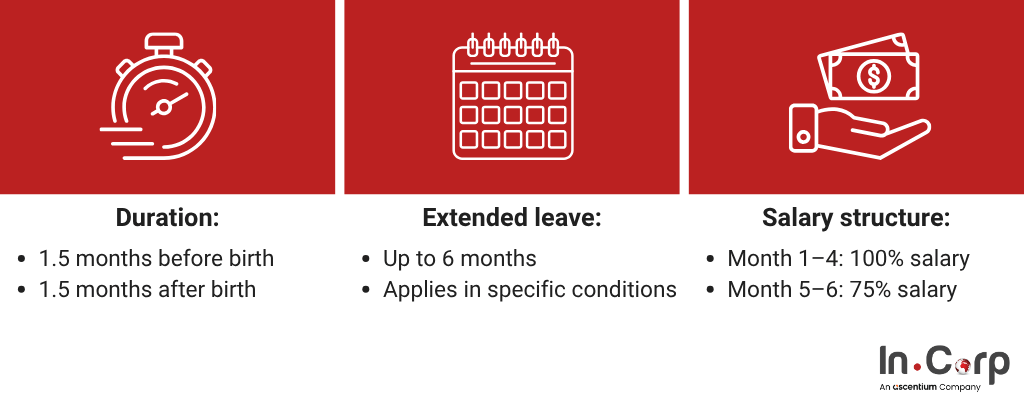
Standard maternity leave duration
Under the Manpower Law, employees are entitled to:
- 3 months of maternity leave:
- 1.5 months before childbirth
- 1.5 months after childbirth
This remains the default structure applied by most companies.
Extended maternity leave
With the introduction of the KIA Law, maternity leave may be extended in certain situations.
- Leave can be extended up to 6 months
- Typically applies in cases such as:
- Medical conditions
- Complications during or after childbirth
In practice, employers need to assess supporting documentation and ensure internal policies can accommodate this extension.
Salary during maternity leave
Salary entitlement depends on the duration of leave:
- First 4 months: 100% salary
- 5th and 6th month (if extended): 75% salary
This creates a shift from the previous approach, in which the standard 3-month leave was fully paid, and there was no structured extension framework.
Employee rights during maternity leave
Employers must uphold employee rights during maternity leave. Issues often arise not from entitlement, but from how it is managed.
Job protection and return to work
Employees on maternity leave are entitled to:
- Protection from termination due to pregnancy or childbirth
- The right to return to their previous position or an equivalent role
In practice, this means employers need to plan to avoid role displacement during the leave period.
Working hours and facilities for pregnant and nursing employees
In practice, how these arrangements are implemented often depends on the company’s internal policies and operational setup. However, employers are generally expected to provide reasonable support for employees before and after childbirth. This may include:
- Adjustments to working conditions, where necessary (e.g., based on medical recommendation)
- Avoidance of hazardous or high-risk tasks for pregnant employees
- Provision of lactation facilities, such as a private and hygienic space
- Time allowance for breastfeeding or pumping during working hours
While implementation levels can vary, these areas are increasingly viewed as part of a company’s broader approach to compliance and employee well-being.
Paternity leave in Indonesia
While maternity leave is more structured, paternity leave in Indonesia remains relatively limited. Even so, it remains regulated and should be considered part of the overall leave framework.
Legal entitlement for fathers
According to the Manpower Law, male employees are entitled to 2 days of paid leave upon the birth of a child. Some companies may choose to provide additional days based on internal policy, particularly in multinational or more progressive workplace environments.
Paternity leave for miscarriage
Paternity leave also applies in the event of a miscarriage, allowing for 2 days of paid leave to support the employee’s spouse. Although this duration is brief, it is an important part of the statutory leave entitlement and should be applied consistently.
Other types of leave in Indonesia
In addition to maternity and paternity leave, employers must also address other statutory leave entitlements. While these are more familiar, they often intersect with workforce planning when employees are already on extended leave.
Annual leave
Annual leave is a basic entitlement for all employees after a certain period of service.
- Minimum 12 days per year after 12 consecutive months of service
- Typically scheduled based on mutual agreement
Sick leave
Sick leave applies when employees are unable to work due to health conditions.
- Granted based on the medical certificate
- Salary is paid, with a decreasing scale depending on the length of absence
Menstrual leave
Menstrual leave is specifically provided for female employees under certain conditions.
- 1–2 days of leave on the first and/or second day of menstruation
- Applies when the employee is unable to work
Marriage and family leave
This type of leave covers specific personal and family-related events.
- Marriage
- Child-related events (e.g., baptism, circumcision)
- Death of family members
Religious leave
Religious leave may be relevant to employees who observe certain obligations.
- May be provided for religious activities (e.g., Hajj)
- Implementation often depends on company policy
Compliance risks when applying maternity leave in practice
Issues around maternity leave often arise not from the absence of policy, but from how it is applied. Misalignment between regulations and internal practices can expose companies to unnecessary risk. Common areas to watch include:
- Incorrect leave duration or structure, particularly when extended maternity leave is involved
- Inaccurate salary payment, especially for longer leave periods
- Overlooking updated regulations, including provisions under the KIA Law
- Lack of workplace support, such as facilities for nursing employees
Even where policies exist, inconsistent implementation can lead to employee disputes or compliance concerns.
Operational considerations when implementing maternity leave
Maternity and paternity leave can impact daily operations if not properly planned. Even standard leave periods may affect workflows and team structure. Key considerations include:
- Workforce planning: Prepare temporary coverage, reallocate tasks, and anticipate extended leave.
- Policy alignment: Ensure local compliance while aligning with global or internal standards.
- Internal communication: Set clear expectations on leave duration, role coverage, and responsibilities.
Payroll Outsourcing in Indonesia: Building Continuity Through Compliance

Simplify workforce management with InCorp
Maternity and paternity leave in Indonesia are clearly regulated, but applying them in practice often requires careful handling. Beyond compliance, companies need to manage payroll, policies, and day-to-day operations consistently.
InCorp Indonesia (an Ascentium Company) offers comprehensive Employer of Record (EOR) services to assist businesses with:
- Ensuring compliance with Indonesian employment regulations and managing contracts
- Administering payroll and managing leave, including maternity and paternity leave
- Offering ongoing HR support throughout the employee lifecycle
Complete the form below to ensure companies maintain compliance while keeping operations running smoothly.
Frequently Asked Questions
How long is maternity leave in Indonesia?
Maternity leave in Indonesia is generally 3 months, consisting of 1.5 months before childbirth and 1.5 months after childbirth.
Can maternity leave be extended in Indonesia?
Yes. Maternity leave can be extended up to 6 months in certain cases, such as medical conditions or childbirth complications.
Is maternity leave fully paid in Indonesia?
Yes, for the first 4 months at 100% salary. If extended, the 5th and 6th months are paid at 75% salary.
What are employee rights during maternity leave in Indonesia?
Employees are protected from termination due to pregnancy and have the right to return to the same or an equivalent position after leave.
How many days of paternity leave are given in Indonesia?
Paternity leave in Indonesia is 2 days of paid leave, including in cases of childbirth or miscarriage.
Get in touch with us.
What you'll get
A prompt response to your inquiry
Knowledge for doing business from local experts
Ongoing support for your business
Disclaimer
The information is provided by PT. Cekindo Business International (“InCorp Indonesia/ we”) for general purpose only and we make no representations or warranties of any kind.
We do not act as an authorized government or non-government provider for official documents and services, which is issued by the Government of the Republic of Indonesia or its appointed officials. We do not promote any official government document or services of the Government of the Republic of Indonesia, including but not limited to, business identifiers, health and welfare assistance programs and benefits, unclaimed tax rebate, electronic travel visa and authorization, passports in this website.