An import permit can complicate import activities in Indonesia. Even when logistics are prepared and documentation appears complete, missing or incorrect permits may delay shipments and disrupt timelines. This is where understanding the structure of import permit requirements in Indonesia becomes important.
In this guide, we will examine the various types of import permits, their application processes, and how companies can approach them more systematically.
What is an import permit in Indonesia?
An import permit is a regulatory approval that allows specific goods to enter Indonesia. It is different from a company’s import license. While an import license (through NIB) establishes a company as an importer, an import permit determines whether a particular product can be imported under certain conditions.
In most cases, import permits are required for goods classified as restricted or regulated (Lartas). Depending on the product, the approval may come from different authorities, such as:
- Ministry of Trade
- National Agency of Drug and Food Control (BPOM)
- Ministry of Health
- Ministry of Agriculture
- Ministry of Industry
Each authority applies its own requirements, timelines, and validation process.
Types of import permits in Indonesia
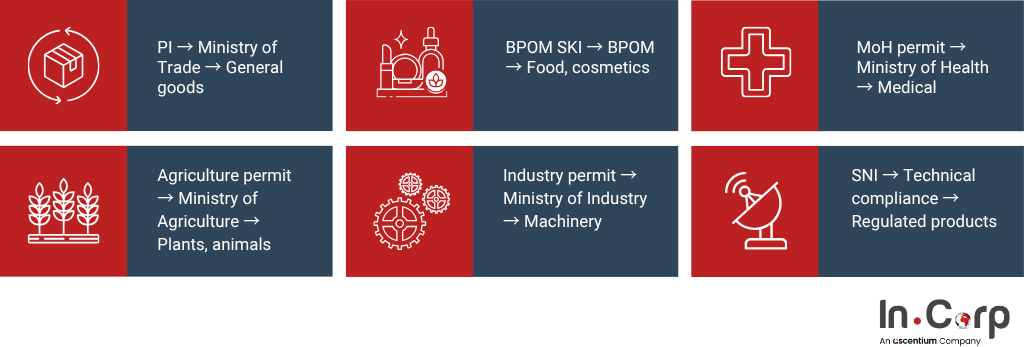
Import permit requirements in Indonesia are not standardized under a single system. Each type of permit is tied to the nature of the goods and the authority overseeing them.
A company may need more than one permit, depending on what is being imported and how it will be used. Below are the main types of import permits commonly encountered:
Persetujuan Impor (PI)
This is one of the most frequently required permits, issued by the Ministry of Trade. It applies to goods categorized as restricted, including certain consumer products and industrial materials. The approval typically defines:
- Type of goods
- Quantity or quota
- Validity period
PI is processed through the Inatrade system and often serves as the initial layer of control for regulated imports.
Import clearance for consumable goods
For products intended for consumption, an additional permit, in the form of an SKI (import clearance) from BPOM, is required. This applies to:
- Food and beverages
- Cosmetics
- Health supplements
Approval is typically granted for each shipment only after the product has been properly registered. Without completing this step, goods cannot proceed through customs clearance.
Ministry of Health import approval
Medical-related products require a separate permit issued by the Ministry of Health. This includes:
- Medical devices
- Pharmaceuticals
Importers must hold the appropriate distribution license, and the product must be registered before importation. The process is more controlled due to the nature of the goods.
Ministry of Agriculture permit
Products derived from animals or plants require agricultural permits. These typically involve:
- Import recommendations
- Quarantine clearance
This layer ensures that imported goods meet health and safety standards before entering Indonesia.
Ministry of Industry technical approval
Certain industrial goods require technical approval for imports. This often applies to:
- Machinery
- Raw materials
- Capital goods
The requirement is commonly associated with companies that import their own production activities.
SNI and technical compliance approvals
For specific product categories, compliance with Indonesian National Standards (SNI) is mandatory. This is not always referred to as an import permit, but in practice, it functions as a precondition for import approval. Products without the required certification may be held or rejected at customs.
Other specific import permits
Additional import permits may apply depending on the product, such as:
- Hazardous materials (B3) approvals
- Telecommunication equipment certification
- Environmental-related permits
These are typically more specialized and assessed on a case-by-case basis.
How import permits work in practice
Import permit requirements are rarely applied in isolation. In most cases, they are part of a layered process that connects company eligibility, product approval, and shipment clearance. At a minimum, the structure typically looks like this:
- Import license (NIB): Establishes the company as a registered importer
- Import permit: Confirms whether specific goods can be imported
- Shipment clearance: Final approval at the time of import (e.g., SKI or customs documents)
Each layer depends on the other. Having one without the others does not complete the process. This means that even with a permit in place, additional approvals may still be required before the goods can enter Indonesia.
Common challenges when managing import permits
Even with a general understanding of import permit requirements, issues often arise during execution. This is usually not due to a lack of permits but to misalignment between the product, classification, and regulatory scope.
Some of the more common challenges include:
- Incorrect HS code classification: A small difference in classification can change the type of import permit required. This often leads to mismatched documentation at customs.
- Overlapping authorities: Certain products fall under the jurisdiction of multiple regulators. Without clear mapping, companies may secure one permit but miss another required approval.
- Multiple approvals for a single product: It is not uncommon for a single product to require multiple permits, especially for regulated goods. Managing timelines across authorities can become complex.
- Regulatory changes and updates: Import requirements may shift depending on policy adjustments, affecting permit validity or application procedures.
These challenges surface at later stages, when goods are already in transit or have arrived. At that point, resolving permit issues can lead to delays, additional costs, or reprocessing.
Clear Paths to Product Registration in Indonesia
Manage import permit requirements with InCorp
Navigating import permit requirements can be complex, especially when multiple approvals apply to a single product. A structured approach helps ensure that each requirement is identified early and aligned properly.
InCorp Indonesia (an Ascentium Company) supports companies through a comprehensive approach to import permit requirements by providing:
- Import permit assessment based on product and HS code
- Identification of Lartas and regulatory requirements
- Coordination with relevant authorities
- Support for product registration and technical approvals
- End-to-end guidance to align import documentation and compliance
Fill out the form below to proceed with a more structured, well-prepared import process.
Frequently Asked Questions
What is an import permit in Indonesia?
An import permit is a regulatory approval that allows specific goods to enter Indonesia, separate from a company’s import license (NIB).
Is an import permit different from an import license (NIB)?
Yes. An import license (NIB) registers a company as an importer, while an import permit determines whether a specific product can be imported.
When is an import permit required in Indonesia?
An import permit is typically required for restricted or regulated goods (Lartas), depending on the product classification and applicable regulations.
Which authorities issue import permits in Indonesia?
Import permits may be issued by different authorities, including the Ministry of Trade, BPOM, Ministry of Health, Ministry of Agriculture, and Ministry of Industry.
Can one product require multiple import permits?
Yes. A single product may require multiple permits if it falls under different regulatory authorities or compliance requirements.
Get in touch with us.
What you'll get
A prompt response to your inquiry
Knowledge for doing business from local experts
Ongoing support for your business
Disclaimer
The information is provided by PT. Cekindo Business International (“InCorp Indonesia/ we”) for general purpose only and we make no representations or warranties of any kind.
We do not act as an authorized government or non-government provider for official documents and services, which is issued by the Government of the Republic of Indonesia or its appointed officials. We do not promote any official government document or services of the Government of the Republic of Indonesia, including but not limited to, business identifiers, health and welfare assistance programs and benefits, unclaimed tax rebate, electronic travel visa and authorization, passports in this website.

Verified by
Hotdo Nauli
Senior Legal & Delivery Manager at InCorp Indonesia
Hotdo heads the Legal and Delivery team at InCorp Indonesia, managing Product Registration, Legal Advisory, and Business Licensing. With over 8 years of experience, she focuses on compliance and integrity, ensuring all client operations align with Indonesian laws and regulatory standards, including contract reviews and sector-specific licenses. She is also a licensed advocate and a member of the Indonesian Advocates Association (PERADI).