
Most foreign investors notice PT PMA requirements only when something delays the setup process, such as an incorrect KBLI code, capital issues, or an Investor KITAS rejection. PT PMA setup is now governed by BKPM Regulation No. 5 of 2025 and Government Regulation No. 28 of 2025 on risk-based licensing. The company’s structure still complies with Law No. 40 of 2007 on Limited Liability Companies.
To establish a PT PMA in Indonesia, foreign investors generally need at least two shareholders, IDR 2.5 billion in paid-up capital (a 75% reduction from the previous IDR 10 billion requirement), one director, one commissioner, a registered commercial address, and a notarized Deed of Incorporation. Registration is done through the OSS-RBA system and usually takes around 4–8 weeks.
PT PMA requirements at a glance
| Requirement | Detail |
| Shareholders | Minimum 2 (individuals or companies, any nationality) |
| Paid-Up Capital | IDR 2.5 billion |
| Total Investment Plan | Over IDR 10 billion per 5-digit KBLI code, per location |
| Capital Lock-Up | 12 months (unless spent on operations or assets) |
| Board | Minimum 1 director + 1 commissioner |
| Business Address | Commercial/office only (residential not allowed) |
| Licensing | NIB + risk-based licenses via OSS-RBA |
| Setup Time | 4–8 weeks |
| Governing Rules | Law No. 40/2007; BKPM Reg. 5/2025; GR 28/2025 |
What is a PT PMA?
A PT PMA (Penanaman Modal Asing) is an Indonesian limited liability company with foreign ownership. Even 1 foreign-owned share is enough to classify a company as a PT PMA. This structure allows foreign investors to operate legally in Indonesia, issue local invoices, generate revenue, hire employees, and enter into contracts.
Can foreigners own 100% of a PT PMA?
Foreign ownership depends on the company’s business sector under Indonesia’s Positive Investment List. In general, sectors may fall into three categories:
| Sector Category | Foreign Ownership Rule |
| Open Sectors | Up to 100% foreign ownership |
| Partially Restricted Sectors | Foreign ownership is capped, often requiring a local partner |
| Closed Sectors | Foreign investment is not allowed |
Since ownership limits are linked to the company’s KBLI business classification, investors should review the KBLI and ownership structure together before preparing the Deed of Incorporation.
PT PMA capital requirements under BKPM Regulation No. 5/2025
BKPM Regulation No. 5/2025 reduced the minimum paid-up capital requirements for PT PMA but did not remove other investment and structuring requirements. Foreign investors still need to understand how paid-up capital, total investment value, and Investor KITAS eligibility work under the updated rules.
Capital and investment value
Under BKPM Regulation No. 5/2025, the minimum paid-up capital for PT PMA requirements is now IDR 2.5 billion. However, the total investment plan must still exceed IDR 10 billion for each 5-digit KBLI code and project location. This amount generally excludes land and buildings, except for property and certain asset-heavy sectors.
12-month capital lock-up
Paid-up capital cannot be withdrawn within the first 12 months unless used for valid operational needs or capital expenses. This means investors should prepare the capital with proper cash flow planning, not only for incorporation purposes.
Separate Investor KITAS
The lower paid-up capital requirement does not automatically change Investor KITAS eligibility. To qualify for an Investor KITAS, an individual investor must still hold shares valued at IDR 10 billion. This distinction is important because a misunderstanding can lead to an immigration application being rejected.
How to register a PT PMA in Indonesia
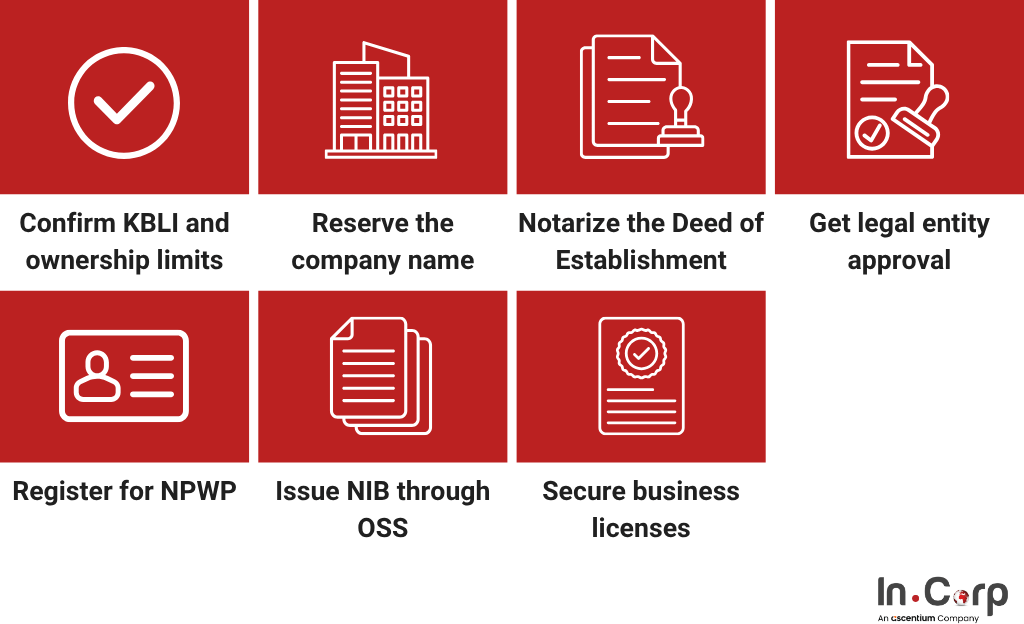
PT PMA registration is processed through the OSS-RBA system. Before applying, foreign investors should ensure that the company’s structure, business activities, and licensing plan are aligned with the latest PT PMA requirements. The process generally includes:
- Confirm the correct KBLI classification and foreign ownership limits.
- Reserve a company name with at least three words.
- Prepare and notarize the Deed of Establishment.
- Obtain legal entity approval from the Ministry of Law.
- Register for a company tax ID, or NPWP.
- Issue the NIB through the OSS system.
- Secure the required risk-based business licenses in accordance with the company’s KBLI and risk level.
Common pitfalls that can delay PT PMA setup in Indonesia
PT PMA registration may seem straightforward, but small mistakes in the early stages can delay the entire process. Many issues arise from choosing the wrong business classification, misunderstanding capital rules, or failing to meet post-incorporation obligations.
Common pitfalls include:
- Wrong KBLI code: Choosing the wrong KBLI is one of the most common reasons applications are rejected or require re-filing.
- Confusing capital requirements: Paid-up capital and total investment plan are different requirements. Treating them as one number can create compliance issues.
- Ignoring the Investor KITAS threshold: The lower paid-up capital requirement does not automatically qualify an investor for an Investor KITAS. Each investor must still meet the required share value threshold.
- Using a residential address: PT PMA requirements must use a registered commercial address. Residential addresses generally do not qualify for company registration.
- Missing LKPM reports: PT PMA companies must submit LKPM reports regularly. Missing these reports can affect compliance monitoring.
Still unsure how PT PMA requirements apply to your business?
InCorp Indonesia can help review your KBLI, capital structure, licensing requirements, and reporting obligations so your PT PMA setup gets off to the right start. Talk to our team ->
Are there other options besides PT PMA?
Yes. Foreign investors do not always need to establish a PT PMA from the start. If the goal is still to explore the Indonesian market, a Representative Office (RO) may be an alternative. However, it comes with important limitations, as it cannot generate revenue or engage in full commercial activities.
PT PMA vs Representative Office
| Factor | PT PMA | Representative Office |
| Revenue | Allowed | Not allowed |
| Activities | Full operations | Liaison & research |
| Hiring | Allowed | Limited |
| Scalability | High | Limited |
A PT PMA is the right structure for foreign investors who want to operate commercially, issue invoices, hire employees, sign contracts, and generate revenue in Indonesia. A Representative Office is more suitable for early-stage market exploration before deciding whether to establish a full legal entity.
Ongoing compliance after PT PMA setup
Once registered, a PT PMA must continue meeting several compliance obligations, including:
- LKPM reporting: Submit quarterly investment activity reports to BKPM.
- Tax reporting: File monthly and annual tax reports through Coretax.
- Accounting records: Maintain records in accordance with Indonesian standards.
- License renewal: Renew sector-specific business licenses before they expire.
- Corporate updates: Report any changes to directors, shareholders, or registered address through OSS.
Guide to Doing Business in Jakarta

Get your PT PMA structure right from the start
Setting up a PT PMA is not only about incorporation. The right KBLI code, capital structure, and Investor KITAS planning must be aligned from the beginning to avoid costly amendments later.
With InCorp Indonesia (an Ascentium Company), you can get support for:
- KBLI classification review to match your business activities with the right license
- Capital structure planning to align paid-up capital, investment value, and shareholder composition
- Notary and incorporation process for the Deed of Establishment and legal entity approval
- NIB and OSS-RBA licensing based on your business risk level
- Investor KITAS guidance to support eligible foreign shareholders
- Post-setup compliance, including LKPM, tax, and corporate reporting obligations
Book a free PT PMA consultation and have your business structure mapped to the latest requirements on your first call.
Frequently Asked Questions
What are the main PT PMA requirements in Indonesia?
To establish a PT PMA in Indonesia, foreign investors generally need at least two shareholders, IDR 2.5 billion in paid-up capital, one director, one commissioner, a commercial registered address, a notarized Deed of Establishment, and OSS-RBA licensing based on the company’s KBLI and risk level.
What is the minimum paid-up capital for a PT PMA in 2026?
The minimum paid-up capital for a PT PMA is IDR 2.5 billion under BKPM Regulation No. 5 of 2025. However, the total investment plan must still exceed IDR 10 billion per 5-digit KBLI code per project location.
Can foreigners own 100% of a PT PMA in Indonesia?
Yes, foreigners can own up to 100% of a PT PMA in sectors that are fully open under Indonesia’s Positive Investment List. In partially restricted sectors, foreign ownership is capped and may require a local Indonesian partner.
How long does PT PMA registration take in Indonesia?
PT PMA registration usually takes around 4–8 weeks, depending on KBLI classification, ownership structure, capital readiness, document preparation, OSS-RBA licensing, and sector-specific approval requirements.
What are common mistakes that delay PT PMA setup?
Common PT PMA setup delays are caused by incorrect KBLI selection, misunderstanding paid-up capital versus total investment value, using a residential address, missing Investor KITAS requirements, and overlooking LKPM reporting obligations after incorporation.
Get in touch with us.
What you'll get
A prompt response to your inquiry
Knowledge for doing business from local experts
Ongoing support for your business
Disclaimer
The information is provided by PT. Cekindo Business International (“InCorp Indonesia/ we”) for general purpose only and we make no representations or warranties of any kind.
We do not act as an authorized government or non-government provider for official documents and services, which is issued by the Government of the Republic of Indonesia or its appointed officials. We do not promote any official government document or services of the Government of the Republic of Indonesia, including but not limited to, business identifiers, health and welfare assistance programs and benefits, unclaimed tax rebate, electronic travel visa and authorization, passports in this website.

Verified by
Ales Cina
Consulting Manager at InCorp Indonesia
Aleš manages solution delivery at InCorp Indonesia, optimizing incorporation processes and client relationships. His experience in internal auditing, retail, and sales offers valuable global insights. Aleš, with a degree in Economics and Finance from the Czech Republic, helps clients navigate cross-border business challenges, focusing on cultural and legal insights.