Indonesia’s semiconductor manufacturing market reached USD 5.08 billion in 2025 and is forecast to grow to USD 7.07 billion by 2030, while a USD 26.7 billion manufacturing hub is taking shape in Batam. For manufacturers, this points to both strong market potential and the need for a clear entry strategy.
This guide highlights the main factors to consider when entering Indonesia’s semiconductor manufacturing market, including site selection, government incentives, legal setup, and operational readiness.
Key Takeaways
- Indonesia’s semiconductor market is growing and is expected to reach USD 7.07 billion by 2030.
- Batam is becoming Indonesia’s main semiconductor hub because of its FTZ benefits, Singapore’s proximity, and large manufacturing projects.
- Indonesia has opportunities in raw material processing, chip assembly, packaging, and chip design.
- Foreign investors need a PT PMA, OSS-RBA licensing, environmental approval, and import compliance to set up a semiconductor factory.
- Before entering Indonesia, semiconductor companies should check the location, incentives, talent supply, permits, and ongoing reporting requirements.
Why is Indonesia a strategic location for semiconductor manufacturing?
Indonesia is no longer just a future destination for semiconductor manufacturing. It is already attracting investment. The country has around 27 billion tons of quartz sand, a key material for silicon wafers, giving it a strong ASEAN advantage. This is supported by a growing electronics market, downstreaming policies, and a more active investment pipeline.
Global recognition is also increasing. The United States has identified Indonesia as a potential semiconductor hub under the CHIPS and Science Act, and Indonesia is one of seven priority countries in the IPEF. Arm Holdings has partnered with the Indonesian government on a USD 125 million initiative, while Samsung, Intel, NXP, and Texas Instruments already have a presence in the market.
Demand is rising as well. Indonesia’s digital economy is expected to reach USD 600 billion by 2030, driven by AI, EV growth, and IoT adoption across a population of more than 270 million.
Where does Indonesia fit in the semiconductor manufacturing value chain?
Indonesia offers growing opportunities across the semiconductor manufacturing value chain, but investors should align their strategies with the country’s current stage of development.
Upstream: Raw material processing
Indonesia is pushing downstreaming to add value locally. With 27 billion tons of quartz sand and nickel reserves, it aims to build onshore silicon wafer capabilities by 2035. Kalimantan is especially relevant for silica-based upstream investment.
Midstream: Assembly, test & packaging
Indonesia’s strongest position today is in OSAT and automotive semiconductor demand. Back-end fabs, SMT lines, and advanced packaging are among the most realistic growth areas for new investment.
Downstream: Chip design and AI semiconductors
Indonesia is also building its downstream ecosystem through chip design and AI-focused initiatives. The ITB SEZ, Nongsa AI Data Center, BRIN’s Photonics Research Center, and Solo AI Center are all helping develop this part of the market.
Where should you build semiconductor manufacturing facilities in Indonesia?
Indonesia’s semiconductor ecosystem is concentrated in several key regions, each with different strengths in power, logistics, talent, and cost.
Batam & Galang Island
Batam is Indonesia’s most active semiconductor hub, backed by a USD 26.7 billion consortium project, Apple’s USD 150 million AirTag plant, and Asia’s first semiconductor R&D center. The Free Trade Zone status and proximity to Singapore are major advantages, although permit delays remain a concern.
Greater Jakarta & Java Corridor
Java remains Indonesia’s most established industrial base, with 35 operational data centers in Greater Jakarta. It offers strong logistics, reliable power, and a deep pool of talent, though land and labor costs are higher.
East Java
East Java hosts the region’s first digital substation by Hitachi Energy, improving grid reliability for back-end fabs. With strong sea access through Surabaya Port and lower labor costs than Jakarta, it is becoming a stronger industrial option.
Central Java
Central Java gained more attention in 2025 with the launch of the Solo AI Center. It offers the lowest labor costs among major Java hubs and is well-suited for smaller back-end or sensor assembly operations. However, its specialized ecosystem is less mature than Jakarta’s.
Kalimantan
Kalimantan is important for upstream investment, especially in quartz sand and silica processing. Its main limitation is inconsistent grid reliability outside major cities, making backup power essential.
Sulawesi (Morowali)
Morowali Industrial Park supports battery precursor production and creates demand for power semiconductors tied to EV and energy storage supply chains. It is promising for heavy industry-linked semiconductor investment, but less suited for precision operations.
Government incentives for semiconductor factory setup
Indonesia has layered multiple incentive mechanisms specifically designed to attract advanced manufacturing, including semiconductor operations.
| Incentive | Coverage | Condition |
| Tax Holiday | 5–20 year CIT exemption | Minimum investment applies |
| Import Duty Exemption | Duty and VAT exemption for production imports | Master List and HS code accuracy required |
| Batam FTZ | Duty-free, VAT-free, simpler customs | Special rules for goods leaving FTZ |
| Arm Partnership | USD 125M for design, training, and infrastructure | Focused on the design-stage ecosystem |
| IPEF / CHIPS Alignment | US support for skills, tech transfer, investment | Indonesia is a priority country |
| Silica Downstreaming | Incentive for local silica processing | Supports upstream investment |
| OSS-RBA | Simpler risk-based licensing | Depends on the business risk class |
| Blue Book Funding | USD 16.185M for ecosystem development | Covers R&D and talent programs |
How do you set up a semiconductor factory in Indonesia?
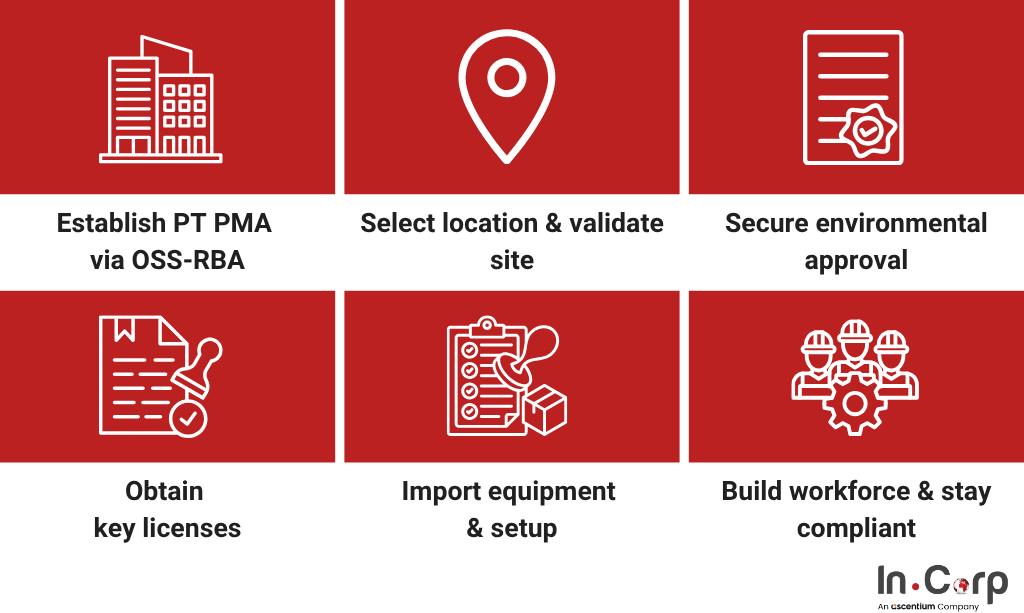
Foreign investors must establish a PT PMA via OSS-RBA, in accordance with BKPM Regulation No. 5 of 2025, which now requires a minimum paid-up capital of IDR 2.5 billion (~USD 160,000). Including detailed steps, such as registering through OSS-RBA and following BKPM procedures, can help investors understand the process in detail and avoid delays.
Here is the current process for establishing your semiconductor factory, providing a clear pathway that can help you navigate Indonesia’s regulatory landscape with confidence.
- Establish PT PMA via OSS-RBA: Set up your legal entity and secure core registrations (KBLI, NIB, tax access).
- Select location & validate site: Choose the right industrial area and confirm zoning, utilities, and FTZ status (if applicable).
- Secure environmental approval: Obtain AMDAL or UKL-UPL before construction and operations.
- Obtain key licenses: Apply for the IUI, PBG, and SLF permits through OSS to operate.
- Import equipment & setup: Manage the import process, including HS code classification, to ensure smooth customs clearance.
- Build workforce & stay compliant: Handle hiring, permits, and ongoing reporting requirements (LKPM reporting, annual tax filings, BPJS, and transfer pricing compliance).
What should semiconductor companies consider before entering Indonesia?
When entering the semiconductor industry, new companies must consider several key operational factors to ensure successful integration and growth.
Layered permit system
Semiconductor manufacturing setup involves PT PMA registration, environmental permits, industrial licensing, building approvals, and potentially hazardous materials permits, each with its own timelines and agencies.
Talent shortage in microelectronics
Specialized engineers in semiconductor process technology, cleanroom operations, and chip design remain in short supply. Strategic HR planning, expatriate management, and university partnerships are necessary.
Import compliance complexity
Semiconductor production equipment and chemical materials require precise HS code classification. Errors in documentation cause costly customs delays and may affect eligibility for duty exemptions.
Ongoing compliance reporting
LKPM investment reports, annual financial audits, workforce reporting, and environmental compliance monitoring create ongoing administrative obligations that require dedicated local management.
Guide to Doing Business in Jakarta
Set up your semiconductor manufacturing operation with InCorp
InCorp Indonesia (an Ascentium Company) has assisted manufacturing companies in navigating Indonesia’s regulatory environment. Our team handles all requirements from PT PMA establishment to ongoing compliance.
- PT PMA registration & structuring
- Environmental permits (AMDAL / UKL-UPL)
- Industrial business license (IUI)
- Import permits & HS Code classification
- Workforce planning & EOR
- Ongoing compliance & LKPM reporting
Ready to enter Indonesia’s semiconductor market? Fill out the form below, and our team will handle licensing, permits, HR, and import compliance so that you can focus on production.
Frequently Asked Questions
Why is Indonesia a strategic location for semiconductor manufacturing?
Indonesia is strategic for semiconductor manufacturing because it has large quartz sand reserves, a growing electronics market, downstreaming policies, and increasing global recognition as a potential semiconductor hub. The country also benefits from rising demand driven by AI, EVs, IoT, and digital economy growth.
Where does Indonesia fit in the semiconductor value chain?
Indonesia has opportunities across the semiconductor value chain, including upstream raw material processing, midstream assembly, testing and packaging, and downstream chip design and AI semiconductor development. Its strongest current position is in OSAT, automotive semiconductors, and back-end manufacturing.
What are the best locations for semiconductor manufacturing in Indonesia?
Key locations include Batam and Galang Island for semiconductor hubs and FTZ benefits, Greater Jakarta and Java for industrial infrastructure and talent, East Java for logistics and grid reliability, Central Java for lower labor costs, Kalimantan for silica processing, and Morowali for EV-linked semiconductor demand.
What incentives are available for semiconductor factory setup in Indonesia?
Semiconductor investors in Indonesia may access incentives such as tax holidays, import duty exemptions, Batam Free Trade Zone benefits, OSS-RBA licensing support, silica downstreaming incentives, and ecosystem development funding. Eligibility depends on investment size, location, product classification, and compliance requirements.
How can foreign investors set up a semiconductor factory in Indonesia?
Foreign investors generally need to establish a PT PMA through OSS-RBA, select and validate an industrial site, secure environmental approvals, obtain industrial and building permits, manage equipment import compliance, and maintain ongoing obligations such as LKPM, tax, BPJS, and transfer pricing reporting.
Get in touch with us.
What you'll get
A prompt response to your inquiry
Knowledge for doing business from local experts
Ongoing support for your business
Disclaimer
The information is provided by PT. Cekindo Business International (“InCorp Indonesia/ we”) for general purpose only and we make no representations or warranties of any kind.
We do not act as an authorized government or non-government provider for official documents and services, which is issued by the Government of the Republic of Indonesia or its appointed officials. We do not promote any official government document or services of the Government of the Republic of Indonesia, including but not limited to, business identifiers, health and welfare assistance programs and benefits, unclaimed tax rebate, electronic travel visa and authorization, passports in this website.

Verified by
Ales Cina
Consulting Manager at InCorp Indonesia
Aleš manages solution delivery at InCorp Indonesia, optimizing incorporation processes and client relationships. His experience in internal auditing, retail, and sales offers valuable global insights. Aleš, with a degree in Economics and Finance from the Czech Republic, helps clients navigate cross-border business challenges, focusing on cultural and legal insights.