SMK3, or Sistem Manajemen Keselamatan dan Kesehatan Kerja, is Indonesia’s mandatory occupational health and safety management system, under Government Regulation No. 50 of 2012.
The system is assessed through an official audit conducted by the Ministry of Manpower, with the certification valid for 3 years. Non-compliance can lead to permit revocation and personal liability for company officers.
For high-risk sectors, demonstrating SMK3 readiness demonstrates your commitment to workplace safety and builds trust and confidence in your operations.
Key Takeaways
- SMK3 is mandatory under PP No. 50 of 2012 for companies with high-risk operations.
- High-risk operations include mining, oil and gas, construction, manufacturing, and other sectors with significant workplace safety risks.
- SMK3 compliance is assessed through 12 audit elements and up to 166 criteria across three certification tiers.
- The SMK3 certificate is issued by the Ministry of Manpower and is valid for 3 years.
- ISO 45001 does not replace SMK3 because they operate under different legal frameworks and must be maintained separately.
Who must comply with SMK3 in heavy industries?
SMK3 is especially important for heavy industries because many operations are considered high-risk, regardless of company size. This includes work involving heavy equipment, production facilities, construction sites, hazardous materials, logistics yards, and contractor activities.
| Company Type | Why It Applies | Examples |
| Large Industrial Employers | Required if they have 100 or more employees | Manufacturing plants, warehouses, logistics operators |
| High-Risk Operations | Required even with fewer than 100 employees | Mining, oil and gas, chemicals, construction, energy |
| Principal Contractors | Expected to manage site safety and subcontractor risk | EPC, construction, industrial project operators |
| Subcontractors | Often required before site access or project mobilization | Maintenance, installation, and equipment service providers |
| Foreign-Owned Companies | PT PMA companies follow the same rules | Foreign manufacturers, mining service companies, logistics operators |
| Tender Participants | Often required for project or vendor pre-qualification | SOE projects, construction tenders, industrial contracts |
Heavy industry companies should review their SMK3 obligations early, especially before tenders, site mobilization, client audits, or operational expansion.
What is SMK3?
SMK3 was introduced through PP No. 50 of 2012, replacing the earlier Permenaker No. 5 of 1996, and is supervised by the Directorate of Occupational Safety and Health Supervision under the Ministry of Manpower.
The system aims to:
- Prevent workplace accidents and occupational diseases
- Protect workers, contractors, and assets
- Build safer, more efficient, and more productive workplaces
- Demonstrate legal compliance to regulators, clients, and investors
The five elements of SMK3
Under PP No. 50 of 2012, every covered company must build its SMK3 around five core elements.
- K3 policy: Written commitment signed by top management, communicated to all workers.
- K3 planning: Hazard identification, risk assessment, legal register, and measurable safety objectives.
- Implementation: SOPs, worker training, emergency response, PPE, communication, and operational controls.
- Monitoring & evaluation: Inspections, incident reporting, performance metrics, and internal audits.
- Management review & improvement: Periodic review by leadership and corrective action.
These five elements are assessed during the external audit against 12 audit elements, which break down into 64, 122, or 166 criteria, depending on the certification tier.
SMK3 certification levels and grading
SMK3 certification is assessed based on the number of audit criteria applied to the company.
| Certification Level | Audit Criteria | Suitable For |
| Initial Level | 64 | Small to medium operations, first-time applicants, or companies with a low to medium risk profile |
| Transition Level | 122 | Mid-sized companies with developing HSE systems |
| Advanced Level | 166 | Large-scale operations, high-risk sectors, or companies with mature HSE systems |
How grading works
The final assessment is based on the percentage of criteria fulfilled during the external audit:
- 0–59%: Failed; corrective action required, re-audit needed
- 60–84%: Good (Tingkat Penilaian Baik)
- 85–100%: Excellent (Tingkat Penilaian Memuaskan)
Major non-conformities can disqualify a company regardless of the percentage score.
What happens if a company does not comply with SMK3?
Under Article 190 of Law No. 13 of 2003 and Permenaker No. 26 of 2014, the Ministry of Manpower may impose escalating administrative sanctions:
- Written warning
- Restriction of business activities
- Suspension of business activities
- Suspension of part or all production equipment
- Cancellation of registration
- Revocation of business permits
Where a workplace incident results in serious injury or death, company officers may face personal criminal liability under Law No. 1 of 1970, in addition to corporate penalties.
How to implement and prepare for SMK3 certification
SMK3 should be approached as an operational system rather than a one-time certification project. For high-risk sectors, preparation should include both documentation and field implementation.
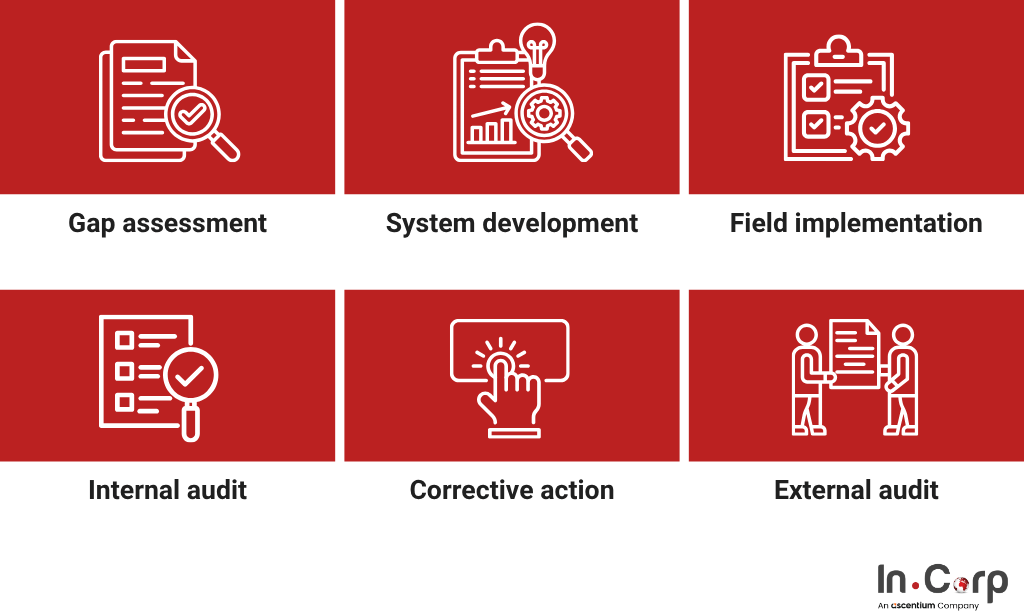
- Gap assessment: Benchmark existing K3 practices against the applicable 64 / 122 / 166 audit criteria.
- System development: Draft K3 policy, risk register, SOPs, emergency procedures, and reporting workflows.
- Field implementation: Conduct worker training, safety briefings, inspections, and contractor onboarding.
- Internal audit: Identify gaps before the external assessment.
- Corrective action: Close findings with documented evidence.
- External audit: Audit conducted by an Appointed Audit Institution (Lembaga Audit), typically taking 1–10 days depending on company size and risk profile.
The full certification is valid for 3 years, with surveillance audits during the cycle and re-certification required before expiry.
SMK3 vs ISO 45001: What’s the difference?
Both standards focus on occupational health and safety, but they are legally and operationally distinct.
| Aspect | SMK3 | ISO 45001 |
| Status | Mandatory under Indonesian law | Voluntary international standard |
| Issuing Authority | Ministry of Manpower | Accredited certification bodies |
| Legal Basis | PP No. 50 of 2012; Permenaker No. 26 of 2014 | ISO standard |
| Validity | 3 years | 3 years |
| Audit Basis | 64 / 122 / 166 criteria across 12 elements | Clause-based framework |
| Recognition | Required for Indonesian tenders, inspections, and licensing | Recognized internationally for client and investor due diligence |
Companies with ISO 45001 may find some documentation and risk management processes supportive of SMK3, but they still need to conduct a separate SMK3 audit to ensure full compliance with Indonesian regulations.
How SMK3 strengthens ESG and operational governance
A well-implemented SMK3 system strengthens ESG reporting by establishing the records, controls, and accountability needed to support sustainability reporting and due diligence.
This is especially relevant for occupational health and safety disclosures, including GRI 403. Through SMK3, companies can build stronger evidence for:
- Worker safety performance metrics
- Incident and corrective action tracking
- Contractor governance
- Internal control and risk management
- Client audit and investor due diligence readiness
For listed companies, multinationals, and businesses tendering with state-owned enterprises, SMK3 offers dual value. It helps meet legal requirements while also strengthening the ESG evidence companies need to demonstrate responsible, well-managed operations.
Guide to Doing Business in Jakarta
Strengthen workplace safety compliance in Indonesia
SMK3 readiness is easier to manage when preparation starts early rather than when an audit or tender deadline approaches. Early preparation helps reduce audit findings, improve documentation quality, and ensure your workplace safety system is properly aligned with regulatory expectations.
InCorp Indonesia (an Ascentium Company) supports businesses with:
- Business Licensing: Regulatory review, compliance readiness, audit coordination, and operational compliance support.
- ESG Advisory: SMK3 preparation, SOP and documentation support, training readiness, contractor safety alignment, and ESG reporting support.
Prepare your workforce for compliance with the right support by filling out the form below.
Frequently Asked Questions
What is SMK3 in Indonesia?
SMK3 (Sistem Manajemen Keselamatan dan Kesehatan Kerja) is Indonesia's mandatory occupational health and safety management system, regulated under PP No. 50 of 2012. It requires covered companies to design, implement, and maintain a structured workplace safety system.
Who must comply with SMK3?
SMK3 is mandatory for companies with at least 100 employees or those operating in high-risk sectors such as mining, oil & gas, construction, manufacturing, energy, and logistics. The obligation applies equally to local and foreign-owned (PT PMA) companies.
What happens if a company does not comply with SMK3?
Sanctions range from written warnings to business suspension, equipment shutdown, registration cancellation, and permit revocation. In serious workplace incidents, company officers may face personal criminal liability under Law No. 1 of 1970.
How long does SMK3 certification take?
The preparation timeline varies between three and twelve months, depending on operational complexity, workforce size, number of sites, and existing HSE maturity. The external audit itself typically takes 1–10 days.
What is the difference between SMK3 and ISO 45001?
SMK3 is mandatory under Indonesian law and is issued by the Ministry of Manpower. ISO 45001 is a voluntary international standard issued by accredited certification bodies. Having ISO 45001 does not exempt a company from SMK3.
How long is an SMK3 certificate valid?
SMK3 certificates are valid for three years, with surveillance audits during the cycle. Re-certification is required before expiry.
What are the three SMK3 certification tiers?
Initial (64 criteria), Transition (122 criteria), and Advanced (166 criteria). Companies choose a tier based on size, complexity, and operational risk.
Get in touch with us.
What you'll get
A prompt response to your inquiry
Knowledge for doing business from local experts
Ongoing support for your business
Disclaimer
The information is provided by PT. Cekindo Business International (“InCorp Indonesia/ we”) for general purpose only and we make no representations or warranties of any kind.
We do not act as an authorized government or non-government provider for official documents and services, which is issued by the Government of the Republic of Indonesia or its appointed officials. We do not promote any official government document or services of the Government of the Republic of Indonesia, including but not limited to, business identifiers, health and welfare assistance programs and benefits, unclaimed tax rebate, electronic travel visa and authorization, passports in this website.

Verified by
Ales Cina
Consulting Manager at InCorp Indonesia
Aleš manages solution delivery at InCorp Indonesia, optimizing incorporation processes and client relationships. His experience in internal auditing, retail, and sales offers valuable global insights. Aleš, with a degree in Economics and Finance from the Czech Republic, helps clients navigate cross-border business challenges, focusing on cultural and legal insights.