For mining companies entering or expanding in Indonesia, SMKP is the compliance foundation that builds stakeholder trust, gains operational approvals, shapes RKAB’s credibility with ESDM, and is the first thing international investors examine when assessing a mining operation’s ESG standing.
Getting it right the first time by accurately defining the scope, implementing effectively, and passing audits without issues are essential steps that drive a business’s success beyond mere administration.
What is SMKP in Indonesia?
SMKP (Sistem Manajemen Keselamatan Pertambangan) is Indonesia’s mandatory mining safety management system, established under Permen ESDM No. 26/2018 and regulated by the Ministry of Energy and Mineral Resources (ESDM).
It requires all IUP holders, IUPK holders, mining contractors, and supporting mining service companies operating in Indonesia to implement, document, and certify a structured occupational safety management system.
SMKP is not an HSE policy document but a management system in operation. ESDM-authorized auditors assess its effectiveness at the site level, rather than just its existence on paper at the head office.
A compliant SMKP must demonstrate:
- A structured risk management framework matched to actual operational activities.
- Standard operating procedures (SOPs) in active use, with evidence of training.
- Competency frameworks for employees and contractors, verifiable by documentation.
- Ongoing monitoring, evaluation, and corrective action cycles
- Emergency response systems that have been tested and can be verified.
The distinction that determines audit outcomes is between a system that exists and a system that functions. Most initial audit failures can be traced directly to this gap.
Is SMKP mandatory for all mining operations?
Yes, SMKP is mandatory for mining companies operating in Indonesia. SMKP applies to:
- IUP (Izin Usaha Pertambangan) holders: The primary mining license
- IUPK (Izin Usaha Pertambangan Khusus) holders: Special mining business permits
- Mining contractors operating under IUP/IUPK license holders
- Supporting mining service companies providing technical services to mining operations
SMKP’s responsibility cannot be transferred to a contractor. The IUP or IUPK holder is fully and non-transferably liable for compliance. If a contractor’s safety integration is deficient, the license holder is the party exposed to regulatory action, operational suspension, and sanctions.
This influences how contractor relationships are structured. License holders must actively include contractors in their Safety Management and Knowledge Programs (SMKP) by assessing their performance, training them, documenting compliance, and auditing safety practices.
What are the processes for obtaining SMKP certification?
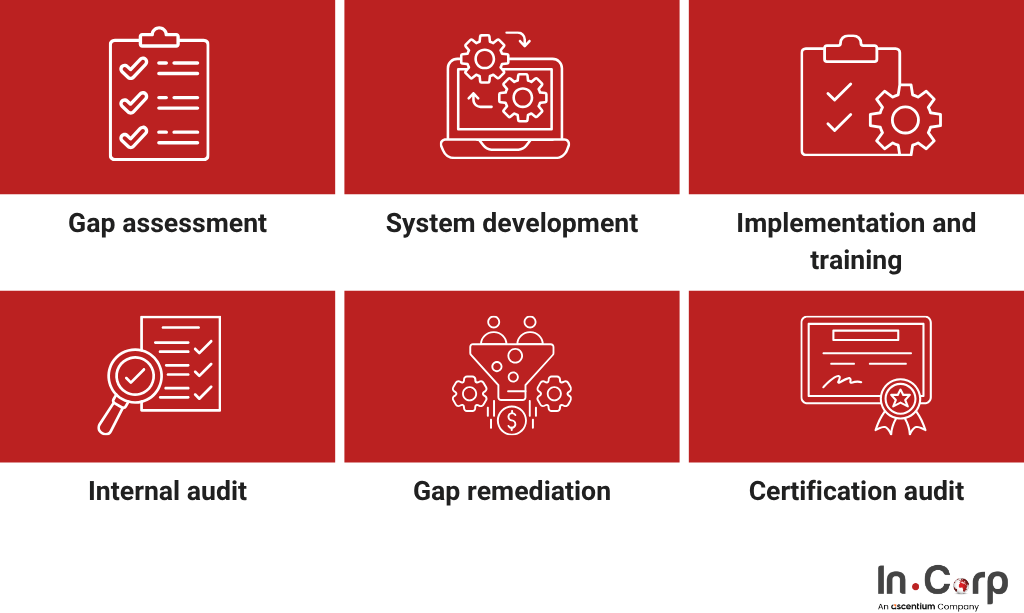
In practice, obtaining SMKP requires a structured approach, not only in preparing documents but also in executing the necessary steps. Here are some key points to consider:
Gap assessment
A thorough review of your HSE systems against the full SMKP requirements is crucial. This assessment helps you feel prepared and confident, reducing future complications and ensuring realistic implementation timelines.
System development
The core design work involves creating safety policies, risk frameworks, standard operating procedures (SOPs), and emergency response protocols. For companies entering Indonesia with existing safety systems, the focus is on adapting them to meet local regulatory requirements rather than replacing them entirely. The result should be a tailored safety system for your operations, not a generic template.
Implementation and training
Most delays stem from this issue. The system must be actively used, and workers and contractors need proper training and assessments. Maintaining accurate records, like training logs and corrective actions, helps you feel in control and ready for audits. If an auditor asks a site supervisor about an emergency procedure and receives no response, it highlights a gap that needs to be addressed.
Internal audit
A thorough internal audit serves two key purposes: it identifies nonconformities before external evaluations and promotes a culture of accountability among management. Companies that treat internal audits as mere practice often discover their real gaps at the worst possible moments.
Gap remediation
Internal audit actions were documented and closed, and their thoroughness directly predicts certification outcomes.
Certification audit
The certification, conducted by an ESDM-authorized body, involves documentation reviews and on-site verification, including site visits, worker interviews, and checks of monitoring records.
How long does SMKP certification take?
The realistic range is 6 to 18 months, depending on operational scale, existing system maturity, number of sites, and contractor complexity.
The following factors often cause timelines to extend beyond initial estimates:
- Gap assessments that overlook site-level documentation issues.
- SOP development that outpaces training, leaving workers unassessed.
- Treating contractor integration as just an administrative task.
- No appointed internal owner with the authority to make decisions across departments.
- Inadequate preparation for the field verification component of certification audits.
SMKP compliance status affects ESDM’s evaluation of annual work plan and budget (RKAB) submissions. For effective planning, create your SMKP implementation timeline by working backward from your next RKAB window.
What are common reasons SMKP implementations fail?
These patterns often lead to failed or delayed certification audits. Identifying them before implementation is far more valuable than any later remediation.
- Documents don’t match operations: SOPs that reflect ideal processes instead of actual site practices create immediate issues during verification.
- Implementation stays at the head office: Strong central documentation means little training, monitoring, and corrective actions are not carried out on-site.
- Contractor integration is too superficial: A compliance statement is not enough. Contractors must be assessed, trained, and monitored under the SMKP framework.
- No empowered internal owner: Without a senior person responsible for decisions and cross-functional implementation, SMKP often stalls.
How SMKP supports ESG goals
For mining companies with investors, financing needs, or public reporting obligations, SMKP now plays a larger role than for regulatory compliance alone.
- Supports GRI 403 reporting: This generates the safety data companies need, such as incident records, risk assessments, training logs, and corrective actions.
- Strengthen investors and lender confidence: In ESG due diligence, having a certificate is only the starting point. What matters more is whether the safety system is clearly implemented and verifiable on site.
- Aligned with ISO 45001: It provides companies with a stronger bridge to internationally recognized safety standards.
Together, this makes SMKP not only a compliance requirement but also a practical foundation for stronger ESG reporting and stakeholder trust.
Guide to Doing Business in Jakarta
How InCorp Indonesia supports SMKP preparation and ESG compliance
InCorp Indonesia (an Ascentium Company) can support companies as an execution partner in the SMKP preparation process. At the same time, the certification itself remains under the mining company’s own entity and compliance responsibility.
Our support includes:
- Business licensing support: Assisting mining companies with licensing and compliance in Indonesia.
- ESG advisory support: Supporting companies in aligning operational compliance with ESG reporting and sustainability goals.
Early support can help companies avoid delays, reduce rework, and manage implementation costs more effectively. Fill out the form below to move through the process with better structure and less delay.
Frequently Asked Questions
What is SMKP in Indonesia?
SMKP (Sistem Manajemen Keselamatan Pertambangan) is a mandatory mining safety management system regulated by the Ministry of Energy and Mineral Resources under Permen ESDM No. 26/2018. It requires companies to implement, document, and certify a structured safety system in mining operations.
Is SMKP mandatory for mining companies in Indonesia?
Yes. SMKP is mandatory for all IUP and IUPK holders, mining contractors, and supporting mining service companies operating in Indonesia, with full compliance responsibility held by the license holder.
What does a compliant SMKP system include?
A compliant SMKP must include risk management frameworks, active SOP implementation, employee competency systems, ongoing monitoring, and tested emergency response procedures that are verifiable during site audits.
How long does SMKP certification take in Indonesia?
SMKP certification typically takes 6 to 18 months, depending on operational scale, system readiness, number of sites, and contractor complexity.
What are the common reasons SMKP certification fails?
SMKP certification often fails due to gaps between documentation and actual operations, weak on-site implementation, insufficient contractor integration, and lack of internal ownership for compliance execution.
Get in touch with us.
What you'll get
A prompt response to your inquiry
Knowledge for doing business from local experts
Ongoing support for your business
Disclaimer
The information is provided by PT. Cekindo Business International (“InCorp Indonesia/ we”) for general purpose only and we make no representations or warranties of any kind.
We do not act as an authorized government or non-government provider for official documents and services, which is issued by the Government of the Republic of Indonesia or its appointed officials. We do not promote any official government document or services of the Government of the Republic of Indonesia, including but not limited to, business identifiers, health and welfare assistance programs and benefits, unclaimed tax rebate, electronic travel visa and authorization, passports in this website.

Verified by
Ales Cina
Consulting Manager at InCorp Indonesia
Aleš manages solution delivery at InCorp Indonesia, optimizing incorporation processes and client relationships. His experience in internal auditing, retail, and sales offers valuable global insights. Aleš, with a degree in Economics and Finance from the Czech Republic, helps clients navigate cross-border business challenges, focusing on cultural and legal insights.