Mining operations in Indonesia require a layered set of licenses before any activity begins, ensuring companies feel supported and confident in compliance steps.
The regulatory landscape has shifted with new rules on annual work plans, mining area allocation, and enforcement, all of which directly affect operational planning. Missing any one of these can halt production or put the entire license at risk.
Why do mining operations require multiple licenses in Indonesia?
Mining operations are categorized as a high-risk business activity under Indonesia’s Risk-Based Business Licensing system. Therefore, simply holding an IUP (Mining Business License) or IUPK (Special Mining Business License) is insufficient. The specific licenses required vary based on several factors, such as:
- The type of commodity
- The location (especially if it overlaps with forest or protected zones)
- The stage of the mining activity
- Whether the company is involved in processing or sales
- Whether the operations produce hazardous waste or wastewater
What are the mandatory licenses for mining operations in Indonesia?
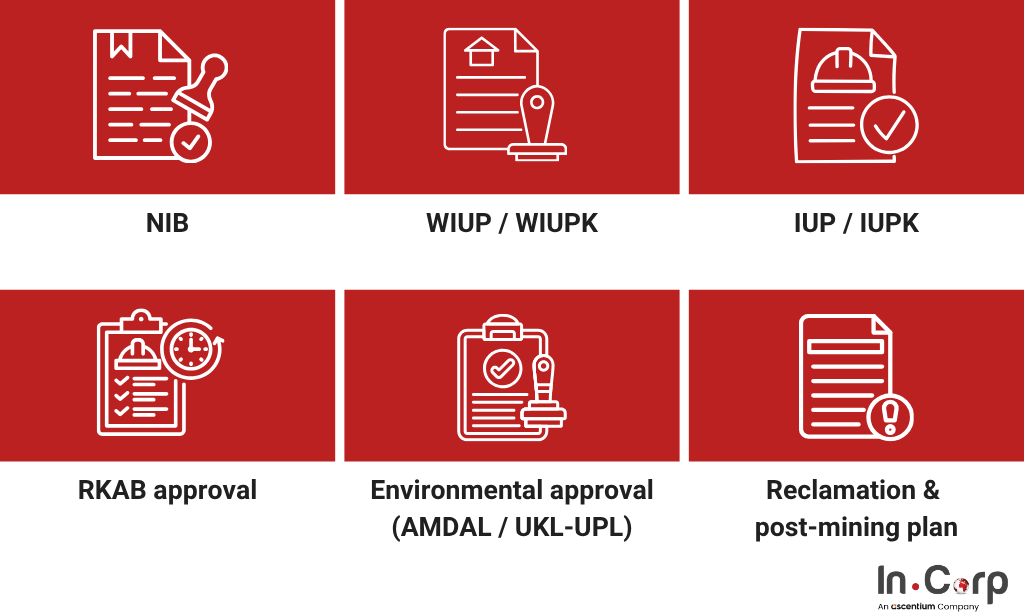
The following licenses and approvals are generally required for mining operations in Indonesia.
NIB (Business Identification Number)
The Nomor Induk Berusaha (NIB) is the essential business registration issued through the Online Single Submission (OSS) system. Every company in Indonesia must obtain an NIB. However, for mining companies, this alone is not sufficient. A specific mining business license is also required.
Foreign investors should ensure that their KBLI classification, ownership structure, and licensing pathway are aligned from the outset, as any misalignment later can result in delays.
WIUP or WIUPK (Mining Business License Area)
Before the main mining license, a company must secure the mining area:
| Area Basis | Meaning | Used For |
| WIUP (Wilayah Izin Usaha Pertambangan) | Mining Business License Area | IUP |
| WIUPK (Wilayah Izin Usaha Pertambangan Khusus) | Special Mining Business License Area | IUPK (typically on former PKP2B or state reserves) |
Under Government Regulation (PP) 96/2021, as amended by PP 25/2024 and PP 39/2025, a Mining Business License (WIUP) for metal minerals and coal is typically obtained through auction, while non-metal minerals and rocks require a standard application.
The maximum area for a metal mineral WIUP is 25,000 hectares, and for a coal WIUP, it is 15,000 hectares. A WIUP or WIUPK only designates the area for applying for the corresponding Mining Business License (IUP or IUPK) and does not permit mining operations by itself.
IUP (Mining Business License)
The IUP (Izin Usaha Pertambangan) is the main mining business license for private companies, including foreign-invested (PMA) companies. It has two stages:
- IUP exploration: General survey, exploration, and feasibility study within the WIUP.
- IUP Production Operation (IUP-OP): Construction, mining, processing/refining, transportation, and sales.
Commercial extraction cannot proceed without an IUP-OP, and the exploration stage (with a feasibility study) must generally be completed first.
IUPK (Special Mining Business License)
The IUPK applies to activities in WIUPK areas, usually former PKP2B coal contract areas or strategic state reserves. As per PP 25/2024, priority for WIUPK licenses can be granted to business entities owned by religious organizations in these areas, as well as to state- and regionally owned enterprises.
RKAB approval (Annual Work Plan and Budget)
The RKAB approval, which sets the work plan, production volume, and budget, is crucial for legal mining activities. Without this approval, a company cannot legally produce or sell minerals, making it a key compliance step.
The 2025–2026 update, under Permen ESDM 17/2025, reintroduces annual RKAB submissions, with applications due from October 1 to November 15 each year. This change affects planning and compliance for upcoming operations.
- Submission window: Applications can be submitted from October 1 to November 15 each year for the following year.
- Evaluation process: Applications will be evaluated within 5 working days, with a final decision made in 8 working days. If this is not met, the application will be auto-approved.
- Validity of previous approvals: Three-year applications previously approved and set to expire on March 31, 2026, are invalid.
- Consequences of non-compliance: Non-compliance will result in phased warnings (SP1 to SP3), followed by a 60-day production suspension and possible revocation of the IUP.
This change aims to prevent oversupply, particularly in nickel, coal, and bauxite, and align production with actual market absorption.
Environmental approval
Required before operations begin, under PP 22/2021. The document depends on the scale of impact:
- AMDAL (Environmental Impact Assessment) for high-impact activities.
- UKL-UPL for lower-impact activities.
Reclamation and post-mining plan
Reclamation and post-mining plans, along with financial guarantees, must now be demonstrated as part of the annual RKAB, thereby tightly linking rehabilitation obligations to operational approvals.
Supporting permits that may be required for mining operations
Depending on the actual operational footprint, additional permits may be mandatory:
| Activity | Supporting Permit |
| Providing mining services to other miners | IUJP (Mining Services Business License) |
| Mining inside a forest area | PPKH (Forest Area Use Permit) |
| Generating hazardous waste | B3 waste management permit |
| Discharging wastewater | Wastewater discharge permit |
| Standalone processing/refining (no integrated mine) | IUI under the Ministry of Industry |
| Transportation and sales only | IUP for Transportation and Sales |
| Employing foreign workers | RPTKA and related workforce permits |
Missing a supporting permit, especially a PPKH for forest areas or a B3 waste permit, is a common cause of inspection findings and production suspensions.
Guide to Doing Business in Jakarta
How InCorp can support your mining operations in Indonesia
Mining licensing requires coordinated work across company setup, OSS-RBA registration, mining approvals, environmental documentation, and ongoing reporting. A gap in any area can delay production or trigger sanctions.
InCorp Indonesia (an Ascentium Company) supports mining companies through:
- Business setup and licensing: Company establishment, KBLI review, NIB, and OSS-RBA licensing preparation.
- Mining sector licensing advisory: Support for IUP, IUPK, IUJP, and other mining-related approvals.
- Environmental and operational compliance: Assist with AMDAL, UKL-UPL, RKL-RPL, B3 waste, wastewater, and supporting permits.
- Post-licensing and reporting support: Ongoing compliance assistance, LKPM reporting, and operational documentation support.
Planning to operate or support mining operations in Indonesia? Fill out the form below to start your mining licensing assessment with clarity on timelines, costs, and compliance requirements.
Frequently Asked Questions
What licenses are required for mining operations in Indonesia?
Mining operations in Indonesia generally require an NIB (Business Identification Number), WIUP or WIUPK mining area approval, IUP or IUPK mining license, RKAB approval, environmental approvals, and additional supporting permits depending on the operational activities.
What is the difference between WIUP and IUP in Indonesia?
WIUP (Mining Business License Area) designates the mining area, while IUP (Mining Business License) grants the right to conduct mining activities such as exploration, production, transportation, and sales. A WIUP alone does not allow mining operations.
Is RKAB approval mandatory for mining companies in Indonesia?
Yes. RKAB (Annual Work Plan and Budget) approval is mandatory before companies can legally produce or sell minerals. Without RKAB approval, mining production activities cannot proceed legally.
What environmental permits are required for mining in Indonesia?
Mining companies generally require AMDAL or UKL-UPL environmental approval, reclamation and post-mining plans, and potentially additional permits such as B3 waste management or wastewater discharge permits.
What happens if a mining company misses a required permit in Indonesia?
Missing required permits can result in inspection findings, production suspension, regulatory sanctions, or possible revocation of the mining license.
Get in touch with us.
What you'll get
A prompt response to your inquiry
Knowledge for doing business from local experts
Ongoing support for your business
Disclaimer
The information is provided by PT. Cekindo Business International (“InCorp Indonesia/ we”) for general purpose only and we make no representations or warranties of any kind.
We do not act as an authorized government or non-government provider for official documents and services, which is issued by the Government of the Republic of Indonesia or its appointed officials. We do not promote any official government document or services of the Government of the Republic of Indonesia, including but not limited to, business identifiers, health and welfare assistance programs and benefits, unclaimed tax rebate, electronic travel visa and authorization, passports in this website.

Verified by
Ales Cina
Consulting Manager at InCorp Indonesia
Aleš manages solution delivery at InCorp Indonesia, optimizing incorporation processes and client relationships. His experience in internal auditing, retail, and sales offers valuable global insights. Aleš, with a degree in Economics and Finance from the Czech Republic, helps clients navigate cross-border business challenges, focusing on cultural and legal insights.