Medical device registration in Indonesia is a required step before any product can enter the market. While the framework is clearly defined, many businesses still face delays due to misalignment in classification, documentation, or local setup.
In practice, the process is not only about obtaining approval. It also affects how a product is introduced, distributed, and managed in the Indonesian market.
Regulatory framework for medical devices in Indonesia
The Ministry of Health primarily governs medical device regulation in Indonesia. The framework is based on several key regulations that define licensing, distribution, and product standards. Key regulations include:
- Minister of Health Regulation No. 62 of 2017: Governs the distribution permit (NIE) for medical devices and IVD products.
- Minister of Health Regulation No. 11 of 2025: Introduces updated standards for risk-based business licensing and product compliance in the healthcare sector.
- CDAKB (Good Distribution Practice for Medical Devices): Certification is required for distributors as part of the registration process and has been enforced since 2024.
- Halal Product Assurance Law No. 33 of 2014 (phased implementation): Applies selectively to medical devices, particularly those with certain materials or use cases.
This regulatory framework is supported by a digital registration system managed by the Ministry of Health, where all medical device applications are submitted and evaluated.
Is medical device registration required in Indonesia?
A medical device must be registered before it can be imported, distributed, or sold in Indonesia. This applies to both locally manufactured and imported products.
Approval is granted through a distribution permit, commonly referred to as NIE (Nomor Izin Edar), issued by the Ministry of Health. Without this approval:
- The product cannot be imported into Indonesia
- Customs clearance will not be processed
- Local distribution and commercial activities cannot proceed
For many companies, this becomes the first regulatory step in market entry, though the structure behind it often requires more careful planning than expected.
Key requirements for medical device registration
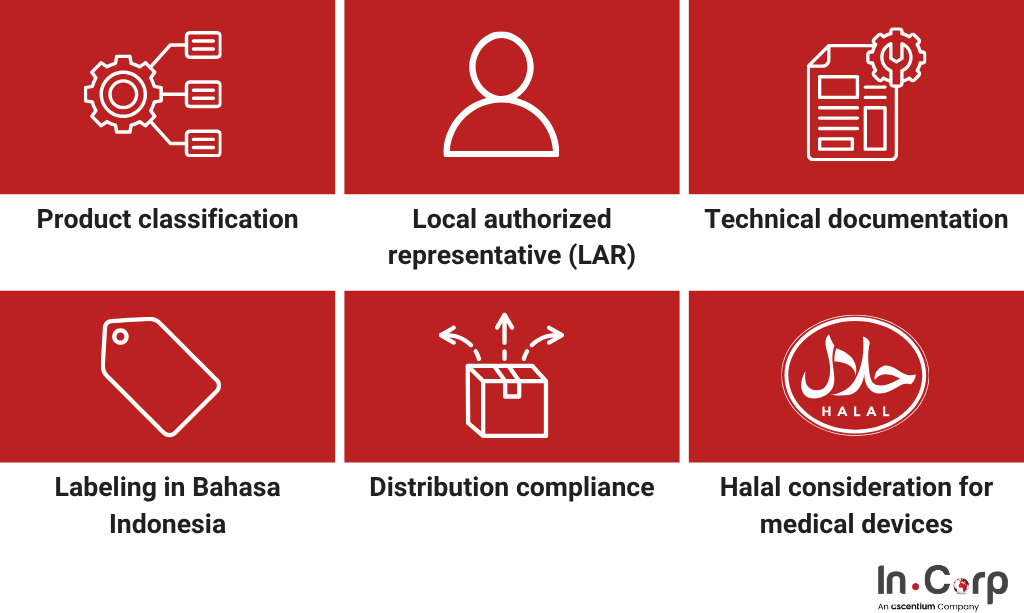
Once the requirement is established, the next step is to understand the requirements for registering a medical device in Indonesia. The process is structured, but most delays come from gaps in preparation rather than the system itself.
Product classification
Medical devices are classified by risk levels (Class A to D), which determines the level of evaluation and the expected timeline. Higher-risk classifications generally require more extensive technical documentation and review.
Local authorized representative (LAR)
Foreign manufacturers cannot register a medical device directly. A locally licensed company must be appointed as the registration holder and serve as the point of contact with the authority. This structure also affects control over product registration and future distribution decisions.
Technical documentation
A complete dossier is required, typically covering product specifications, intended use, and supporting technical or clinical data, depending on the classification. Inconsistent or incomplete documentation is one of the most common causes of delay during evaluation.
Labeling in Bahasa Indonesia
Product labeling and instructions for use must be available in Bahasa Indonesia. This requirement applies even if the product has already been approved in other markets with different labeling standards.
Distribution compliance
The appointed local party must meet distribution standards, including proper certification and licensing to handle medical devices. This ensures that the product is managed in accordance with local quality and safety requirements.
Halal consideration for medical devices
Halal certification is generally not required for most medical devices. However, products containing animal-derived materials or those with specific clinical applications may require further assessment under Indonesia’s halal regulations.
Registration process for medical devices in Indonesia
After preparing the key requirements, the registration of a medical device follows a structured process through the Ministry of Health system. While the steps are straightforward, the sequence and alignment between documents play an important role in how smoothly the process moves.
Appointment of local authorized representative (LAR)
The process begins by appointing a local entity as the registration holder. This party will be responsible for submitting the application and communicating with the authority.
Preparation of registration dossier
All administrative and technical documents are compiled based on product classification. At this stage, consistency across documents, such as product name, specifications, and intended use, is critical.
Submission through the registration system
The application is submitted electronically through the Ministry of Health’s registration platform. Any missing or unclear information may trigger queries during evaluation.
Evaluation by the authority
The authority reviews the submitted medical device based on its classification and supporting data. Additional clarification or document revisions may be requested during this stage.
Issuance of distribution permit (NIE)
Once approved, the medical device is granted a distribution permit (NIE), allowing it to be imported and distributed in Indonesia.
Delays typically arise from evaluation gaps, not the system itself. Early alignment of classification, documentation, and local structure minimizes review discrepancies.
Timeline for medical device registration in Indonesia
The time required to register a medical device in Indonesia largely depends on its classification. Higher-risk devices generally undergo a more detailed evaluation, which can extend the review period.
| Classification | Estimated Timeline |
| Class A (Low Risk) | 1–2 months |
| Class B (Low–Moderate Risk) | 2–3 months |
| Class C (Moderate–High Risk) | 3–6 months |
| Class D (High Risk) | 6–12 months |
While official processing timelines may be shorter under ideal conditions, actual timelines often vary depending on documentation of readiness and review complexity.
Common challenges in medical device registration
While the registration framework for medical devices in Indonesia is clearly defined, challenges often arise during execution. These issues are typically not caused by the system itself, but by gaps in preparation or misalignment between key components.
Some of the more common challenges include:
- Incorrect product classification: Misclassification can lead to the application being rejected or reassessed, affecting both timeline and documentation requirements.
- Incomplete or inconsistent documentation: Differences in product name, specifications, or intended use across documents can trigger additional queries during evaluation.
- Labeling adjustments in Bahasa Indonesia: Even when a medical device is already approved in other markets, labeling must follow local language and format requirements, which may require revision.
- Dependency on local authorized representative (LAR): The appointed local entity holds the registration, which can create limitations if there are future changes in distribution or partnership.
- Misalignment between registration and import process: Differences between registered product details and import documentation may delay customs clearance.
Taking a structured approach early can help reduce delays and maintain better control over the introduction and management of the medical device in Indonesia.
Clear Paths to Product Registration in Indonesia
Streamline medical device entry into Indonesia with InCorp
Bringing a medical device into Indonesia involves more than completing the registration process. Early decisions around structure, documentation, and local setup can influence how smoothly the product enters and operates in the market.
InCorp Indonesia (an Ascentium Company) supports businesses through each stage of the process with:
- Pre-registration guidance: Classification assessment and regulatory approach
- Document preparation and labeling: ASEAN Common Submission Dossier Template (CSDT) documentation and Bahasa Indonesia compliance
- MoH submission and approval: Application handling and authority coordination
- Post-approval maintenance: Renewal and ongoing compliance support
With the right preparation, medical device registration can be managed more efficiently while minimizing disruptions.
Frequently Asked Questions
Is medical device registration mandatory in Indonesia?
Yes. All medical devices must be registered and obtain a distribution permit (NIE) before they can be imported, distributed, or sold in Indonesia.
Who regulates medical device registration in Indonesia?
Medical devices are regulated by the Ministry of Health Indonesia under specific regulations covering licensing, distribution, and product standards.
Can foreign companies register medical devices directly in Indonesia?
No. Foreign manufacturers must appoint a Local Authorized Representative (LAR) to handle registration and act as the official license holder.
What determines the timeline for medical device registration?
The timeline depends on product classification (Class A–D). Higher-risk devices require more extensive review and longer approval time.
What are the most common reasons for registration delays?
Delays are usually caused by incorrect classification, incomplete or inconsistent documentation, and non-compliant labeling in Bahasa Indonesia.
Get in touch with us.
What you'll get
A prompt response to your inquiry
Knowledge for doing business from local experts
Ongoing support for your business
Disclaimer
The information is provided by PT. Cekindo Business International (“InCorp Indonesia/ we”) for general purpose only and we make no representations or warranties of any kind.
We do not act as an authorized government or non-government provider for official documents and services, which is issued by the Government of the Republic of Indonesia or its appointed officials. We do not promote any official government document or services of the Government of the Republic of Indonesia, including but not limited to, business identifiers, health and welfare assistance programs and benefits, unclaimed tax rebate, electronic travel visa and authorization, passports in this website.

Verified by
Hotdo Nauli
Senior Legal & Delivery Manager at InCorp Indonesia
Hotdo heads the Legal and Delivery team at InCorp Indonesia, managing Product Registration, Legal Advisory, and Business Licensing. With over 8 years of experience, she focuses on compliance and integrity, ensuring all client operations align with Indonesian laws and regulatory standards, including contract reviews and sector-specific licenses. She is also a licensed advocate and a member of the Indonesian Advocates Association (PERADI).