
Employment contracts in Indonesia generally fall into two structures: PKWT and PKWTT. While both regulate the employment relationship, they are designed for different situations and carry different legal implications.
For companies managing workforce planning, choosing between PKWT (fixed-term employment) and PKWTT (permanent employment) affects contract duration, termination rights, and employee entitlements. Understanding the distinction helps ensure employment agreements align with the nature of the role.
Types of employment contracts in Indonesia
Indonesian labor regulations recognize two primary employment agreements: PKWT and PKWTT. These contracts determine the duration of the employment relationship and the manner of termination.
While both agreements regulate the rights and obligations of employers and employees, they are designed for different workforce needs. Selecting the appropriate contract helps ensure the employment arrangement reflects the nature of the work.
These employment agreements are regulated by Law No. 13 of 2003 on Manpower, as amended by Law No. 6 of 2023 on Job Creation, with further provisions set out in Government Regulation No. 35 of 2021.
Understanding PKWT in Indonesia
PKWT (Perjanjian Kerja dengan Waktu Tertentu) refers to a fixed-term employment agreement with a defined duration or expected completion within a certain period.
This type of contract is typically used for project-based roles, temporary operational needs, or seasonal activities. Since PKWT is intended for limited-term work, the agreement must clearly state the contract period and employment conditions in writing.
Understanding PKWTT in Indonesia
PKWTT (Perjanjian Kerja Waktu Tidak Tertentu) refers to a permanent employment agreement without a predetermined end date. This contract is commonly used for roles that support ongoing business operations. Employees under permanent employment may be subject to a probationary period and are entitled to protections regarding termination procedures and employment benefits.
Key differences between PKWT and PKWTT
After understanding the basic structure, the next step is recognizing how the two agreements differ in practice. The distinction mainly affects employment duration, workforce planning, and termination obligations.
For companies, choosing the correct contract type helps ensure that the employment arrangement reflects the nature of the role.
| Aspect | PKWT | PKWTT |
| Contract Duration | Limited to a specific period | No predetermined end date |
| Employment Nature | Temporary or project-based | Ongoing employment |
| Probation Period | Not permitted | Allowed (maximum 3 months) |
| Contract Ending | Ends automatically when the term expires | Requires a formal termination process |
| Employee Entitlement | Contract completion compensation | Severance and other termination benefits |
In practice, fixed-term employment is generally used when the work has a clear timeframe, while permanent employment is applied when the role supports long-term business operations.
Termination rights under PKWT and PKWTT
The termination rights follow different principles because the contracts serve different employment arrangements. A fixed-term employment contract is tied to a specific duration or project, while permanent employment governs ongoing employment without a fixed end date. As a result, the rights and compensation received when employment ends also differ.
Termination rights under PKWT
Under fixed-term employment, employment generally ends when the contract period expires or the agreed work is completed. At the end of the contract, employees are entitled to contract completion compensation, calculated based on their length of service, as regulated under Government Regulation No. 35 of 2021.
The calculation follows these general principles:
- 12 months of service: Compensation equal to 1 month’s salary
- 1–12 months of service: Calculated proportionally (length of service ÷ 12 × 1 month’s salary)
- More than 12 months: Calculated using the same proportional formula
If the contract is terminated before the agreed period ends, the terminating party may be required to pay compensation equal to the remaining wages until the contract’s expiry, as stated in Article 62 of Law No. 13 of 2003 on Manpower.
Termination rights under PKWTT
Termination under permanent employment follows a different structure because the employment relationship lacks a fixed end date. Ending the employment relationship generally requires a valid reason and must comply with the termination procedures set out in Indonesian labor law.
When termination occurs, employers are typically required to provide several forms of compensation to employees. According to Article 156 of Law No. 6 of 2023 on Job Creation, these entitlements may include:
- Severance pay
- Long-service pay
- Compensation of rights
The amount employees receive may vary based on factors such as the duration of employment, the reason for termination, company policies, and the circumstances surrounding the termination.
Understanding the basis for termination is crucial for both employers and employees in managing permanent employment relationships, as different grounds for termination lead to different entitlements.
When should companies use PKWT or PKWTT?
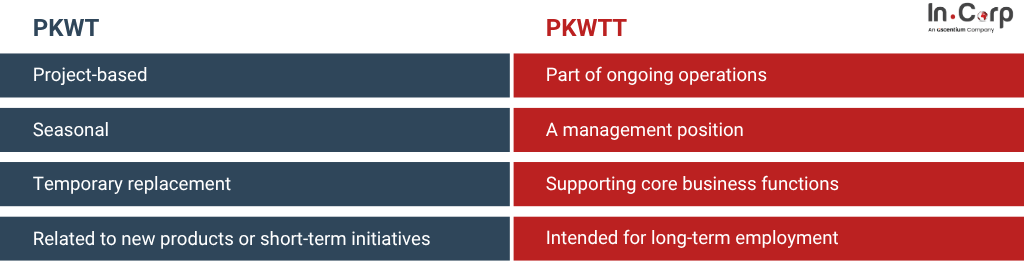
Choosing these employment contracts should reflect the nature and duration of the work. Applying the appropriate contract helps ensure the employment arrangement aligns with Indonesian labor regulations.
When PKWT may be appropriate
PKWT is generally used for work that can be completed within a set period or is temporary. This type of contract is commonly used for roles associated with specific activities or operational needs. Examples include:
- Project-based or one-time work
- Seasonal activities are dependent on the weather or demand
- Temporary work related to new products or business initiatives
- Daily or irregular work where working days are limited
Under current regulations, the duration of fixed-term employment may reach up to five years, including extensions, depending on the nature of the work.
When PKWTT may be appropriate
PKWTT is used for roles that support the company’s ongoing operations. These positions are not limited to a specific timeframe and are expected to remain part of the organization’s workforce.
The permanent employment governs permanent employment relationships and remains valid until an employee resigns, retires, or the employment is terminated in accordance with labor regulations.
Compliance risks when using the wrong contract type
Using PKWT and PKWTT incorrectly can create compliance issues for companies. This often occurs when a fixed-term contract is applied to work that is essentially permanent or part of the company’s core operations.
When a PKWT does not meet the legal requirements for fixed-term employment, the agreement may be deemed invalid and treated as permanent employment. This can change the employee’s status and affect termination obligations.
Some common risks include:
- The fixed-term employment contract is automatically considered permanent employment
- Additional obligations related to severance and termination benefits
- Potential employment disputes with workers
For this reason, companies generally need to ensure that the contract type reflects the nature of the work and complies with Indonesian labor regulations.
Payroll Outsourcing in Indonesia: Building Continuity Through Compliance

Simplify employment management with InCorp
For businesses operating in Indonesia, managing employment contracts is often part of a broader workforce strategy. InCorp Indonesia (an Ascentium Company) can help ensure employment arrangements remain aligned with labor regulations, such as:
- Employer of record (EOR) for compliant hiring without establishing a local entity
- Recruitment services to identify suitable talent for business operations
- Payroll services to manage salary administration and statutory obligations
Complete the form below to streamline operations and ensure workforce compliance.
Frequently Asked Questions
What is PKWT in Indonesia?
PKWT is a fixed-term employment contract used for temporary, project-based, seasonal, or time-limited work in Indonesia.
What is PKWTT in Indonesia?
PKWTT is a permanent employment contract with no predetermined end date, commonly used for ongoing roles that support regular business operations.
What is the main difference between PKWT and PKWTT?
The main difference is that PKWT is limited to a specific period, while PKWTT has no fixed end date and is used for long-term employment.
Does PKWT allow a probation period?
No. Indonesian labor rules do not permit a probation period under PKWT, while PKWTT may include probation for up to 3 months.
What happens if PKWT is used for permanent work?
If PKWT is used for work that is actually permanent or part of core operations, the contract may be treated as PKWTT, which can create additional severance and termination obligations.
Get in touch with us.
What you'll get
A prompt response to your inquiry
Knowledge for doing business from local experts
Ongoing support for your business
Disclaimer
The information is provided by PT. Cekindo Business International (“InCorp Indonesia/ we”) for general purpose only and we make no representations or warranties of any kind.
We do not act as an authorized government or non-government provider for official documents and services, which is issued by the Government of the Republic of Indonesia or its appointed officials. We do not promote any official government document or services of the Government of the Republic of Indonesia, including but not limited to, business identifiers, health and welfare assistance programs and benefits, unclaimed tax rebate, electronic travel visa and authorization, passports in this website.