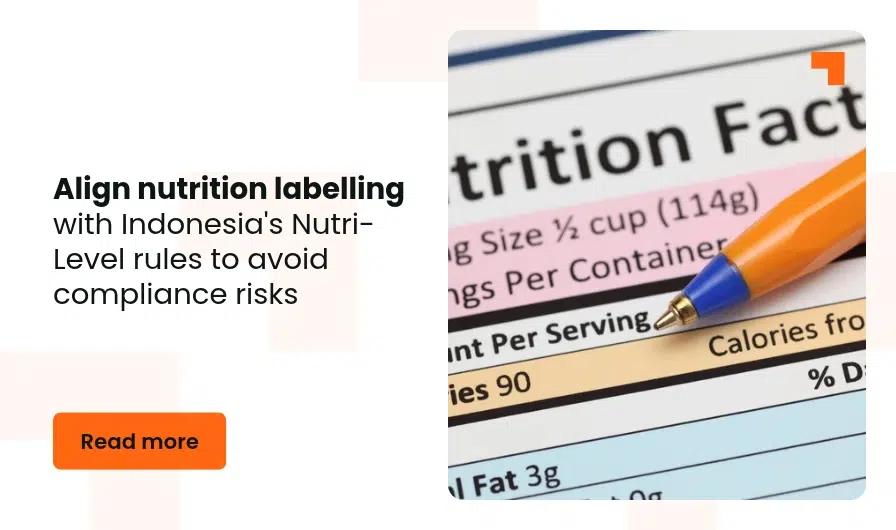
Indonesia’s nutrition labelling rules have changed under BPOM Regulation No. 10 of 2026, introducing updated Nutritional Value Information (Informasi Nilai Gizi or ING) requirements and the new Nutri-Level system for certain beverage products.
The regulation took effect on June 17, 2026, with updated requirements applying to new registration applications from August 3, 2026, and a transition period for existing products ending on June 17, 2028.
Businesses introducing new products or maintaining existing portfolios should start aligning their nutrition data and packaging before these requirements affect their commercial timelines.
Key takeaways
- BPOM Regulation 10/2026 replaces the previous nutrition labelling framework for processed foods in Indonesia, subject to specified exemptions.
- New product registrations submitted from August 3, 2026, must meet the updated ING requirements.
- Nutri-Level introduces front-of-pack nutrition grades from A to D for specified ready-to-drink, powdered and concentrated beverages.
- Existing registered products have a 24-month transition period, ending on June 17, 2028, to meet the applicable updated requirements.
- Early nutrition analysis, packaging assessment, and alignment with BPOM registration can reduce the risk of costly revisions and market-entry delays.
What changed under Indonesia’s 2026 nutrition labelling rules?
BPOM Regulation No. 10 of 2026 changes how food and beverage businesses prepare nutrition information for products sold in Indonesia.
The regulation replaces BPOM Regulation 26/2021 and related previous provisions, updates nutrition information requirements, and introduces Nutri-Level for specified beverage categories.
| Regulatory change | What businesses need to know | Business implications |
| Updated nutrition information (ING) | Nutrition values, serving sizes, and label presentation must follow BPOM 10/2026. | Existing nutrition panels may require recalculation or redesign. |
| Nutri-Level introduction | Specified beverages require front-of-pack grades from A to D, subject to the transition period. | Brands must assess nutrition profiles and update packaging. |
| New registration requirements | Applications submitted from August 3, 2026, must meet the updated ING requirements. | Incomplete nutrition data can delay BPOM approval. |
| Existing product transition | Affected products must comply by June 17, 2028. | Businesses need to plan portfolio-wide packaging updates. |
| Imported products | Imported products must meet applicable Indonesian nutrition labelling requirements. | Overseas labels may require local adjustments before distribution. |
Please note that Nutri-Level doesn’t replace the standard ING nutrition information. Businesses must differentiate between general nutrition labelling obligations and the additional front-of-pack grading requirements for relevant beverages.
Why Nutri-Level matters for food and beverage businesses
Indonesia’s Nutri-Level system is designed to make beverages’ sugar, salt, and fat content easier for consumers to understand.
For manufacturers, importers, and distributors, however, its implications extend beyond consumer information.
Products may require additional nutritional analysis, revised packaging, and closer coordination among regulatory, product development, and marketing teams.
How Nutri-Level grades are determined
Nutri-Level assigns a grade from A to D based on the sugar, sodium and total fat content per 100 ml of the beverage in its ready-to-consume form.
| Nutrient per 100 ml | Level A | Level B | Level C | Level D |
| Sugar | ≤ 0.5 g | > 0.5–6 g | > 6–12.5 g | > 12.5 g |
| Sodium | ≤ 5 mg | > 5–120 mg | > 120–500 mg | > 500 mg |
| Total fat | ≤ 0.5 g | > 0.5–3 g | > 3–17 g | > 17 g |
A product’s overall Nutri-Level is determined by its least favourable nutrient grade. For example, a beverage classified as Level B for sugar, Level A for sodium, and Level C for total fat receives an overall Level C.
BPOM also establishes restrictions on the use of food-additive sweeteners:
- Level A: Natural and artificial food-additive sweeteners are not permitted, including carry-over.
- Level B: Only natural food-additive sweeteners are permitted.
- Levels C and D: Natural or artificial food-additive sweeteners may be used, subject to applicable requirements.
Other product-specific rules and exemptions may also apply, including particular treatment of certain plain milk products.
Which beverage products are affected?
Nutri-Level applies to specified beverage categories, including:
- Ready-to-drink beverages
- Powdered beverages
- Liquid beverage concentrates
- Solid beverage concentrates
Certain specialised products, including infant formula, follow-on formula, growing-up formula and processed food for special medical purposes, cannot display Nutri-Level under these provisions.
For companies managing multiple beverage brands, product classification should be assessed individually. Not every beverage or processed food product meets the same labelling requirements.
What businesses must get right before the deadline?
With new BPOM registration requirements already in effect and the transition deadline set for June 17, 2028, businesses should prioritise the following actions:
- Identify affected products: Review which products require updated nutrition information or Nutri-Level grading.
- Verify nutrition data: Confirm nutritional values against product formulations and supporting documentation.
- Update product labels: Align nutrition facts and Nutri-Level information with BPOM requirements.
- Match BPOM registration records: Ensure updated labels and product information match registration documents.
- Plan implementation early: Coordinate packaging updates, regulatory submissions and inventory transitions to avoid delays.
Addressing these requirements early can reduce costly revisions and keep product launches and distribution on schedule.
What happens if businesses fail to comply?
Failing to meet applicable Indonesian nutrition labelling requirements can lead to both regulatory and commercial consequences.
- Registration delays: Incomplete or inconsistent nutrition information can trigger requests for clarification or correction.
- Packaging rework: Incorrect labels may require redesign, reprinting, or replacement before products can be distributed compliantly.
- Higher operational costs: Additional laboratory testing, regulatory submissions, and packaging modifications can increase compliance expenditure.
- Disrupted product launches: Delays in finalising compliant documentation and packaging can affect import schedules, distributor readiness and market entry.
- Ongoing compliance exposure: Products that remain non-compliant after applicable transition deadlines may face regulatory action.
Addressing these requirements before packaging approval or BPOM submission is generally more efficient than correcting them after commercial schedules are established.
Clear Paths to Product Registration in Indonesia
Get your nutrition labels BPOM-ready with Ascentium
Incorrect nutrition labels can delay product registration, disrupt distribution, and increase compliance costs. Ascentium Indonesia (formerly InCorp Indonesia) supports food and beverage manufacturers, importers and distributors through:
- Regulatory assessment: Identifying applicable nutrition labelling and Nutri-Level requirements.
- BPOM product registration: Preparing and coordinating registration submissions and supporting documents.
- Label and documentation review: Assessing nutrition information, packaging, and supporting evidence for compliance.
- Import compliance support: Assisting imported food and beverage brands with registration and market-entry requirements.
Book a free consultation to assess your nutrition labelling requirements and avoid delays to your next product launch. Fill out the form below. *
*T&C apply.
Frequently asked questions
What is BPOM Regulation 10/2026?
BPOM Regulation No. 10 of 2026 is Indonesia's updated regulation governing Nutritional Value Information (Informasi Nilai Gizi or ING) on processed food labels. It also introduces Nutri-Level front-of-pack grading for specified beverage products.
Is nutrition labelling mandatory for all processed foods in Indonesia?
Nutrition information is generally mandatory for processed food products covered by BPOM Regulation 10/2026, subject to exemptions. Certain products, including specified coffee, tea, bottled water and other exempt categories, may not require an ING panel. Businesses should confirm their product classification before preparing labels.
When do Indonesia's new nutrition labelling rules take effect?
BPOM Regulation 10/2026 took effect on June 17, 2026. Updated ING requirements apply to new registration applications from August 3, 2026, while affected existing products have a transition period ending on June 17, 2028.
Is Nutri-Level mandatory in Indonesia?
Yes. Nutri-Level is being introduced as a mandatory front-of-pack grading requirement for specified beverage products, following the applicable 24-month transition period ending on June 17, 2028.
Does Nutri-Level apply to imported beverages?
Yes. Imported beverages that fall within the specified Nutri-Level categories are subject to the applicable Indonesian requirements. Foreign manufacturers and importers should confirm that their nutrition data, label artwork, and BPOM registration documentation meet local standards.
Can companies use international nutrition labels in Indonesia?
International nutrition labels cannot automatically be used without assessment. Businesses must ensure their nutrition declarations, serving sizes, formatting and other applicable requirements comply with Indonesian regulations.
How can a beverage company determine its Nutri-Level?
A beverage Nutri-Level is determined using applicable sugar, sodium and total fat thresholds per 100 ml of the ready-to-consume product, together with relevant sweetener restrictions. The least favourable applicable nutrient grade determines the overall level.
Do existing BPOM-registered products need to update their labels?
Affected products registered before BPOM Regulation 10/2026 took effect are provided with a transition period of 24 months from June 17, 2026. Businesses should review their existing labels and make any necessary adjustments by June 17, 2028.
Can incorrect nutrition information delay BPOM product registration?
Yes. Inconsistent nutrition values, incorrect serving information, or non-compliant artwork can trigger additional clarification or correction requests during product registration. Pre-submission reviews can help identify these issues before they affect approval timelines.
How can Ascentium support nutrition labelling compliance in Indonesia?
Ascentium Indonesia (formerly InCorp Indonesia) supports food and beverage businesses through BPOM regulatory assessments, product registration assistance, nutrition label and documentation review, and import compliance services. This helps companies align applicable labelling requirements with their product registration and commercial launch plans.
Get in touch with us.
What you'll get
A prompt response to your inquiry
Knowledge for doing business from local experts
Ongoing support for your business
Disclaimer
The information is provided by PT. Cekindo Business International (“InCorp Indonesia/ we”) for general purpose only and we make no representations or warranties of any kind.
We do not act as an authorized government or non-government provider for official documents and services, which is issued by the Government of the Republic of Indonesia or its appointed officials. We do not promote any official government document or services of the Government of the Republic of Indonesia, including but not limited to, business identifiers, health and welfare assistance programs and benefits, unclaimed tax rebate, electronic travel visa and authorization, passports in this website.

Verified by
Hotdo Nauli
Senior Legal & Delivery Manager at InCorp Indonesia
Hotdo heads the Legal and Delivery team at InCorp Indonesia, managing Product Registration, Legal Advisory, and Business Licensing. With over 8 years of experience, she focuses on compliance and integrity, ensuring all client operations align with Indonesian laws and regulatory standards, including contract reviews and sector-specific licenses. She is also a licensed advocate and a member of the Indonesian Advocates Association (PERADI).