
Inventory discrepancies cost businesses worldwide approximately $1.77 trillion annually. For companies, understanding the differences between stock opname and stocktaking, and complying with PSAK 202, is essential to safeguarding their bottom lines.
This guide outlines the key differences and helps you determine which approach is right for your business.
Key Takeaways
- Stock opname is a formal inventory count followed by accounting reconciliation, while stocktaking is mainly used for operational review and planning.
- Stock opname is needed for financial reporting, DJP audits, PSAK 202 disclosure, ERP reconciliation, and unexplained inventory variances.
- Stocktaking is useful for procurement planning, warehouse reviews, due diligence, and checking damaged, obsolete, or slow-moving stock.
- Under PSAK 202, Indonesian businesses must record inventory at the lower of cost and net realizable value, using FIFO or Weighted Average methods.
- Poor inventory documentation can create audit risks, tax corrections, and financial reporting issues for companies in Indonesia.
Stock opname or stocktaking: Which one does your business need?
Choosing the right process at the right time ensures you gain operational control and confidence, helping your business run smoothly without unnecessary disruptions.
When to conduct stock opname
- Preparing financial statements (quarterly or annual)
- Facing an external audit or a tax audit by the Direktorat Jenderal Pajak (DJP)
- Suspecting theft, shrinkage, or unexplained variance
- Reconciling ERP data after a system migration
- Required to disclose inventory under PSAK 202
- Post-event: new warehouse, staff turnover, fire, or flooding
When to conduct stocktaking
- Planning a major procurement or restocking cycle
- Conducting due diligence before a business acquisition
- Assessing damaged, obsolete, or slow-moving stock
- Reorganizing a warehouse or distribution center
- Preparing a general baseline before a full stock opname
- No formal accounting reconciliation is required
In Indonesia, understanding that stock opname generates formal accounting journal entries and is necessary for compliance with PSAK 202 helps you ensure accurate financial reporting and regulatory adherence.
Key difference between stock opname and stocktaking
While often used interchangeably in everyday business conversation, stock opname and stocktaking are separate processes with different scopes, purposes, and frequencies.
| Aspect | Stock Opname | Stocktaking |
| Output | Adjusted accounting records, variance reports, PSAK 202 disclosures | Stock availability report, procurement, or write-off recommendations |
| Scope | Full reconciliation — every SKU counted, compared, and adjusted | General overview of quantities and conditions, no formal adjustments |
| Frequency | Monthly, quarterly, or annually, based on risk and regulatory need | Annually, or before major procurement/acquisition events |
| Compliance | Required for financial reporting, DJP audits, PSAK 202 disclosure | Not a compliance requirement — operational planning tool |
| Best For | Retail, wholesale, manufacturing, distribution — all PSAK-reporting entities | Pre-acquisition due diligence, warehouse planning, and obsolescence reviews |
Not sure where to start? InCorp’s team offers comprehensive stock opname and stocktaking services across all major Indonesian cities, ensuring minimal disruption to your operations. Talk to an expert →
What is stock opname in Indonesia?
Stock opname in Indonesia is a formal physical inventory count followed by an accounting reconciliation, both of which are essential for compliance with PSAK 202 and for maintaining accurate financial records. This three-phase process involves counting all stock, comparing it with system records, and adjusting accounting records to address discrepancies.
Used across retail, wholesale, manufacturing, and distribution, stock opname is essential for maintaining accurate inventory balances in financial statements. In 2026, global retail shrinkage reached $132 billion, driven by employee theft (29%), external shoplifting (37%), and administrative errors (20%). Regular stock opname is crucial to prevent unnoticed losses.
Why it matters for Indonesian businesses
Inventory inaccuracies can cost businesses up to 10% of their annual revenue. For companies in Indonesia, there is also a regulatory risk: unreconciled inventory discrepancies in financial statements are often highlighted during DJP tax audits, leading to reassessments and penalties.
How PSAK 202 applies to stock opname
PSAK 14 has been updated and is now referred to as PSAK 202 since 2024. While the principles remain largely the same, businesses in Indonesia must comply with PSAK 202 for inventory reporting in 2026.
PSAK 202 is Indonesia’s accounting standard for inventory. It sets the rules for how businesses record, value, and report stock in their financial statements.
Under PSAK 202, inventory must be recorded at the lower value between cost and net realizable value (NRV). Businesses may use only FIFO or Weighted Average, but LIFO is not allowed. Companies must also disclose inventory value, cost of goods sold, and any write-downs.
This is why stock opname matters. If a physical count reveals differences, the business must properly record and explain each adjustment. Poor inventory documentation can lead to audit issues and possible tax corrections.
5 essential steps to conduct a stock opname
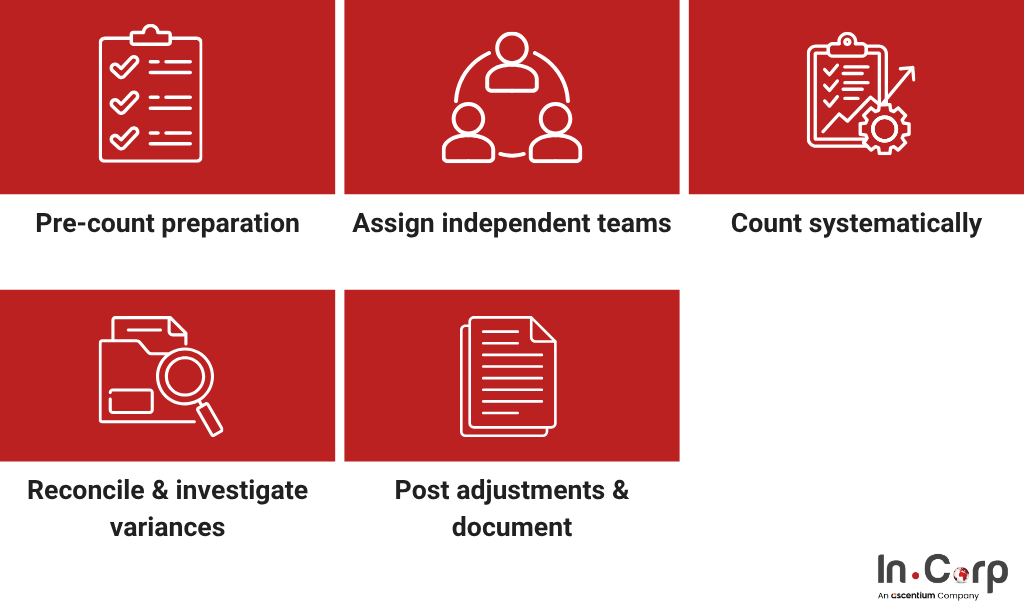
An effective stock opname requires disciplined preparation, clear role assignments, and a structured reconciliation process. Here is the framework:
Pre-count preparation
Because inventory movements occur 24–48 hours before the count. Export current system records as your baseline. Organize storage so every item is accessible and labeled.
Assign independent teams
Use two teams (one to count, one to verify) and separate them from the staff managing day-to-day inventory. This is your primary control against fraud.
Count systematically
Work by location (aisle, bin, shelf). Use barcode or RFID scanning where possible; manual processes average only 65–75% accuracy vs. 95%+ with scanning.
Reconcile & investigate variances
Compare physical counts to system records for every SKU. Flag variances exceeding your tolerance threshold and investigate the root causes before making adjustments.
Post adjustments & document
Record formal journal entries with explanations. Under PSAK 202, any write-down to net realizable value (NRV) must be disclosed. Maintain a full audit trail for DJP purposes.
Guide to Doing Business in Jakarta

How InCorp helps streamline your stock management
Accurate stock management is foundational for financial reporting, tax compliance, and operational efficiency. Whether your business needs periodic stock opname support, full stocktaking services, or help navigate PSAK 202 disclosure requirements, partnering with experienced professionals eliminates risk and saves time.
InCorp Indonesia (an Ascentium Company) provides professional stocktaking services and business advisory support across Indonesia by managing:
- Full stock opname execution: Independent counting teams, variance investigation, and PSAK 202-compliant adjustment documentation
- Stocktaking for due diligence: Pre-acquisition assessments, write-off reviews, and warehouse audits
- Accounting & tax compliance: Ensuring inventory disclosures meet DJP and IAI requirements
Ready to fix your inventory compliance? Fill out the form below to get a free initial consultation.
Frequently Asked Questions
What is stock opname in Indonesia?
Stock opname in Indonesia is a formal physical inventory count followed by accounting reconciliation. It involves counting stock, comparing it with system records, and adjusting accounting records to reflect discrepancies. This process is important for accurate financial statements and PSAK 202 compliance.
What is the difference between stock opname and stocktaking?
Stock opname is a formal reconciliation process that updates accounting records and supports PSAK 202 disclosures. Stocktaking is a general inventory check used for operational planning, procurement, warehouse review, or due diligence, without formal accounting adjustments.
When should a business conduct stock opname?
A business should conduct stock opname when preparing financial statements, facing an external or tax audit, investigating inventory variance, reconciling ERP data, or meeting PSAK 202 inventory disclosure requirements.
How does PSAK 202 apply to stock opname?
PSAK 202 requires businesses to record, value, and report inventory correctly in financial statements. Inventory must be recorded at the lower of cost or net realizable value, and any stock adjustments or write-downs must be properly documented and disclosed.
Why should companies use professional stock opname services?
Professional stock opname services help companies conduct independent counts, investigate variances, prepare PSAK 202-compliant documentation, and maintain audit trails for financial reporting and DJP tax purposes. This reduces compliance risk and improves inventory control.
Get in touch with us.
What you'll get
A prompt response to your inquiry
Knowledge for doing business from local experts
Ongoing support for your business
Disclaimer
The information is provided by PT. Cekindo Business International (“InCorp Indonesia/ we”) for general purpose only and we make no representations or warranties of any kind.
We do not act as an authorized government or non-government provider for official documents and services, which is issued by the Government of the Republic of Indonesia or its appointed officials. We do not promote any official government document or services of the Government of the Republic of Indonesia, including but not limited to, business identifiers, health and welfare assistance programs and benefits, unclaimed tax rebate, electronic travel visa and authorization, passports in this website.