
Employee termination in Indonesia is subject to strict legal safeguards. To ensure compliance, employers must justify each dismissal with proper documentation, communicate it through formal notice, and follow a multi-step dispute process, which helps prevent legal disputes and keeps employers informed of their obligations.
For foreign employers, failing to comply with these rules can lead to costly consequences, including reinstatement orders, lengthy litigation, and expenses exceeding the original severance costs, underscoring the need for strict adherence to legal procedures.
Key Takeaways
- Employee termination in Indonesia must be based on a valid, documented reason and follow the procedure under the Job Creation Law and GR 35/2021.
- Employers must issue a written termination notice, followed by bipartite negotiation, mediation, and court process if the dispute is unresolved.
- Employee termination is prohibited if it is based on discrimination, pregnancy, whistleblowing, certified illness, trade union activity, or religious obligations.
- Wrongful employee termination can lead to reinstatement orders, back-pay exposure, higher termination costs, and business disruption.
- Termination compensation may include severance pay, long-service pay, and compensation for unused rights, depending on the employee’s contract type and reason for termination.
What is the legal framework for terminating employment in Indonesia?
Indonesian law requires employers to have a valid, documented reason for every dismissal. The following are the recognized grounds under the Job Creation Law and GR 35/2021:
Underperformance or misconduct
Employee termination may be based on repeated underperformance or serious misconduct, provided the employer has proper supporting records. In practice, conduct-based employee termination generally requires two written warnings, as verbal warnings are not sufficient in court.
Common grounds include failure to meet documented targets despite support, serious violations of company rules or a collective labor agreement, fraud or theft, negligence resulting in proven losses, and absence without authorization for 5 consecutive working days after proper notice.
Economic or structural reasons (Layoffs)
Layoffs may also be carried out for business reasons such as downsizing, restructuring, mergers, acquisitions, or closure. Even in these cases, employers must still follow the full termination procedure and provide the employee with their statutory entitlements.
Completion of a fixed-term contract (PKWT)
A fixed-term employment relationship ends automatically upon the expiration of the contract. Under GR 35/2021, a time-based PKWT may not exceed five years in total, including extensions.
If a PKWT is ended early, the terminating party must pay compensation for the completed service period and the remaining contract value.
Foreign worker exception
Foreign employees working under a PKWT are not entitled to the standard end-of-contract compensation given to Indonesian employees. However, foreign employees on indefinite-term contracts remain subject to the usual severance framework.
Voluntary resignation
Employees may resign by giving at least 30 days’ written notice. In this case, employers are generally not required to pay severance, although a separation payment may still be offered. The resignation must also be clearly voluntary and not made under pressure.
Retirement
Retirement also ends the employment relationship, but with enhanced statutory benefits. Under GR 35/2021, the employee is entitled to 1.75 times the standard severance formula, plus long-service pay and compensation for unused rights.
When is employee termination strictly prohibited?
Any dismissal on the following grounds is null and void under Indonesian law. An employee terminated for these reasons may seek reinstatement, full back pay, and enhanced compensation through the Industrial Relations Court.
- Discrimination: Dismissal based on gender, race, religion, ethnicity, skin color, or disability.
- Pregnancy & maternity: Law No. 4/2024 explicitly prohibits termination of employment related to pregnancy or maternity rights.
- Whistleblowing: Employees cannot be dismissed for reporting corruption, safety issues, or unethical conduct
- Certified illness: Employees on doctor-certified sick leave are protected for up to 12 consecutive months
- Trade union activity: Lawful union membership or activity is protected.
- Religious obligation: Terminating an employee for performing religious duties is prohibited.
Step-by-step employee termination procedure in Indonesia
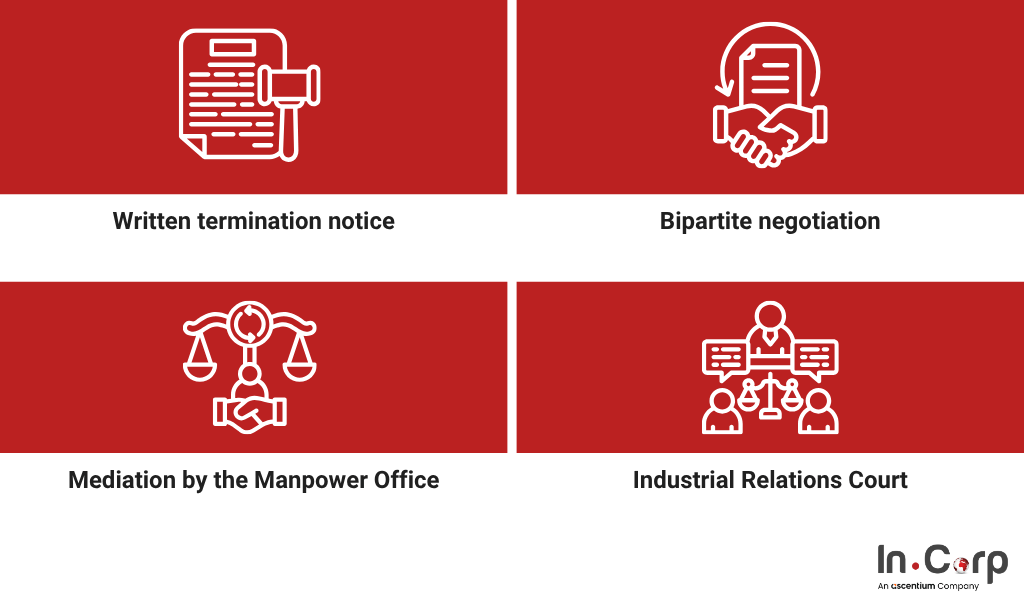
GR 35/2021 establishes a structured process that must be followed for a termination to be legally effective. Following this clear procedure can help employers feel more secure and in control of the termination process, minimizing legal risks.
Written termination notice
The employer must issue a termination notice stating the reason for dismissal, the proposed severance, and the response deadline. The notice must be in Bahasa Indonesia or bilingual, signed by an authorized representative, and delivered within the required notice period.
Bipartite negotiation
The employer and employee must first try to settle the matter through direct negotiation. If they reach an agreement, it should be documented and registered with the court.
Mediation by the Manpower Office
If bipartite negotiations fail, either party may refer the dispute to the local Manpower Office for mediation. The mediator will review the case and issue a recommendation.
Industrial Relations Court
If the dispute remains unresolved, either party may escalate it to the Industrial Relations Court. If the court finds the termination unlawful, the employer may be ordered to reinstate the employee and pay back wages.
Employee termination risk in Indonesia can be complex to manage on your own. InCorp’s EOR service acts as the legal employer, helping reduce your exposure while you stay focused on business growth. See if EOR is right for you →
What are the consequences of getting a termination wrong?
An employee termination mistake in Indonesia can quickly become far more expensive than expected. Even a single procedural error can turn a manageable exit into a lengthy dispute with serious financial and operational consequences. Employers may face:
- Reinstatement orders: The employee may be ordered to return to their role, with employment rights preserved.
- Back-pay exposure: The employer may need to pay salary, allowances, and benefits for the duration of the dispute.
- Higher termination costs: If the dismissal is ruled unlawful, full severance and other entitlements may still apply.
- Business disruption: Termination disputes can consume management time, strain HR resources, and raise wider compliance concerns.
The cost of getting termination wrong can easily exceed the cost of handling it properly from the start. In Indonesia, following the right process is not only about legal compliance, but also about protecting your business from avoidable risk.
Severance, long-service pay & compensation after employee termination
Employee termination compensation for indefinite-term employees includes up to three components under GR 35/2021. The multiplier for each component varies based on the reason for termination. Employers may offer more generous compensation, but cannot provide less than the statutory minimum.
Severance pay (uang pesangon) for indefinite-term employees
| Length of Service | Severance Pay |
| Less than 1 year | 1 month’s wage |
| 1–2 years | 2 months’ wage |
| 2–3 years | 3 months’ wage |
| 3–4 years | 4 months’ wage |
| 4–5 years | 5 months’ wage |
| 5–6 years | 6 months’ wage |
| 6–7 years | 7 months’ wage |
| 7–8 years | 8 months’ wage |
| 8 years or more | 9 months’ wage (maximum) |
Long-service appreciation pays (Uang penghargaan masa kerja)
| Length of Service | Severance Pay |
| 3–6 years | 2 months’ wage |
| 6–9 years | 3 months’ wage |
| 9–12 years | 4 months’ wage |
| 12–15 years | 5 months’ wage |
| 15–18 years | 6 months’ wage |
| 18–21 years | 7 months’ wage |
| 21–24 years | 8 months’ wage |
| 24 years or more | 10 months’ wage (maximum) |
Compensation pay for fixed-term (PKWT) employees
| Service Period | Compensation Pay |
| Less than 12 months | Pro-rata based on months worked |
| 12 months or more | 1 month’s salary per year of service |
Note: If a fixed-term contract is terminated early by either party, the terminating party must also pay the balance of contract pay (Article 62, Manpower Law as amended, confirmed by SEMA No. 3/2023). Foreign PKWT employees are exempt from compensation pay under Article 15(5) GR 35/2021.
Payroll Outsourcing in Indonesia: Building Continuity Through Compliance
Reduce HR risk with the right support from InCorp
InCorp Indonesia (an Ascentium Company) assists businesses of all sizes in managing compliant, dispute-free employee terminations. Our EOR services handle everything from policy drafting to severance calculation and dispute representation.
- Build compliant HR policies
- Streamline employee recruitment and onboarding
- Handle employee terminations in line with Indonesian labor law
Avoid costly disputes by filling out the form below to streamline your HR process.
Frequently Asked Questions
What is the legal requirement for employee termination in Indonesia?
Employee termination in Indonesia must be based on a valid and documented reason. Employers must follow formal procedures, including written notice, bipartite negotiation, and possible mediation or court resolution if the employee disputes the termination.
What are valid reasons for terminating an employee in Indonesia?
Valid termination grounds include underperformance, misconduct, restructuring, business closure, completion of a fixed-term contract, resignation, and retirement. Each reason must be supported by proper documentation and handled according to Indonesian labor law.
When is employee termination prohibited in Indonesia?
Termination is prohibited when based on discrimination, pregnancy or maternity rights, whistleblowing, certified illness, trade union activity, or religious obligations. Dismissals on these grounds may be declared null and void.
What is the correct employee termination process in Indonesia?
The termination process generally starts with a written termination notice, followed by bipartite negotiation between employer and employee. If no agreement is reached, the case may proceed to Manpower Office mediation and then to the Industrial Relations Court.
What happens if an employer handles termination incorrectly?
If termination is handled incorrectly, employers may face reinstatement orders, back-pay obligations, higher termination costs, business disruption, and lengthy disputes. Proper procedure helps reduce legal and financial risks.
Get in touch with us.
What you'll get
A prompt response to your inquiry
Knowledge for doing business from local experts
Ongoing support for your business
Disclaimer
The information is provided by PT. Cekindo Business International (“InCorp Indonesia/ we”) for general purpose only and we make no representations or warranties of any kind.
We do not act as an authorized government or non-government provider for official documents and services, which is issued by the Government of the Republic of Indonesia or its appointed officials. We do not promote any official government document or services of the Government of the Republic of Indonesia, including but not limited to, business identifiers, health and welfare assistance programs and benefits, unclaimed tax rebate, electronic travel visa and authorization, passports in this website.