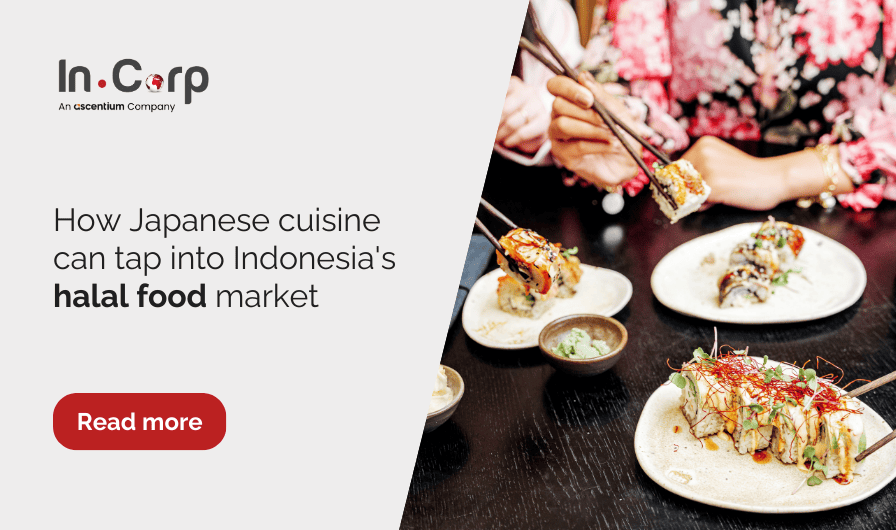
As the world’s largest Muslim population, Indonesia has emerged as a thriving market for halal food. With a growing interest in Japanese cuisine, this presents a significant opportunity for Japanese food brands to expand and thrive in this dynamic market.
However, tapping into this market requires full halal compliance. Explore more to find how a Japanese brand can successfully enter Indonesia’s halal food sector with the right strategy.
Indonesia’s booming halal food industry
The food and beverage sector dominates Indonesia’s halal market, driven by its predominantly Muslim population and rising middle class. The domestic halal food market accounts for a significant share of Indonesia’s US$135 billion halal economy. It is projected to reach US$258 billion by 2030, a notable 6.7% growth from 2023.
Several factors fuel the growth of halal food in Indonesia:
- Young Demographics: Over 60% of Indonesia’s population is under 40, driving modern food trends, including Japanese cuisine.
- Rising Middle-Class Income: More disposable income increases demand for premium and international halal-certified food.
- Increased Awareness: Consumers are better educated and more conscious of halal certification and ingredients.
- Tourism & Globalization: International cuisine is gaining popularity, especially in urban centers such as Jakarta, Bandung, and Surabaya.
This growing demand is a promising signal for Japanese food businesses aiming to enter the market with halal-certified offerings.
Read more: The halal industry: Trends and prospects in Indonesia
Why halal certification is essential for Japanese food brands

For Japanese cuisine to thrive in Indonesia, obtaining halal certification is mandatory, especially for food products marketed to Muslim consumers. Halal certification also offers several strategic benefits for Japanese brands:
1. Wider Market Access
Halal certification is legally required for food products targeting Muslim consumers in Indonesia. Without it, your products may be restricted from entering local markets, supermarkets, and major online platforms.
2. Gain Consumer Trust & Confidence
A halal label assures customers that the food meets Islamic dietary standards. This builds trust, especially in a market where food transparency and religious adherence are non-negotiable.
3. Good Brand Reputation
Certified halal brands are viewed as clean, safe, and ethical. This enhances your brand’s credibility and position among both Muslim and non-Muslim consumers.
4. Competitive Advantage among Japanese Brands
Few Japanese cuisine brands are halal-certified in Indonesia. Getting certified early gives you an edge over competitors and helps you stand out in a high-growth segment.
Halal certification is not just a regulatory requirement; it’s a smart business strategy for long-term growth in Indonesia’s halal market.
Opportunities for halal Japanese cuisine in Indonesia
The demand for halal Japanese food is growing in Indonesia. Many Japanese food companies are actively exploring halal certification to expand in Indonesia. Popular brands like Yoshinoya and Marugame Udon have already established halal-certified outlets and are performing well in major cities. The market opportunities are:
Urban Consumer Demand
Indonesia’s urban population, especially in Jakarta, Surabaya, and Bandung, increasingly seeks diverse international food experiences. With sushi, ramen, and yakiniku already loved across the country, Japanese cuisine is seen as premium, healthy, and trendy. This makes halal Japanese cuisine attractive to middle and upper-class consumers.
Halal Market Gaps
As demand for halal food among urban Indonesians continues to rise, only a small number of Japanese restaurants and food products currently hold halal certification. The limited availability of authentic, certified Halal Japanese food creates a golden opportunity for pioneers.
Untapped Categories Await Innovation
Many sub-categories within Japanese cuisine remain underdeveloped in Indonesia’s halal market, including:
- Halal sushi chains offering seafood-only or certified meats
- Halal ramen brands using chicken or plant-based broth instead of pork
- Halal izakaya-style dining that aligns with social but alcohol-free environments
- Ready-to-eat Japanese meals for retail and e-commerce
For Japanese brands looking to localize menus and meet halal standards, Indonesia offers a scalable, welcoming market with high growth potential.
Read more: The untapped potential of Indonesia’s processed food industry
Key challenges of halal food businesses: Halal certification guide
While the halal food market in Indonesia is large, entering it is not without challenges. Japanese companies must navigate strict halal certification laws, ingredient control, and evolving regulations, all within a tight timeline.
The 2026 Halal Certification Deadline
Indonesia’s government has made halal certification mandatory for all food and beverage products by October 17, 2026. After this deadline, non-certified products may be banned from sale, import, or public distribution. This rule applies to both local and foreign businesses.
It’s crucial to start preparing early for the 2026 Halal Certification Deadline. Failing to do so can lead to rushed compliance, missed business opportunities, or even legal consequences. Early preparation is key to a successful market entry.
Halal Certification Process: Key Steps for a Restaurant
The halal certification process for Japanese food chains involves:
- Product Ingredient Audit: Ensuring every item used, including seasoning, sauces, and oils, is halal-certified or traceable.
- Supplier Verification: All suppliers must provide halal-compliance documents.
- Kitchen and Equipment Check: Utensils and preparation areas must be free from cross-contamination with non-halal items.
- Employee Training: Staff must follow halal food handling procedures.
- Sharia Audit by a Halal Body LPPOM (MUI): Final verification is conducted by an official certifier before approval.
This multi-step process can be complex, especially for foreign brands unfamiliar with Indonesian regulations and religious standards. Therefore, working with a knowledgeable partner like InCorp can ensure a smoother, faster, and fully compliant entry to Indonesia’s halal market.
Read more: Indonesia’s Halal Certification Procedure: 2025 Update
Clear Paths to Product Registration in Indonesia
Ready to enter Indonesia’s halal food market?
Indonesia offers a golden opportunity in the halal food market, especially for Japanese cuisine. But to succeed, businesses must act now to ensure full halal compliance and regulatory readiness.
Partnering with the right expert can make all the difference. InCorp Indonesia (an Ascentium Company) offers a complete solution for your business:
- End-to-end support for halal certification
- Supplier verification and ingredient audits
- Local representation and regulatory handling
- Product registration for food and beverage imports
Contact us today and start your halal journey in Indonesia smoothly, faster, and fully compliant.
Frequently Asked Questions
Why is halal certification important for Japanese food brands in Indonesia?
Halal certification is mandatory for food products sold to Muslim consumers in Indonesia. Without it, Japanese food brands may face restrictions on sales, imports, and distribution through supermarkets and online platforms.
Does halal certification help Japanese brands gain more customers?
Yes. A halal label builds consumer trust by confirming that the food meets Islamic dietary standards, helping Japanese brands reach a wider market and improve acceptance among Indonesian consumers.
What is the deadline for halal certification in Indonesia?
All food and beverage products must be halal-certified by 17 October 2026. Products that are not certified after this date may be prohibited from sale, import, or public distribution.
What are the main steps in the halal certification process for restaurants?
The process includes ingredient audits, supplier verification, kitchen and equipment checks, staff training, and a final sharia audit by an authorized halal body such as LPPOM MUI.
What challenges do Japanese food businesses face in obtaining halal certification?
Common challenges include ensuring all ingredients are halal-compliant, managing supplier documentation, preventing cross-contamination, and understanding Indonesia’s halal regulations and certification procedures.
Get in touch with us.
What you'll get
A prompt response to your inquiry
Knowledge for doing business from local experts
Ongoing support for your business
Disclaimer
The information is provided by PT. Cekindo Business International (“InCorp Indonesia/ we”) for general purpose only and we make no representations or warranties of any kind.
We do not act as an authorized government or non-government provider for official documents and services, which is issued by the Government of the Republic of Indonesia or its appointed officials. We do not promote any official government document or services of the Government of the Republic of Indonesia, including but not limited to, business identifiers, health and welfare assistance programs and benefits, unclaimed tax rebate, electronic travel visa and authorization, passports in this website.

Verified by
Hotdo Nauli
Senior Legal & Delivery Manager at InCorp Indonesia
Hotdo heads the Legal and Delivery team at InCorp Indonesia, managing Product Registration, Legal Advisory, and Business Licensing. With over 8 years of experience, she focuses on compliance and integrity, ensuring all client operations align with Indonesian laws and regulatory standards, including contract reviews and sector-specific licenses. She is also a licensed advocate and a member of the Indonesian Advocates Association (PERADI).